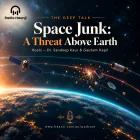
















































































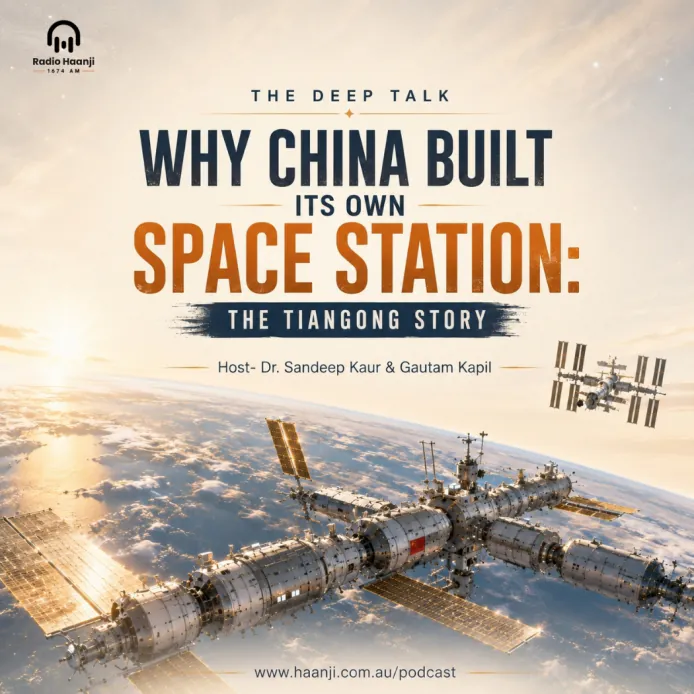
Why China Built Its Own Space Station: The Tiangong Story - The Deep Talk
Host:-
 Dr. Sandeep Kaur
 Gautam Kapil
Discover why China built its own space station, how the Tiangong technology compares to the ISS, and how India’s upcoming platform changes orbit.
For decades, human presence in low Earth orbit was defined by an unprecedented act of global harmony: the International Space Station (ISS). High above our fractured borders, astronauts and cosmonauts shared meals, conducted experiments, and proved that humanity could transcend terrestrial rivalries. Yet, if you look up at the night sky today, you are tracking more than just a single outpost. You are witnessing a divided sky, home to a permanently occupied, state-of-the-art alternative.
The presence of the Chinese Space Station, known as Tiangong ("Heavenly Palace"), tells a story of profound isolation turned into rapid, sovereign triumph. To understand why China built its own space station, one must look past the shining solar arrays and dive into a complex web of international legislation, security anxieties, and an unyielding desire for self-reliance. As the ISS nears the twilight of its operational lifespan, the story of Tiangong offers a vital glimpse into the future of human exploration—one where the spirit of international collaboration is increasingly met by the reality of independent cosmic outposts.
Why is China not part of the International Space Station?
Direct Answer: China is not part of the International Space Station primarily due to U.S. political opposition and legislative barriers. In 2011, the U.S. Congress passed the Wolf Amendment, which strictly prohibits NASA from using government funds to collaborate directly with Chinese state organizations due to national security and technology transfer anxieties.
Before the Wolf Amendment institutionalized this divide, China had expressed interest in joining the international coalition during the early stages of the ISS program in the 1990s and 2000s. However, consensus among the member nations—most notably led by Washington—was never reached. U.S. policymakers frequently raised concerns regarding the dual-use nature of China's space program, pointing out the deeply intertwined relationship between its civilian space agency and the People's Liberation Army.
Faced with a closed door, leadership in Beijing chose to turn exclusion into a catalyst for independent innovation. Instead of waiting for a change in international political winds, China activated a multi-decade, three-step human spaceflight strategy that culminated in the assembly of its own permanently crewed modular habitat, proving that exclusion can sometimes breed rapid technological self-sufficiency.
The Birth of Tiangong: Is China Late to the Space Station Game?
When the core module of the Tiangong space station launched into orbit, critics remarked that China was merely retracing steps the United States and the Soviet Union had taken decades prior. By the time China achieved a permanent orbital footprint, the ISS had been continuously occupied for over twenty years, and old Soviet stations like Mir had long since faded into history.
However, viewing Tiangong as "late" misses the technological leapfrogging that occurred during its development. China did not copy 1990s technology; instead, it utilized decades of observed successes and failures from the ISS to build a highly streamlined, modular, and efficient habitat. While the ISS required dozens of launches over more than a decade to assemble, China completed the primary T-shaped structure of Tiangong in less than two years, demonstrating an incredibly compressed and highly orchestrated modern assembly timeline.
Anatomy of a Modern Habitat: What are the Parts of the Chinese Space Station?
The Chinese Space Station relies on a modular architecture designed to maximize scientific efficiency while minimizing structural bulk. At its core is the Tianhe module, which serves as the nervous system and primary living quarters for the three-person crew. It manages the station's power, propulsion, life support, and guidance systems, acting as the anchor for everything else that docks in orbit.
Radiating out from the core are two specialized laboratory cabin modules:
-
Wentian: Optimized for life science and biological experiments, this module also houses backup control capabilities and an extravehicular activity (EVA) airlock for spacewalks.
-
Mengtian: Dedicated primarily to microgravity physics, material science, and fluid dynamics, featuring a specialized cargo airlock to deploy small satellites directly into space.
Powering this entire structure are massive, flexible GaAs (gallium arsenide) solar arrays that boast an energy conversion efficiency far surpassing older generations of space hardware. Tiangong also features a highly advanced robotic arm capable of crawling along the station’s exterior, a tool critical for maintaining the outpost and assisting astronauts during complex external operations.
Tiangong vs. ISS Comparison: Which Space Station is Better?
Determining whether the ISS or Tiangong is "better" depends heavily on whether one values massive scale or modern efficiency. The ISS remains an unparalleled engineering marvel: it weighs roughly 450 tons, stretches the size of an American football field, and can comfortably accommodate a rotating crew of six to seven astronauts. Tiangong, by contrast, is much more compact, weighing approximately 90 to 100 tons—roughly one-fifth the mass of the ISS—and standardly housing three taikonauts.
+--------------------------+-----------------------+-----------------------+
| Feature                  | ISS                   | Tiangong (CSS)        |
+--------------------------+-----------------------+-----------------------+
| Mass                     | ~450 Tons             | ~90–100 Tons          |
| Standard Crew Size       | 6–7 Astronauts        | 3 Taikonauts          |
| Assembly Period          | 1998–2011             | 2021–2022             |
| Primary Propulsion       | Hydrazine / Progress  | Ion Thrusters + Fuel  |
| Living Space (Volume)    | ~388 cubic meters     | ~110 cubic meters     |
+--------------------------+-----------------------+-----------------------+
Where Tiangong shines is its cutting-edge infrastructure. Because it was designed in the late 2010s, its interior resembles a clean, modern laboratory rather than the dense, wire-heavy corridors of the aging ISS. Crucially, Tiangong utilizes advanced Hall-effect thrusters (ion propulsion) for orbit maintenance. This marks the first time ion engines have been trusted to maintain a crewed space station's altitude, drastically reducing the amount of chemical fuel that must be ferried up from Earth each year.
When will India launch its own space station?
Direct Answer: India plans to launch the first modular component of its own space station, the Bharatiya Antariksha Station (BAS), by 2028, with the goal of achieving a fully operational, permanently crewed orbital outpost by 2035. This initiative follows the critical milestones of India's crewed Gaganyaan missions.
The Indian Space Research Organisation (ISRO) is executing a highly methodical roadmap to establish this sovereign foothold in low Earth orbit. The initial phases focus on perfecting crew escape systems, automated docking mechanisms, and environmental control systems. By testing these technologies through the Gaganyaan program, India ensures its engineers possess the practical, hands-on experience required to sustain life in the harsh vacuum of space before launching the heavier BAS modules.
The Bharatiya Antariksha Station is envisioned as a 20-ton platform capable of hosting three astronauts for up to 15 to 20 days at a time. Rather than aiming to compete immediately with the massive scale of the ISS, India is focusing on building a highly specialized, cost-effective platform dedicated to microgravity research, space medicine, and serving as a crucial stepping stone for future deep-space missions to the Moon and Mars.
The Rise of Sovereign Outposts and the Future of Low Earth Orbit
The geopolitics of space are entering an era characterized by regional independence rather than unified global platforms. As the International Space Station edges toward its planned decommissioning around 2030, the sky will no longer rely on a solitary, shared sanctuary. The paradigm has shifted irrevocably toward national outposts and commercial commercial clusters.
This transition highlights a deep human truth: the innate desire to reach into the dark is universal, but our trust networks remain deeply local. The emergence of independent platforms like Tiangong and the upcoming Bharatiya Antariksha Station represents a double-edged sword. While it signals a fragmentation of international scientific unity, it also fosters a resilient ecosystem where a single political disagreement or structural failure cannot completely halt humanity's presence among the stars. Multiple stations mean redundancy, diverse engineering philosophies, and a healthy competitive drive that could drastically accelerate the commercialization of low Earth orbit.
Key Takeaways
-
China built the Tiangong space station independently after being legally barred from participating in the ISS by the U.S. Wolf Amendment in 2011.
-
The Chinese Space Station consists of three primary modules (Tianhe, Wentian, and Mengtian) assembled in less than two years.
-
Tiangong utilizes revolutionary ion propulsion thrusters for orbital maintenance, drastically decreasing its dependency on heavy chemical refueling missions.
-
India has officially committed to launching its own platform, the Bharatiya Antariksha Station, with the first module targeted for 2028 and completion by 2035.
-
The retirement of the ISS will mark the end of single-monolithic space outposts, giving way to a diverse ecosystem of national and commercial space stations.
References and Further Reading
-
NASA History Office: Documentation detailing the international agreements, geopolitical negotiations, and congressional frameworks that shaped the membership and exclusions of the International Space Station program.
-
Indian Space Research Organisation (ISRO): Official strategic roadmaps and press releases outlining the development phases of the Gaganyaan mission and the structural timeline for the Bharatiya Antariksha Station (BAS).
-
China Manned Space Agency (CMSA): Technical blueprints, module specifications, and operational updates regarding the scientific payloads and ion propulsion capabilities of the Tiangong space station.
Frequently Asked Questions
Can international astronauts visit the Chinese Space Station?
Why does the U.S. ban NASA from working with China?
How long is the Chinese Space Station expected to last?
What happens to the ISS when it retires?
How does India's space station differ from Tiangong?
The expansion of independent outposts above our atmosphere reminds us that the sky is no longer a canvas for a singular human journey, but a reflection of our diverse capabilities on Earth. The creation of Tiangong and the approach of India's new orbital platform prove that national resilience can turn isolation into exceptional achievement. If you want to stay updated on how these new space stations are rewriting the rules of technology and global exploration, subscribe to our newsletter or share your thoughts in the comments section below on who you think will lead the next golden age of discovery.
What's Your Reaction?