






























































































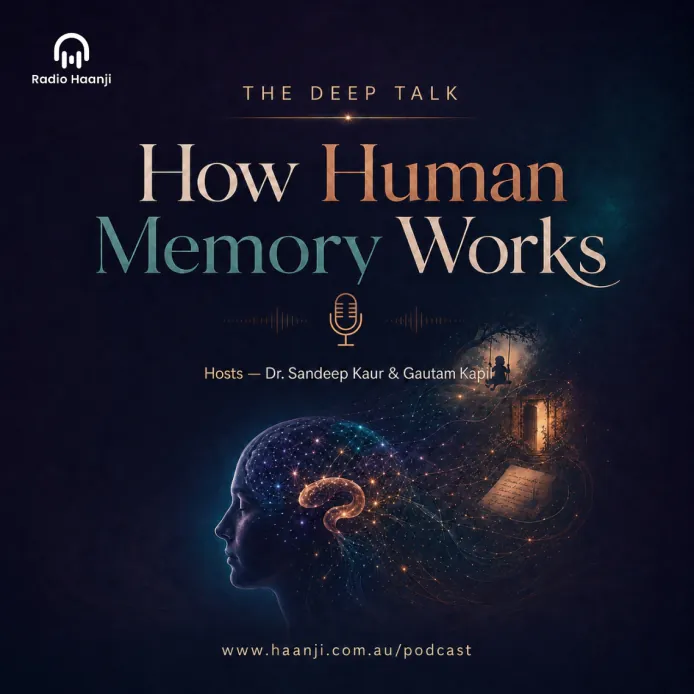
How Human Memory Works: The Science Explained - The Deep Talk
Host:-
 Dr. Sandeep Kaur
 Gautam Kapil
Discover how human memory actually works, why we forget, and science-backed ways to remember more. Read the full breakdown now.
In 1953, a young man known publicly only by his initials, H.M., underwent brain surgery to stop severe seizures — and woke up unable to form a single new memory for the rest of his life. He could hold a conversation, then forget it had ever happened the moment he looked away. His case became one of the most cited in the history of neuroscience, because it proved something doctors had only suspected: memory isn't stored in one place in the brain, and losing the right piece of tissue can erase your ability to build a future at all.
Understanding how human memory works matters far beyond textbook curiosity. It shapes how we study, how we age, how we grieve, and how confidently we can trust our own recollection of events. As Dr. Sandeep Kaur explained on Radio Haanji's Deep Talk Show, memory isn't a single system but a distributed, reconstructive process spread across trillions of synapses — closer to a puzzle than a video recording.
This article walks through what memory is, how it forms, why children can't remember infancy, and what actually works to strengthen recall — grounded in both classical philosophy and modern neuroscience.
What Memory Actually Is (It's Not a Recording)
Memory is often described casually as if it were footage stored on a hard drive, waiting to be replayed exactly as it happened. That description is wrong, and understanding why is the first step to understanding how memory actually works.
Human memory represents the totality of a person's knowledge and lived experience — it is, in a very real sense, what builds identity and individuality (Dr. Sandeep Kaur, Radio Haanji Deep Talk Show). Unlike a computer file or a video clip, memory has no single storage location. It exists as a distributed pattern across an enormous web of neural connections, meaning that recalling one memory involves reactivating a scattered network rather than retrieving a saved file.
That distributed structure has a consequence most people underestimate: memory is reconstructive, not exact. Roughly half of the specific details of an event can fade or change within a year of it occurring (Dr. Sandeep Kaur, Radio Haanji Deep Talk Show), which is why two people who witnessed the same event can later recall it in genuinely different, and equally sincere, ways.
The Different Types of Memory Your Brain Runs On
Not all memory works the same way, and the brain treats a phone number, a wedding day, and the ability to ride a bike as entirely separate systems. Short-term or working memory holds information for mere seconds — just long enough to dial a number or follow the next step in a recipe — before it either fades or gets consolidated into something longer-lasting.
Beyond that, explicit memory covers everything we can consciously recall and describe. This splits into episodic memory, which stores personal events and milestones like a school trip or a wedding, and semantic memory, which holds general facts and knowledge detached from personal experience, such as knowing how neurons communicate or understanding a social convention.
Implicit memory operates in the background, without conscious effort. Procedural memory governs motor skills and habits — driving a car, locking a door — performed almost automatically once learned. Associative or primed memory is triggered involuntarily by cues: a particular song, smell, or word that instantly summons a memory you weren't actively trying to recall.
How Does the Brain Turn Experience Into Memory?
The brain forms memories through four linked stages: encoding, where sensory input activates neural pathways; consolidation, where the hippocampus stabilises the memory during deep sleep; reconsolidation, where recalled memories become temporarily editable; and emotional tagging by the amygdala, which strengthens emotionally significant memories.
Encoding is the entry point. When you experience something, sensory input travels through the brain and activates specific, traceable neural pathways — this is the raw material memory is built from. Without encoding, there's simply nothing for the brain to hold onto later.
Consolidation is where a fragile new memory becomes durable, and it depends heavily on deep sleep. During this stage, the hippocampus effectively replays the day's experiences and coordinates with the neocortex to file them into longer-term storage, which is one reason sleep-deprived learning tends to stick so poorly.
What surprises most people is reconsolidation: every time an old memory is recalled, it briefly becomes pliable and open to modification before being re-saved. This is compounded by emotional valence — memories carrying strong fear, stress, or emotional weight, processed by the amygdala, tend to leave a deeper and more durable neural impression than neutral ones.
What Did Patient H.M. Teach Neuroscience About the Hippocampus?
Patient H.M., who had his hippocampus surgically removed in 1953 to treat epilepsy, lost the ability to form new explicit memories, proving the hippocampus is essential for creating conscious, long-term recollections and for imagining future scenarios.
H.M.'s case remains one of the most referenced in neuroscience because of how precisely it isolated the hippocampus's function. He retained his personality, his procedural skills, and memories formed before the surgery, but he could not form a single new episodic or semantic memory afterward — every new person he met was, to him, a stranger each time.
What made the case even more revealing was what it showed about imagination. Researchers later found that people with hippocampal damage struggle not just to remember the past but to vividly imagine future scenarios, suggesting the hippocampus isn't just a memory archive — it's a scenario-building engine the brain uses for both remembering and planning ahead.
Why Can't We Remember Being Babies?
Most adults cannot recall memories from before age three or four due to childhood amnesia, caused by rapid neurogenesis — the brain generates new neurons at such a high rate in early life that earlier neural pathways are continually overwritten before they can stabilise into lasting memories.
In the first few years of life, the brain undergoes extraordinarily fast neuron formation and synaptic reorganisation. This rapid rewiring is essential for early development, but it comes at a cost: the neural circuits holding a toddler's earliest experiences are frequently restructured or replaced before those memories can consolidate into anything retrievable later.
As children grow, this rate of neurogenesis slows and neural connections begin to stabilise, which is why episodic memory — the kind that lets you recall your fifth birthday but not your first — starts becoming reliable somewhere around the preschool years rather than infancy.
Aristotle's Ancient Rules for Remembering
Long before neuroscience had tools to scan the brain, philosophers were already building working theories of memory — and some of them still hold up. Aristotle proposed that recall operates through three core associations: similarity, where one face reminds you of another; contrast, where tasting something sweet brings a bitter taste to mind; and contiguity, where two things experienced at the same time or place become mentally linked.
Ancient orators put a related principle to practical use through spatial anchoring, commonly known today as the Method of Loci or "memory palace" technique. By mentally placing pieces of a speech at specific points along a familiar route, speakers could deliver lengthy addresses without notes — a technique modern memory athletes still rely on, and one that lines up neatly with the brain's genuine strength for spatial and contextual memory.
How Can You Actually Improve Your Memory?
You can meaningfully improve memory by minimising multitasking during learning, using active recall and spaced repetition instead of cramming, turning information into stories or mental images, and prioritising sleep and physical exercise, which support the biological processes memory consolidation depends on.
Multitasking is one of the most underestimated saboteurs of memory. Splitting attention during learning degrades how well information gets encoded in the first place, meaning no amount of later review can fully compensate for a distracted first exposure.
Active recall and spaced repetition — testing yourself on material at increasing intervals rather than re-reading it — reinforce synaptic connections far more effectively than cramming the night before, because retrieval practice itself strengthens the neural pathway being recalled. Framing information as a story or a mental image works for a similar reason: narrative and visualisation recruit broader neural networks than rote repetition alone, giving the brain more retrieval routes to the same information.
Two lifestyle factors round out the picture. Speaking multiple languages keeps neural circuitry continuously exercised and has been associated with delaying the onset of dementia-like symptoms by roughly four years (Dr. Sandeep Kaur, Radio Haanji Deep Talk Show). Meanwhile, regular aerobic exercise supports neuroplasticity, and getting adequate sleep — around 8 to 10 hours for teenagers — gives the hippocampus the time it needs to properly consolidate the day's memories.
Key Takeaways
- Human memory is stored as a distributed pattern across trillions of synapses rather than in one fixed location in the brain.
- Roughly half of an event's specific details can fade or change within a year, making memory reconstructive rather than exact.
- Memory splits into short-term, explicit (episodic and semantic), and implicit (procedural and associative) systems, each governed by different brain processes.
- The hippocampus, shown critically in patient H.M.'s case, is essential for forming new explicit memories and for imagining future scenarios.
- Childhood amnesia results from rapid early-life neurogenesis overwriting the neural pathways that would otherwise hold infant memories.
- Active recall, spaced repetition, reduced multitasking, and consistent sleep are among the most evidence-backed ways to strengthen memory.
References and Further Reading
- Radio Haanji — Deep Talk Show with Dr. Sandeep Kaur — source discussion covering the neuroscience, psychology and philosophy of memory referenced throughout this article.
- Scoville & Milner's landmark case study of patient H.M. — the foundational neurological research establishing the hippocampus's role in forming new explicit memories.
- Aristotle, De Memoria et Reminiscentia — the classical philosophical text outlining the laws of association (similarity, contrast, contiguity) that still inform modern memory theory.
Memory is less like a filing cabinet and more like a living, editable story your brain keeps rewriting every time you tell it. That's not a flaw — it's what lets you learn, adapt, and grow from experience rather than being trapped by an unchangeable past. If this breakdown changed how you think about your own memory, share it with someone who's convinced their recollection is a perfect recording, and explore more evidence-based deep dives on how the brain shapes everyday life.
Frequently Asked Questions
Is it true that memory gets worse the more you recall it?
Does forgetting mean a memory is gone forever?
Can stress actually help you remember something better?
Is there a real difference between memory and intelligence?
Why do some people have vivid early childhood memories while others don't?
Does the Method of Loci actually work for regular people, not just memory champions?
How quickly does sleep deprivation affect memory consolidation?
What's Your Reaction?