





























































































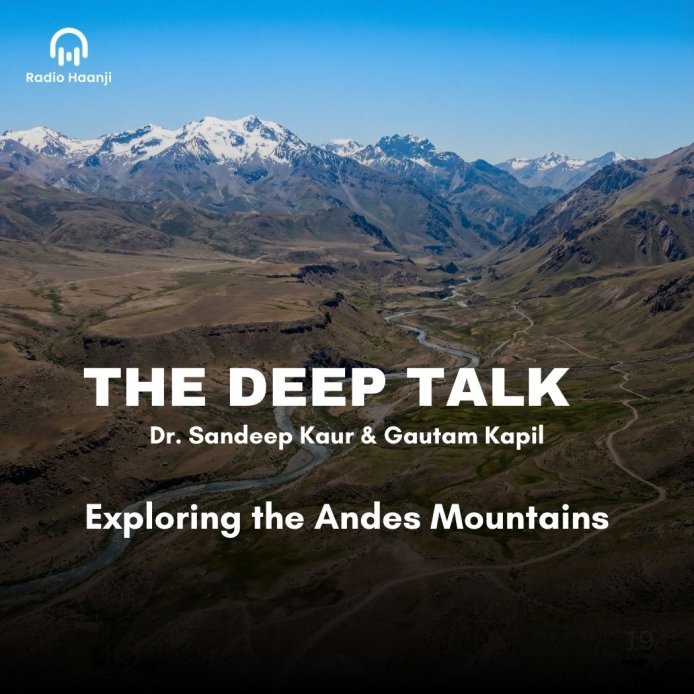
Exploring the Andes Mountains: Earth's Longest Range & Hidden Wonders Meta - The Deep Talk
Host:-
 Dr. Sandeep Kaur
 Gautam Kapil
Journey through the Andes Mountains! Discover geology, rare wildlife, and ancient cultures with insights from Radio Haanji's Dr. Sandeep Kaur & Gautam Kapil
magine a wall of stone so vast it acts as the spine of an entire continent. Stretching from the tropical Caribbean coast of Venezuela all the way down to the icy fjords of Chile and Argentina, the Andes Mountains are a geological marvel.
On a recent broadcast of Radio Haanji 1674AM, hosts Dr. Sandeep Kaur and Gautam Kapil took listeners on an audio expedition across this 7,000-kilometer giant. From the physics of colliding tectonic plates to the resilience of the people living at breathless altitudes, the discussion revealed just how dynamic this region is.
Whether you tuned in or are just joining us now, this guide dives deep into the science, history, and wonder of the Andes.
What Are the Andes Mountains?
The Andes are not just a single line of peaks; they are a complex system of mountain ranges (or cordilleras), plateaus, and volcanoes. They span seven countries: Venezuela, Colombia, Ecuador, Peru, Bolivia, Chile, and Argentina.
A Geological Collision Zone
As Dr. Sandeep Kaur explained on air, the Andes are a textbook example of plate tectonics.
-
The Process: Millions of years ago, the oceanic Nazca Plate began sliding underneath the continental South American Plate.
-
The Result: This process, called subduction, crumpled the Earth's crust like a car hood in a slow-motion crash, pushing rock upward to form the jagged peaks we see today.
-
Ongoing Activity: This geological engine is still running! It creates the region's frequent earthquakes and fuels its many active volcanoes, including Cotopaxi in Ecuador.
Climate Zones: From Rainforests to Glaciers
One of the most fascinating points raised by Gautam Kapil during the show was the "vertical climate" of the Andes. You can experience nearly every climate on Earth just by walking up a mountain.
1. Tropical Andes (North)
In countries like Colombia and Ecuador, the mountains rise from lush, humid rainforests. Here, biodiversity explodes. The cloud forests are constantly bathed in mist, providing a home for thousands of orchid species and hummingbirds.
2. The Dry Andes (Central)
Moving south into Peru and Bolivia, the landscape changes. This is home to the Altiplano, the second-highest plateau on Earth (after Tibet). It is a stark, windswept high desert where indigenous cultures have thrived for millennia.
3. The Wet Andes (South)
In southern Chile and Argentina, the mountains catch the westerly winds, creating temperate rainforests and massive ice fields. This is Patagonia—a land of jagged granite spires and blue glaciers calving into lakes.
Remarkable Wildlife of the High Altitudes
Surviving in the Andes requires grit. The air is thin, and temperatures can swing wildly between day and night. Yet, nature has adapted beautifully.
-
The Andean Condor: The symbol of the Andes. With a wingspan of over 10 feet (3 meters), it is one of the world's largest flying birds, riding thermal currents to hunt without expending energy.
-
Camelids (Llamas, Alpacas, Vicuñas): These animals are the tractors, sweaters, and spiritual symbols of the Andes. Their specialized blood cells allow them to absorb more oxygen from the thin air.
-
The Spectacled Bear: The only bear species in South America, immortalized as the inspiration for "Paddington Bear," lives in the cloud forests.
Did You Know? The potato was first domesticated in the Andes! Ancient farmers developed thousands of varieties to survive different altitudes and microclimates.
Cultures of the Clouds
The Andes are as much a human story as a geological one. Long before Europeans arrived, complex civilizations flourished here.
The most famous, of course, is the Inca Empire. They built a road system (the Qhapaq Ñan) that stretched longer than the Roman roads, all without the wheel or iron tools. The breathtaking citadel of Machu Picchu remains a testament to their engineering genius—building structures that could withstand centuries of earthquakes.
Today, millions of Quechua and Aymara people maintain these traditions. From the colorful textiles of the Sacred Valley to the intricate terraced farming that prevents soil erosion, the Andean way of life is a masterclass in sustainability.
Why the Radio Haanji Discussion Matters
On Radio Haanji 1674AM, Dr. Sandeep Kaur and Gautam Kapil highlighted an important connection: how mountains influence global weather. The Andes act as a massive barrier, affecting rainfall patterns across South America. They essentially "create" the Amazon Rainforest by trapping moisture in the basin.
Understanding these systems helps us appreciate our planet's delicate balance. As the hosts noted, climate change is causing Andean glaciers to melt at alarming rates, threatening the water supply for millions of people in cities like Lima and La Paz.
Missed the episode? Keep an eye on the Radio Haanji schedule for rebroadcasts or future discussions on global geography.
Conclusion
The Andes Mountains are more than just rock and ice. They are a living engine of geology, a sanctuary for unique life, and a cradle of human history. As we learned from the insightful discussion on Radio Haanji, exploring these peaks—whether physically or through the airwaves—reminds us of the Earth's raw power and beauty.
Frequently Asked Questions (FAQs)
How long are the Andes Mountains?
The Andes Mountains are approximately 7,000 kilometers (4,350 miles) long, making them the longest continental mountain range in the world. They span seven South American countries.
How were the Andes formed?
The Andes were formed (and are still being shaped) by plate tectonics. The Nazca Plate is slowly sliding (subducting) beneath the South American Plate, pushing the land upward to create mountains and volcanoes.
What is the highest peak in the Andes?
The highest peak in the Andes is Mount Aconcagua in Argentina. It stands at 6,961 meters (22,837 feet) above sea level, making it the highest mountain outside of Asia.
What animals live in the Andes Mountains?
The Andes are home to unique wildlife like the Andean condor, llamas, alpacas, vicuñas, chinchillas, and the spectacled bear. These animals have specialized adaptations to survive in cold, low-oxygen environments.
Which radio station discussed the Andes Mountains?
The detailed discussion about the Andes Mountains aired on Radio Haanji 1674AM, hosted by Dr. Sandeep Kaurand Gautam Kapil.
Why are the Andes important for the Amazon?
The Andes act as a massive wall that blocks moisture coming from the Atlantic Ocean. This trapped moisture falls as rain, feeding the Amazon River basin and sustaining the world's largest rainforest.
What's Your Reaction?