




















































































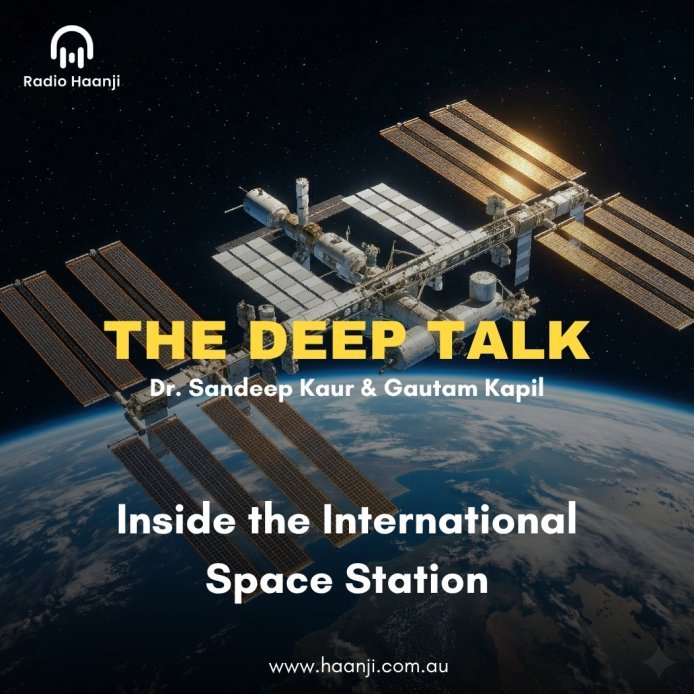
International Space Station Life - The Deep Talk - Dr. Sandeep Kaur - Gautam Kapil
Host:-
 Dr. Sandeep Kaur
 Gautam Kapil
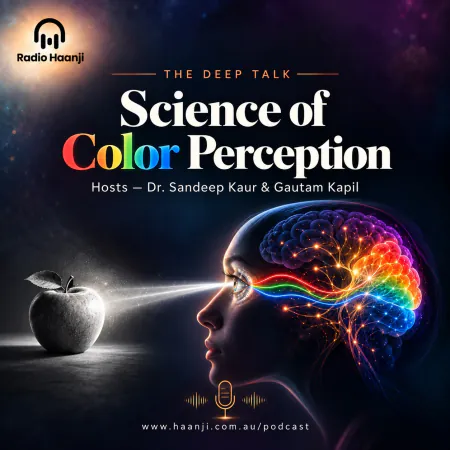
Explore life on the International Space Station with The Deep Talk podcast. Gautam Kapil & Dr. Sandeep Kaur discuss ISS science. Radio Haanji 1674 AM.
Podcast: The Deep Talk - Host: Gautam Kapil - Special Guest: Dr. Sandeep Kaur - Presented By: Radio Haanji 1674 AM
Inside the International Space Station: Life in Orbit Explored on The Deep Talk with Gautam Kapil
Ever wondered what it's actually like to live 400 kilometers above Earth, floating in a laboratory the size of a football field? Radio Haanji's thought-provoking podcast "The Deep Talk" takes listeners on a fascinating journey to the International Space Station (ISS) in this special episode hosted by Gautam Kapil with guest Dr. Sandeep Kaur.
From the breathtaking views of Earth spinning below to the daily realities of eating, sleeping, and conducting groundbreaking experiments in zero gravity, this episode unpacks the extraordinary science and human experience behind humanity's most ambitious orbital laboratory. Whether you're a space enthusiast or simply curious about life beyond Earth, this conversation offers insights into how astronauts live, what they discover, and why the ISS matters for the future of space exploration.
What Is the International Space Station?
The International Space Station represents one of humanity's greatest collaborative achievements. Orbiting Earth at an altitude of approximately 400 kilometers (250 miles), the ISS travels at a speed of about 28,000 kilometers per hour (17,500 mph), completing a full orbit around our planet every 90 minutes. This means astronauts aboard the ISS witness 16 sunrises and sunsets every single day.
Size and Structure
As Gautam Kapil and Dr. Sandeep Kaur discuss in the episode, the ISS is massive by spacecraft standards. The station measures roughly 109 meters (357 feet) from end to end — about the length of an American football field. It weighs approximately 420,000 kilograms (925,000 pounds) and has a pressurized volume equivalent to a Boeing 747 jumbo jet.
The ISS consists of multiple modules contributed by different space agencies, creating a truly international facility. Major components include laboratories from NASA (United States), Roscosmos (Russia), ESA (European Space Agency), JAXA (Japan), and CSA (Canada). This multinational collaboration makes the ISS not just a scientific achievement but a diplomatic one — nations that sometimes struggle to cooperate on Earth work seamlessly together in orbit.
Who Built the ISS and Why?
Construction of the International Space Station began in 1998 with the launch of the Russian Zarya module. Over the following 13 years, more than 40 assembly missions gradually added modules, solar arrays, robotic arms, and living quarters. The station was declared complete in 2011, though upgrades and additions continue.
The primary purposes of the ISS include:
Scientific Research: Conducting experiments impossible on Earth, particularly in microgravity conditions. Research aboard the ISS has contributed to advances in medicine, materials science, Earth observation, and biological studies.
Technology Development: Testing equipment and systems for future deep space missions, including potential trips to Mars. The ISS serves as a proving ground for life support systems, spacecraft design, and long-duration spaceflight impacts on human health.
International Cooperation: Demonstrating that nations can collaborate on large-scale peaceful projects despite political differences. The ISS partnership includes the United States, Russia, Canada, Japan, and 11 European nations.
Education and Inspiration: Inspiring the next generation of scientists, engineers, and space explorers through educational programs and public engagement activities.
Life Aboard the ISS: Daily Routines in Zero Gravity
One of the most fascinating aspects covered in The Deep Talk episode is what daily life actually looks like for astronauts living in space. While the view might be extraordinary, the day-to-day reality involves carefully structured routines designed to maintain health, productivity, and sanity in an environment humans didn't evolve to inhabit.
Sleeping in Space
Astronauts sleep in small crew quarters about the size of a phone booth. Since there's no "up" or "down" in microgravity, astronauts zip themselves into sleeping bags attached to walls to prevent floating around during sleep. They use sleep masks and earplugs because the station remains well-lit and noisy due to constant ventilation and equipment operation.
However, sleeping in space presents unique challenges. The 16 sunrises per day disrupt natural circadian rhythms. The station's artificial lighting tries to compensate, but many astronauts still struggle with sleep quality. Some report vivid dreams, possibly because the brain continues processing the unusual sensory experience of weightlessness even during sleep.
Eating and Drinking
Food in space has come a long way from the squeeze tubes of early spaceflight. Modern astronauts eat from a diverse menu of rehydratable meals, thermostabilized foods, and some fresh fruits and vegetables delivered by resupply missions. The episode explains how meals work in zero gravity — food must either be sticky, packaged, or eaten carefully to prevent crumbs from floating away and potentially damaging equipment.
Water is precious on the ISS. The station recycles about 93% of all water, including moisture from breath, sweat, and yes, urine. Advanced filtration systems make this recycled water cleaner than most tap water on Earth. Astronauts joke that "today's coffee becomes tomorrow's coffee," but the technology represents crucial life support innovation for long-duration missions.
Interestingly, taste perception changes in space. The fluid shift that occurs in microgravity causes congestion similar to a head cold, diminishing taste and smell. As a result, astronauts often prefer spicier or more strongly flavored foods than they would on Earth.
Exercise: Fighting the Effects of Weightlessness
Perhaps the most important part of any astronaut's day is exercise. In The Deep Talk discussion, Dr. Sandeep Kaur likely emphasized the critical health implications of long-duration spaceflight — without gravity, muscles atrophy and bones lose density at alarming rates.
Astronauts must exercise at least two hours every day using specially designed equipment:
TVIS (Treadmill Vibration Isolation System): Astronauts run on a treadmill while wearing a harness that simulates body weight through tension. The treadmill is mounted on a vibration isolation system to prevent the runner's footfalls from shaking the entire station.
ARED (Advanced Resistive Exercise Device): This machine uses vacuum cylinders to simulate lifting weights, allowing astronauts to perform squats, deadlifts, and other resistance exercises crucial for maintaining muscle mass.
CEVIS (Cycle Ergometer): A stationary bicycle for cardiovascular exercise.
Despite rigorous exercise routines, astronauts still lose bone density and muscle mass during long missions. Research on the ISS helps scientists understand these processes and develop countermeasures for future long-duration missions to Mars and beyond.
Hygiene and Personal Care
Showering in space is impossible — water would float everywhere. Instead, astronauts use wet towels, no-rinse shampoo, and special rinseless soap. They brush their teeth normally but must spit toothpaste into a towel or swallow it rather than spitting into a sink.
The toilet on the ISS uses airflow instead of water to direct waste. Liquid waste gets recycled into drinking water, while solid waste is stored and eventually burned up during reentry on disposal spacecraft. Using the space toilet requires training — astronauts practice on Earth to ensure proper positioning and technique.
Stunning Views: Earth from the ISS Cupola
One of the most remarkable features of the ISS is the Cupola — a seven-window observatory module that offers 360-degree views of Earth and space. As discussed in The Deep Talk episode, astronauts frequently describe the Cupola experience as life-changing.
From the ISS, Earth appears breathtakingly beautiful and fragile. Astronauts report feeling a profound shift in perspective known as the "overview effect" — seeing our planet as a tiny, vulnerable oasis in the vast darkness of space, with no visible borders between nations, only one interconnected ecosystem.
The view includes:
Auroras: The northern and southern lights appear as shimmering curtains of green, red, and purple dancing across the atmosphere below the station.
Thunderstorms: Massive storm systems lit by lightning, appearing as spectacular natural fireworks from above.
City Lights: At night, human civilization reveals itself through glowing webs of light marking cities, highways, and coastlines.
Natural Wonders: The Amazon River snaking through rainforest, the Sahara Desert's vast expanse, the Himalayas' snow-capped peaks, and coral reefs glowing turquoise in tropical waters.
Sunrise and Sunset: With 16 sunrises per day, astronauts witness Earth's atmosphere illuminated as a thin blue line separating our world from space — a vivid reminder of how fragile our protective layer truly is.
Astronauts often spend their limited free time photographing Earth, contributing to scientific research, disaster response efforts, and public engagement programs that share these extraordinary perspectives with people worldwide.
Cutting-Edge Science: Experiments in Zero Gravity
The real purpose of the ISS isn't tourism or Earth observation — it's science. The station serves as a unique laboratory where researchers conduct experiments impossible on Earth, particularly those requiring sustained microgravity conditions.
Medical and Biological Research
Much of the research aboard the ISS focuses on understanding how living organisms function without gravity. This work has direct applications both for space exploration and Earth-based medicine.
Aging Studies: Astronauts' bodies age faster in space — bones weaken, muscles atrophy, and cardiovascular systems change. By studying these accelerated aging processes, researchers gain insights into age-related diseases on Earth like osteoporosis and muscle wasting.
Drug Development: Protein crystals grow larger and more uniform in microgravity than on Earth. These higher-quality crystals help researchers understand protein structures more clearly, leading to better drug design. Several medications, including treatments for muscular dystrophy and cancer, have benefited from ISS research.
Immune System Research: The immune system functions differently in space, making astronauts more susceptible to infections. Understanding these changes helps develop treatments for immune disorders on Earth.
Plant Growth: Experiments with growing plants in space aren't just about providing fresh food for astronauts — they help us understand fundamental biology. Research on the ISS has revealed how plants sense gravity and grow, with applications for agriculture on Earth.
Materials Science and Physics
Microgravity allows scientists to study phenomena obscured by gravity on Earth.
Combustion Research: Fire behaves completely differently in space. Flames form perfect spheres instead of the teardrop shape we see on Earth. This research improves fire safety on Earth and in space while advancing our understanding of combustion fundamentals.
Fluid Physics: Without gravity to pull liquids down, fluids behave in fascinating ways. This research has applications ranging from fuel systems in spacecraft to more efficient medical devices on Earth.
Materials Manufacturing: Certain alloys, crystals, and composite materials can be manufactured with properties impossible to achieve under gravity. While producing materials in space remains expensive, the research informs terrestrial manufacturing processes.
Earth Observation and Climate Science
The ISS orbits at an ideal altitude for observing Earth. Multiple instruments aboard the station monitor our planet's atmosphere, oceans, land surface, and even human activity.
Climate Change Monitoring: Instruments track changes in ice coverage, vegetation patterns, ocean temperatures, and atmospheric composition. The long-term data collected from the ISS contributes to climate science and helps verify computer models of climate change.
Disaster Response: When hurricanes, floods, wildfires, or other disasters strike, astronauts can quickly photograph affected areas, providing crucial information to response teams on the ground.
Environmental Monitoring: The ISS tracks deforestation, desertification, urbanization, and other environmental changes, creating a continuous record of how Earth's surface transforms over time.
Technology Testing: Preparing for Deep Space Missions
As The Deep Talk episode likely emphasizes, the ISS serves as more than a research laboratory — it's a proving ground for technologies and procedures necessary for future missions to the Moon, Mars, and beyond.
Life Support Systems
The ISS has continuously supported human life in the hostile environment of space since 2000. The Environmental Control and Life Support System (ECLSS) manages air quality, water recycling, temperature, pressure, and waste processing. Every component represents crucial technology that must work flawlessly on future deep space missions where resupply from Earth is impossible.
The water recycling system alone represents a technological marvel. It processes urine, condensation from breath and sweat, and moisture from other sources, removing contaminants and producing water cleaner than most drinking water on Earth. The 93% recovery rate continues improving — future systems may achieve 98% or higher, essential for Mars missions where bringing water from Earth would be prohibitively expensive.
Long-Duration Spaceflight Effects
NASA plans crewed missions to Mars lasting 2-3 years. Understanding how the human body and mind cope with extended time in space is crucial. ISS expeditions lasting 6-12 months provide invaluable data on:
Psychological Effects: Isolation, confinement, distance from Earth, and the inability to immediately return home create psychological challenges. Researchers study how crew members cope, what activities help maintain morale, and how mission design can minimize mental health issues.
Radiation Exposure: Beyond Earth's protective magnetic field, space radiation poses serious health risks. The ISS orbits within Earth's magnetic field, but instruments aboard measure radiation levels, helping scientists understand risks for lunar and Martian missions.
Countermeasures: Testing exercise equipment, nutrition programs, medication regimens, and other interventions that help maintain astronaut health during long missions.
Robotics and Automation
The ISS features remarkable robotic systems, including Canadarm2 — a 17-meter robotic arm that can move along the station's exterior, grapple visiting spacecraft, and perform repairs. More advanced robots like Robonaut 2 have tested human-robot collaboration in space, potentially reducing the need for dangerous spacewalks on future missions.
International Cooperation: A Model for Global Collaboration
One aspect The Deep Talk episode likely highlights is the remarkable international cooperation the ISS represents. In an era of geopolitical tensions, the ISS demonstrates what humanity can achieve when nations work together toward common goals.
The partnership includes:
NASA (United States): Provides the largest modules, including Destiny laboratory, Tranquility (with the Cupola), and primary life support systems.
Roscosmos (Russia): Contributed the first modules and provides primary propulsion and reboost capabilities that keep the station in orbit.
ESA (European Space Agency): Built the Columbus laboratory and provides the ATV cargo vehicle (retired) and currently supports crew and cargo missions.
JAXA (Japan): Built the Kibo laboratory, the largest single module on the ISS, and provides the HTV cargo vehicle.
CSA (Canada): Developed Canadarm2 and Dextre, the robotic systems used for station maintenance and spacecraft capture.
Astronauts from 20+ countries have visited the ISS, and crew members routinely train in each other's languages (primarily English and Russian) and learn to operate each other's systems. The station operates under complex agreements where different nations own different modules but crew members move freely throughout, embodying international cooperation.
This cooperation continued even during periods of significant Earth-based political tension, including the 2014 Ukraine crisis and ongoing US-Russia diplomatic challenges. While political leaders argue, astronauts and cosmonauts live and work together harmoniously 400 kilometers above, demonstrating that cooperation is possible when focused on shared goals.
The Human Side: Astronaut Experiences and Stories
The Deep Talk episode with Gautam Kapil and Dr. Sandeep Kaur undoubtedly explores not just the technical aspects of the ISS but the human experiences that make space travel extraordinary.
Famous Astronaut Stories from the ISS
Chris Hadfield's Space Oddity: Canadian astronaut Chris Hadfield became an internet sensation when he recorded David Bowie's "Space Oddity" while floating in the Cupola, guitar in hand, with Earth spinning below. His social media presence gave millions of people an intimate look at life aboard the ISS.
Scott Kelly's Year in Space: American astronaut Scott Kelly spent 340 consecutive days on the ISS (2015-2016), the longest single spaceflight by an American. His identical twin brother Mark (also an astronaut) remained on Earth as a genetic control subject. The twins study provided unprecedented insights into how long-duration spaceflight affects the human body at the genetic level.
Samantha Cristoforetti's Coffee Achievement: Italian astronaut Samantha Cristoforetti made headlines when she became the first person to brew fresh espresso in space using the ISSpresso machine. This seemingly small victory meant a lot for astronaut morale — having familiar comforts makes extended missions more psychologically sustainable.
Spacewalks: The Ultimate Adventure
Spacewalks (technically called EVAs or Extravehicular Activities) represent one of the most dangerous and awe-inspiring aspects of ISS life. When astronauts venture outside to perform repairs or upgrades, they're protected only by their spacesuits from the deadly vacuum of space.
Modern spacesuits are essentially personal spacecraft costing millions of dollars each. They provide oxygen, remove carbon dioxide, regulate temperature, and protect against radiation and micrometeorite impacts. Despite these protections, spacewalks remain risky — astronauts train for months to prepare for each EVA, practicing in giant swimming pools that simulate microgravity.
Astronauts describe spacewalks as simultaneously terrifying and magical. Floating 400 kilometers above Earth with only a thin suit between you and space, watching the planet roll by beneath your feet, creates an experience unlike anything possible on Earth.
Why the ISS Matters for Future Space Exploration
As Gautam Kapil and Dr. Sandeep Kaur likely discuss, the ISS isn't just about the present — it's crucial infrastructure for humanity's future in space.
Gateway to the Moon and Mars
NASA's Artemis program aims to return humans to the Moon by 2026, establishing a sustainable presence that will eventually support missions to Mars. The ISS provides essential data for these plans:
Life Support Technology: Systems proven on the ISS will be adapted for lunar Gateway stations and Martian habitats.
Medical Knowledge: Understanding how to keep astronauts healthy during months or years in space comes directly from ISS research.
Operational Experience: Managing long-duration missions, coordinating international crews, and maintaining complex spacecraft operations — all lessons learned on the ISS apply to future missions.
Commercial Space Development
The ISS has become a testing ground for commercial space companies. SpaceX, Northrop Grumman, and other private companies regularly deliver cargo and crew to the station, demonstrating capabilities that support the emerging commercial space industry.
NASA plans to eventually transition from the ISS to commercial space stations operated by private companies. Several companies are developing commercial stations intended to replace the ISS around 2030. These stations will serve tourists, researchers, manufacturers, and potentially even film production crews, creating new space economies.
Inspiring the Next Generation
Perhaps the ISS's most important contribution is inspiration. Every day, astronauts conduct educational programs connecting with students worldwide. Children watch experiments in real-time, ask questions of astronauts, and dream of becoming space explorers themselves.
For the Punjabi community listening to The Deep Talk on Radio Haanji, the ISS story carries special resonance. India's ISRO (Indian Space Research Organisation) has become a major space power, and Indian-origin astronauts like Kalpana Chawla and Raja Chari have flown to space. The message is clear: space isn't just for superpowers anymore — it's an arena where talent, education, and dedication matter more than geography.
The Future of the ISS
Current plans call for operating the ISS until at least 2030. What happens after that remains unclear and is the subject of ongoing international negotiations.
Extending the Mission
Some advocate for extending ISS operations beyond 2030. The station remains scientifically productive, and abandoning it would waste decades of investment. However, maintaining aging spacecraft becomes increasingly expensive and risky. Key modules date back to the 1990s, and while upgrades continue, fundamental structures cannot be replaced.
Controlled Deorbit
When the ISS finally retires, it cannot simply be abandoned. Uncontrolled reentry would scatter debris across a wide area, potentially causing casualties. Instead, the plan involves a controlled deorbit using propulsion systems to direct the station toward a remote area of the Pacific Ocean called the "spacecraft cemetery," where Mir and other spacecraft have been disposed of safely.
Transition to Commercial Stations
NASA and international partners are investing in commercial space station development. Companies like Axiom Space, Blue Origin, and Nanoracks are designing commercial stations that will initially attach to the ISS, eventually separating to form independent facilities.
These commercial stations will offer services to governments, researchers, manufacturers, and eventually tourists, creating sustainable space economies not dependent on government funding alone.
Lunar Gateway
Simultaneously with ISS operations, NASA and partners are developing the Lunar Gateway — a smaller station orbiting the Moon. Gateway will support Artemis program lunar landings and serve as a staging point for eventual Mars missions. Many technologies and operational procedures proven on the ISS will transfer directly to Gateway.
What We've Learned: Key Takeaways from The Deep Talk Episode
This episode of The Deep Talk with Gautam Kapil and Dr. Sandeep Kaur provides listeners with fascinating insights into one of humanity's greatest achievements. Key takeaways include:
The ISS is Massive: A football-field-sized laboratory traveling at 28,000 km/h, completing an orbit every 90 minutes.
Daily Life is Structured: Astronauts follow carefully planned routines including 2+ hours of daily exercise to combat the health effects of microgravity.
The View is Extraordinary: The Cupola offers 360-degree views of Earth that create profound shifts in perspective for those who experience them.
Science is Revolutionary: From medical breakthroughs to materials science advances, research conducted in space benefits life on Earth.
International Cooperation Works: Despite Earth-based political tensions, ISS partners collaborate seamlessly in space.
The Future is Bright: The ISS serves as a proving ground for technologies and procedures that will enable humanity's expansion throughout the solar system.
Space is for Everyone: Modern space exploration is increasingly accessible, with more nations and even private companies participating.
The Deep Talk: Where Science Meets Curiosity
This International Space Station episode exemplifies what makes The Deep Talk one of Radio Haanji's most intellectually engaging programs. Host Gautam Kapil has built a reputation for tackling complex scientific, historical, and philosophical topics in ways that remain accessible to general audiences.
Previous episodes have explored subjects ranging from the formation of the Himalayas to Iran's Islamic Revolution, from the Apollo 11 moon landing debate to questions about Australia's population distribution. The show doesn't shy away from complexity but presents information clearly enough that listeners without specialized backgrounds can follow along and learn.
Special guest Dr. Sandeep Kaur brings additional expertise to this space-focused discussion. While details about Dr. Kaur's specific background weren't provided, her participation suggests either medical expertise (relevant given the health implications of spaceflight) or scientific credentials that complement Gautam Kapil's presentation style.
Other Radio Haanji Programs Worth Exploring
If you enjoyed The Deep Talk's exploration of the International Space Station, Radio Haanji offers a diverse lineup of programs that educate, entertain, and inform:
The Insight Report: Gautam Kapil also hosts this program analyzing current events, international relations, and geopolitical developments.
Sikh History: Ranjodh Singh presents stories from Sikh heritage and Punjab's past, connecting listeners with their cultural roots.
Nani Ji: Vishal Vijay Singh and Harpreet Shergil discuss life wisdom, relationships, personal growth, and community issues.
Health Talk: Dr. Sandeep Bhagat addresses medical topics in Punjabi, making healthcare information accessible to the community.
The Yash and Vishal Show: Youth-driven content covering pop culture, personal growth, and topics relevant to young Indian-Australians.
The Walkman Show: Gautam Kapil explores Bollywood music history and artist profiles.
Laughter Therapy: Daily comedy and entertainment featuring Punjabi humor.
Each program contributes to Radio Haanji's mission of serving as Australia's most comprehensive Punjabi and Hindi community radio station.
How to Listen to The Deep Talk
New episodes of The Deep Talk air regularly on Radio Haanji 1674 AM. Access the show through:
Traditional Radio: Tune to 1674 AM in Melbourne or Sydney for live broadcasts
Online Streaming: Visit haanji.com.au to stream live from anywhere
Podcast Platforms: Subscribe on Apple Podcasts, Spotify, Google Podcasts, YouTube, Amazon Music, or Podbean
Mobile Apps: Download the Radio Haanji app for iOS or Android to access shows on demand
For listeners interested in science, history, current events, and thought-provoking discussions, The Deep Talk represents some of the best intellectual content available in Punjabi podcasting.
Radio Haanji 1674 AM — Australia's First 24/7 Punjabi Community Radio Station
Broadcasting from Melbourne and Sydney | Listen online: haanji.com.au
Text: 0447 171674 | Email: info@haanji.com.au
Listen free:
Radio Haanji 1674 AM is Austalia's Punjabi community radio station.
Listen free at haanji.com.au | Spotify | Apple Podcasts | iOS App | Android App
Serving the Punjabi community in Australia, Canada, Singapore and world wide.
What's Your Reaction?