






























































































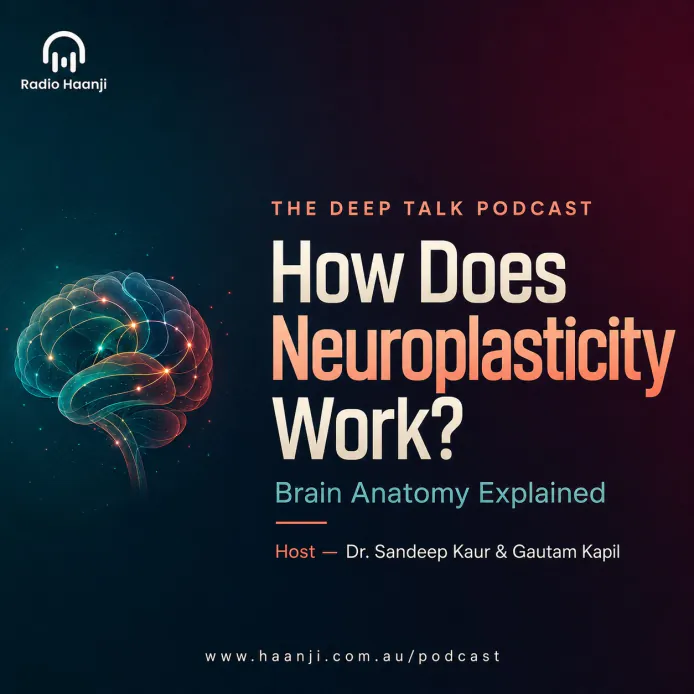
How Does Neuroplasticity Work? Brain Anatomy Explained - The Deep Talk
Host:-
 Dr. Sandeep Kaur
 Gautam Kapil
Learn how neuroplasticity really works — from the hippocampus to BDNF — and the daily habits proven to help your brain rewire itself. Read more.
For decades, the standard medical position was blunt: the adult brain is finished growing, and whatever wiring you're left with after childhood is the wiring you're stuck with. That idea has been thoroughly overturned. On a recent episode of Radio Haanji's "The Deep Talk," host Gautam Kapil and neuroscience expert Dr. Sandeep Kaur walked through exactly how does neuroplasticity work — and the answer turns out to be one of the more genuinely hopeful findings in modern brain science.
The conversation moved from the brain's smaller, lesser-known control structures — the glands quietly running your hormones and sleep cycle — through to the landmark studies that proved the adult brain can still change its own physical structure. This article lays out that full picture: the anatomy behind memory, emotion and hormone regulation, and the specific, named research that turned neuroplasticity from a fringe theory into an accepted pillar of neuroscience.
By the end, you'll understand not just that your brain can change, but precisely where in the brain that change happens, what triggers it, and which everyday habits are backed by real evidence for encouraging it.
The Brain's Hidden Control Centre
Most conversations about the brain focus on the cerebrum or the visible folds of the cortex. But some of the most powerful structures in the brain are small, deep, and rarely discussed — starting with the pituitary gland. Often called the "master gland," the pituitary is roughly pea-sized and sits behind the nose, yet it regulates and releases hormones that influence growth, metabolism, stress response and reproduction throughout the entire body.
The pituitary doesn't act alone. Just above it sits the hypothalamus, which sends chemical signals instructing the pituitary when to release specific hormones. The hypothalamus itself is remarkably multitasked, regulating body temperature, circadian rhythm (the sleep-wake cycle), hunger, thirst, memory, and emotional responses — making it one of the busiest, least talked-about regions in the entire brain.
A third structure, the pineal gland, works alongside this system by responding to light and darkness to help regulate circadian rhythm — part of why exposure to natural light, or the lack of it, has such an outsized effect on sleep quality and mood. Supporting all of this is cerebrospinal fluid (CSF), a clear, watery fluid that cushions the brain and spinal cord, delivers nutrients, and clears out metabolic waste — effectively acting as both shock absorber and cleaning system for the entire central nervous system.
What Is the Hippocampus Responsible For?
The hippocampus is a seahorse-shaped brain structure primarily responsible for learning, spatial navigation, and the formation of long-term memories. It's one of the few brain regions where researchers have directly observed structural growth in response to intense learning, and it's also one of the earliest regions affected in conditions like Alzheimer's disease.
What makes the hippocampus particularly interesting is how directly it responds to use. Unlike some brain structures that are relatively fixed once development ends, the hippocampus shows measurable physical change in response to sustained mental demands — a property that became the basis for one of the most cited neuroplasticity studies of the last twenty-five years, which we'll come back to shortly.
Working alongside the hippocampus is the amygdala — two almond-shaped structures, one in each hemisphere, that regulate emotion, emotional memory, and the fight-or-flight response. The two structures are closely linked: the amygdala tags an experience with emotional weight, and the hippocampus helps encode the surrounding details into memory, which is part of why emotionally intense events tend to be remembered far more vividly than routine ones.
The Amygdala and the Fight-or-Flight Response
The amygdala is the brain's threat-detection centre, responsible for triggering the fight-or-flight response and attaching emotional significance to memories. When it detects danger — real or perceived — it activates a rapid physiological response, releasing stress hormones and preparing the body to react before conscious thought fully catches up.
This system is ancient and, evolutionarily speaking, extremely effective at keeping organisms alive. The trade-off is that the amygdala doesn't distinguish well between a genuine physical threat and a modern stressor like a difficult email or a looming deadline — both can trigger a similar physiological cascade, which is one reason chronic stress takes such a measurable toll on the body over time.
Because the amygdala works so closely with the hippocampus, chronic activation of this stress response can actually interfere with memory formation and hippocampal function, which is part of why prolonged stress is associated with both emotional strain and measurable cognitive effects.
Can Adults Really Rewire Their Brain?
Yes. Neuroplasticity — the brain's ability to reorganise its neural connections — continues throughout adulthood, not just during childhood. Adult brains can form new neural pathways in response to learning, repeated practice, and even injury, overturning the older assumption that brain structure was essentially fixed after early development.
Neuroscientists generally describe two distinct types of plasticity. Structural plasticity refers to physical changes in neural connections and gray matter density that result from learning a new skill — picking up a musical instrument or a second language, for example. Functional plasticity is different: it's the brain's ability to shift a function from a damaged area to an undamaged one, which is the mechanism behind much of the recovery seen after a stroke, when a patient gradually regains speech or movement as healthy brain regions take over lost functions.
The idea that neural tissue could adapt wasn't entirely new — psychologist William James floated early versions of the concept in The Principles of Psychology back in 1890, and animal studies in the 1960s documented measurable cortical reorganisation in monkeys following sensory stimuli. But it took until the 2000s for the idea to move from academic theory into mainstream understanding, helped significantly by psychiatrist Dr. Norman Doidge's 2007 book The Brain That Changes Itself, which brought decades of neuroplasticity research to a general audience for the first time.
The Research Behind Neuroplasticity
The single most cited real-world demonstration of adult neuroplasticity is the London taxi driver research from the 2000s. Licensed London cab drivers are required to memorise "The Knowledge" — roughly 25,000 streets across the city — without relying on GPS. Brain scans of these drivers showed significantly increased gray matter volume in the hippocampus compared to control groups, and notably, compared to London bus drivers, who follow fixed routes and don't face the same constant spatial-memory demand.
That comparison with bus drivers is what makes the study so persuasive: both groups spend similar hours navigating London traffic, but only the taxi drivers — whose job specifically demands active spatial memory and constant route recalculation — showed the hippocampal growth. It strongly suggests the change was driven by the specific cognitive demand of the task, not simply time spent driving.
A separate and equally striking line of research comes from studies on sensory adaptation in visually impaired children. When the visual processing areas of the brain go largely unused, the brain doesn't leave that tissue idle — it reorganises, effectively reallocating processing capacity to heighten other senses like hearing and touch. This is one of the clearest demonstrations of functional plasticity: the brain actively redistributing resources based on what it actually needs, rather than following a fixed, unchangeable blueprint.
Does Exercise Increase Brain Plasticity?
Yes. Physical exercise stimulates the production of brain-derived neurotrophic factor (BDNF), a protein that supports neuron survival, growth, and the formation of new synaptic connections. Because of this, regular physical activity is one of the most consistently evidence-backed lifestyle factors for supporting neuroplasticity at any age.
BDNF is sometimes informally described as "fertiliser for the brain" because of how directly it supports the biological infrastructure neuroplasticity depends on — healthier neurons, stronger synaptic connections, and better conditions for new pathways to form. This is part of why exercise is increasingly discussed not just as a physical health intervention, but as a cognitive one.
This doesn't mean only intense training counts. Consistent moderate activity — regular walking, cardio, or resistance training — has been associated with measurable BDNF increases, making this one of the more accessible entry points into supporting long-term brain health.
Daily Habits That Support a Healthier Brain
Beyond exercise, several other factors came up repeatedly in the episode as evidence-supported ways to encourage neuroplasticity. Continuous learning and mental stimulation — deliberately challenging the brain with new skills or unfamiliar problems — strengthens synaptic connections in much the same way physical training strengthens muscle. This is precisely the mechanism behind the taxi driver findings: sustained, active cognitive demand produces measurable structural change.
Sleep plays an equally critical, if less discussed, role. Seven to eight hours of quality sleep allows the brain to consolidate memories, repair cells, and optimise cognitive performance — meaning that skipping sleep doesn't just cause fatigue, it directly interferes with the biological processes neuroplasticity depends on. Mindfulness and meditation practices have also been associated with enhanced focus, better memory retention, and reduced stress-related cognitive decline, likely in part because they help regulate the same amygdala-driven stress response discussed earlier.
Finally, balanced nutrition rounds out the picture. A diet with adequate essential nutrients and protein supports cellular health and long-term brain longevity — not as a dramatic single intervention, but as part of the same consistent, compounding approach that runs through every other factor on this list.
Key Takeaways
- Neuroplasticity is the brain's ability to reorganise its neural connections throughout life, not only during childhood, and includes both structural plasticity (physical changes from learning) and functional plasticity (shifting functions after injury).
- The hippocampus, responsible for memory and spatial navigation, is one of the few brain regions where structural growth has been directly observed in response to sustained learning demands.
- London taxi drivers who memorised roughly 25,000 streets showed significantly increased hippocampal gray matter compared to bus drivers following fixed routes, demonstrating adult neuroplasticity in a real-world setting.
- The amygdala regulates emotion and the fight-or-flight response, and chronic activation of this stress system can interfere with hippocampal memory function.
- Exercise increases production of BDNF, a protein that supports neuron survival and the formation of new synaptic connections, making physical activity one of the most evidence-backed ways to support brain plasticity.
- Dr. Norman Doidge's 2007 book "The Brain That Changes Itself" played a major role in bringing decades of neuroplasticity research into mainstream understanding.
If this deep dive into the brain's hidden architecture changed how you think about your own capacity to learn, adapt, or recover, that's exactly what "The Deep Talk" is built for. Catch the full conversation between Gautam Kapil and Dr. Sandeep Kaur on Radio Haanji 1674 AM or the Radio Haanji app, and pass this one along to anyone who thinks it's "too late" to pick up something new.
Frequently Asked Questions
How long does it take for the brain to rewire itself?
Is neuroplasticity the same as brain training apps claim to offer?
Can stress permanently damage the brain's ability to change?
Does age limit how much the brain can rewire itself?
What's the difference between the hypothalamus and the pituitary gland?
Can meditation actually change brain structure, or just brain activity?
Why do emotionally intense memories feel so much clearer than ordinary ones?
What's Your Reaction?