






























































































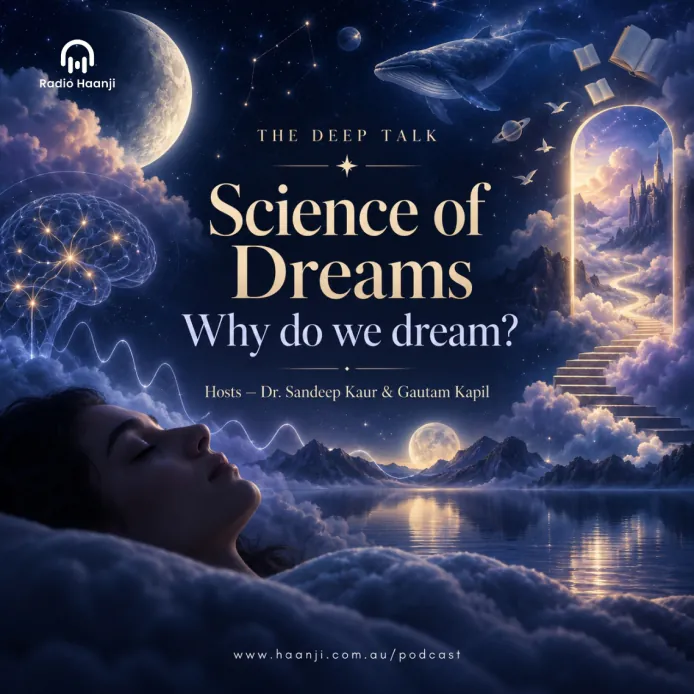
Why We Have Dreams - Science of Dreams: Deep Talk Show with Dr. Sandeep Kaur
Host:-
 Dr. Sandeep Kaur
 Gautam Kapil
Explore the science of dreams on Radio Haanji's Deep Talk Show with Dr. Sandeep Kaur & Gautam Kapill. Listen to the full episode on sleep, REM & lucid dreaming.
Every night, human consciousness slips away from waking reality and enters a realm governed by vivid imagery, shifting logic, and heightened emotion. The modern science of dreams seeks to answer why our minds construct these nocturnal landscapes and what biological purposes they serve. On the Deep Talk Show broadcast via Radio Haanji 1674AM, co-hosts Dr. Sandeep Kaur and Gautam Kapill tackled this exact frontier, exploring the bridge between ancient philosophy and contemporary neuroscience.
Rather than treating dreams as mere random noise, scientific inquiry suggests that our nocturnal visions are closely tied to cognitive health, emotional regulation, and memory consolidation. Dr. Sandeep Kaur highlighted that humans spend roughly twenty-seven years of life asleep, with significant portions of that time occupied by mental narratives shaped by waking experiences, fears, and subconscious desires.
Understanding dreams requires looking at both the biological architecture of sleep cycles and the cognitive mechanisms that fire while our bodies rest. By analyzing the shifts in brain chemistry, the suppression of executive reasoning, and the potential to cultivate conscious awareness through lucid states, this episode unpacks what is truly happening when we close our eyes.
Where to Listen
Catch this episode of the Deep Talk Show hosted by Dr. Sandeep Kaur and Gautam Kapill on Radio Haanji 1674AM. Stream the complete broadcast and explore regular discussions spanning science, psychology, and philosophy across your preferred audio platforms:
-
Spotify: Listen on Spotify
-
Apple Podcasts: Listen on Apple Podcasts
-
Radio Haanji Mobile App: Download the Radio Haanji App
Episode Highlights
-
Ancient Conceptions: Early human civilizations often interpreted dreams as divine omens or direct messages from deities, developing dedicated rituals and dream temples in ancient Greece for bodily healing.
-
Philosophical Frameworks: Classical thinkers shifted the narrative toward internal cognition; Plato viewed dreams as unfiltered desires emerging when rational judgment sleeps, while Aristotle framed them as residual sensory impressions.
-
Sleep Architecture: Human sleep cycles move through distinct non-REM stages (N1, N2, and deep slow-wave N3) before cycling into REM sleep, which houses the most narrative, memorable dreams.
-
Neurological Shifts: Inside the dreaming brain, the prefrontal cortex dials down logical error-checking, while the amygdala stays intensely active to process emotionally charged memories.
-
Lucid States & Animal Sleep: Advanced dreamers can train themselves to recognize and direct dreams, while biological studies confirm that creatures like songbirds mentally rehearse complex motor skills and songs during their sleep.
Why Do We Dream During the Night?
Direct Answer: We dream primarily to consolidate memories, process intense emotional experiences, and stimulate creative problem-solving. During sleep cycles—especially rapid eye movement (REM) stages—the brain reactivates daytime information, lowers stress chemicals like noradrenaline, and integrates recent experiences into existing neural networks without the constraints of waking logic.
Neuroscience demonstrates that dreaming is not an accidental by-product of sleep, but an active cognitive state. While earlier scientific models assumed the brain shut down to rest, modern imaging reveals that neural activity during dreaming can equal or exceed waking levels. A core function highlighted in the discussion is emotional recalibration. During REM sleep, brain concentrations of noradrenaline—a neurochemical associated with stress and anxiety—drop significantly. This creates a neurochemically calm environment where the brain can process difficult, frightening, or distressing memories without triggering an overwhelming physical fight-or-flight response.
Additionally, dreams act as a testing ground for memory consolidation and problem-solving. Complex puzzles, equations, or creative blocks that resist resolution during waking hours are frequently worked through during sleep because the brain can assemble unconventional associations. Writers, visual artists, and researchers regularly trace breakthroughs to dreams, where recent daytime inputs merge fluidly with deeper subconscious memories.
Historical and Philosophical Views on Dreams
Long before modern neuroimaging instruments could record electrical activity across the cerebral cortex, human societies sought frameworks to interpret dreams. Early civilizations frequently assigned spiritual meaning to nocturnal visions, treating them as prophetic warnings or communication from higher powers. In ancient Greece, this worldview manifested in specialized dream temples. Individuals seeking remedies for physical ailments or psychological burdens underwent rigorous purification rituals before sleeping in dedicated temple chambers, anticipating that the deity of medicine would bestow healing guidance in a dream.
A major intellectual shift occurred as classical philosophy began examining dreams as products of human psychology rather than external intervention. Plato posited in works such as The Republic that the human mind is governed by competing faculties. While waking logic keeps primal instincts, aggressive drives, and illicit desires contained, sleep suppresses this rational overseer, allowing suppressed passions to express themselves openly in dream states.
Aristotle approached the subject from a more empirical angle, documenting his observations in treatises such as On Dreams. He dismissed the idea that dreams were divine messages, instead categorizing them as natural phenomena generated by residual sensory impressions. According to Aristotle, daytime sights, sounds, and physical conditions remain lodged in the sensory organs and mind, resurfacing when external inputs fade during the night. Later thinkers like Carl Jung expanded on this, describing personal dreams that process daily routines alongside broader archetypal themes shared across cultures.
What Happens in the Brain When We Dream?
Direct Answer: During dreaming, the prefrontal cortex—the center for executive function, logic, and self-monitoring—becomes largely inactive, explaining why impossible dream events feel ordinary. Simultaneously, the amygdala and memory centers remain highly active, driving the intense emotional resonance and narrative structure characteristic of REM sleep.
Sleep progresses through repetitive cycles lasting approximately ninety minutes each, alternating between Non-Rapid Eye Movement (NREM) and Rapid Eye Movement (REM) sleep. NREM sleep is divided into three distinct phases:
-
N1: The initial five-minute entry phase marking light, transitional sleep where heart rate and muscle tone begin to drop.
-
N2: A deeper stage representing around forty-five percent of total sleep, characterized by slowing brain waves and reduced body temperature.
-
N3: Deep slow-wave sleep responsible for physical repair, tissue regeneration, and immune strengthening. Waking an individual from N3 often results in sleep inertia, causing severe temporary disorientation and confusion.
The transition into REM sleep brings a radical transformation in brain dynamics. The eyes dart rapidly beneath closed lids, breathing becomes irregular, and voluntary muscles enter temporary paralysis to prevent the physical enactment of dreams. While early sleep stages yield fragmented thoughts, REM sleep produces immersive, movie-like dreams that are vividly recalled upon waking. Because the prefrontal cortex is deactivated, bizarre leaps in time, impossible settings, and sudden changes in identity are accepted uncritically until the dreamer wakes up.
What Is Lucid Dreaming and How Does It Work?
Direct Answer: Lucid dreaming occurs when an individual becomes consciously aware that they are dreaming while remaining asleep. By reactivating regions of the prefrontal cortex during REM sleep, lucid dreamers can observe the dream state objectively and intentionally direct the dream environment, characters, and narrative outcomes.
While ordinary dreaming keeps the dreamer passive, lucid dreaming reintroduces metacognition into the sleep state. Practitioners learn to recognize the unreality of their dream surroundings, enabling them to control the narrative rather than simply responding to it. Beyond sheer novelty, lucid dreaming serves valuable therapeutic and creative functions. Mental health professionals and researchers utilize lucid techniques to assist patients dealing with post-traumatic stress disorder (PTSD) and chronic nightmares. By realizing that a terrifying scenario is entirely self-generated, individuals can confront their fears or consciously alter the dream’s storyline to end distress.
Cultivating lucid dreaming requires deliberate mental training. Techniques discussed by Dr. Sandeep Kaur and Gautam Kapill include reality testing—frequently questioning one's waking environment throughout the day so that the habit carries over into sleep. Keeping a dedicated dream journal immediately beside the bed helps capture fleeting REM impressions before they dissolve, gradually sharpening dream recall and subjective awareness during sleep.
Nightmares, Sleep Hygiene, and Reality Testing
Frequent distressing dreams and nightmares can disrupt overall well-being, often reflecting elevated daytime stress or unresolved emotional friction. For both children and adults, exposure to stimulating digital screens, violent imagery, or competitive video games shortly before bed elevates nervous system arousal, directly influencing dream content. When bad dreams occur, waking up in terror is a common reaction. In children, abrupt awakenings can heighten panic; gentle soothing and a calm transition back to rest allow the emotional spike from the amygdala to settle naturally.
Clinical and cognitive frameworks suggest several concrete strategies for minimizing nightmare frequency and mastering dream control:
-
Maintain Consistent Sleep Hygiene: Dim bedroom lights and eliminate blue-light screen exposure before sleep to support natural melatonin release and smooth stage transitions.
-
Keep a Dream Journal: Record fragments immediately upon waking to identify recurring patterns, triggers, and symbols.
-
Perform Daytime Reality Checks: Habitually pause during waking hours to question your surroundings, creating automatic mental triggers that surface within dreams.
-
Implement Dream Rehearsal: In Robert Johnson's framework for dream work (Inner Work: Using Dreams and Active Imagination for Personal Growth), individuals document their dreams, associate symbols with current emotional stressors, and mentally rewrite distressing endings.
Do Animals Dream Like Humans?
Human beings are not the only creatures that experience structured sleep cycles and mental imagery. Comparative biology demonstrates that numerous mammals, birds, and reptiles exhibit neural patterns closely matching mammalian REM sleep. When domestic pets twitch their paws, vocalize, or shift their eyes beneath closed lids, electrophysiological data suggests they are moving through active dream cycles.
A notable study mentioned in the episode centers on the sleep behaviors of young songbirds. During waking hours, juvenile birds listen intently to the complex calls of adult males and attempt to copy them. Researchers monitoring the neurological firing patterns in sleeping birds discovered that the precise motor neurons responsible for singing fire in patterned sequence during their sleep states. The birds silently practice and refine their vocal mechanics while asleep, demonstrating that dreaming plays an evolutionary role in skill acquisition and motor learning across the animal kingdom.
Key Takeaways
-
Emotional Recalibration: Dreaming during REM sleep reduces noradrenaline levels in the brain, allowing emotional processing and trauma resolution to occur in a low-stress biochemical state.
-
Evolution of Thought: Ancient viewpoints treated dreams as divine signs and physical healing omens, whereas classical philosophers like Plato and Aristotle correctly reframed them as internal psychological and sensory processes.
-
Sleep Cycle Breakdown: Sleep alternates between Non-REM stages (N1 light entry, N2 steady sleep, N3 deep restorative slow-wave) and REM sleep, which produces vivid, memorable narrative dreams.
-
Prefrontal Deactivation: Dreams feel entirely plausible while happening because the logical and analytical centers in the prefrontal cortex switch off, even as the emotional amygdala stays active.
-
Conscious Dream Mastery: Lucid dreaming allows practitioners to reactivate executive awareness during sleep, offering therapeutic relief for chronic nightmares and a platform for creative problem-solving.
-
Animal Cognition: Biological research shows that animals, including young songbirds, dream to mentally rehearse survival behaviors and vocal communication skills.
References and Further Reading
-
Robert Johnson: Inner Work: Using Dreams and Active Imagination for Personal Growth — Methodological framework exploring dream analysis, internal symbolism, and personal growth.
-
Plato: The Republic — Classical philosophical inquiry addressing the suppression of rational thought and the emergence of unchecked desires during sleep.
-
Aristotle: On Dreams — Foundational treatise examining sensory residues and natural bodily functions as the drivers of dreams.
The exploration of dreams highlights the complex interplay between brain chemistry, evolutionary biology, and the human subconscious. To hear the complete discussion on dream interpretation, historical philosophies, and sleep neuroscience, listen to Dr. Sandeep Kaur and Gautam Kapill on the Deep Talk Show via Spotify, Apple Podcasts, or the Radio Haanji App.
Frequently Asked Questions
Why do I forget my dreams immediately after waking up?
Can dreams accurately predict future events?
What is the primary difference between REM and Non-REM dreams?
How does lucid dreaming help with recurring nightmares?
Why do impossible events make complete sense inside a dream?
What's Your Reaction?