




























































































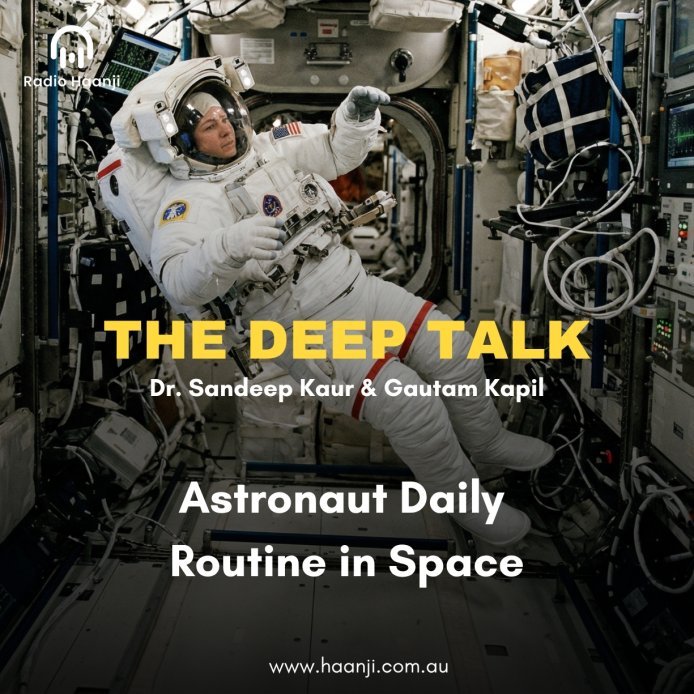


What's it really like living in space? Dr. Sandeep Kaur & Gautam Kapil unpack ISS life on The Deep Talk — free on Radio Haanji. Listen now.
Most of us have seen those videos. An astronaut floating through a corridor, grinning. Water droplets drifting in slow motion. Someone doing a somersault in zero gravity and laughing.
It looks like the best fun imaginable. It is also, in reality, one of the most physically demanding and psychologically intense environments a human being can inhabit. The International Space Station is 250 miles above Earth, travelling at 17,500 miles per hour, and everything inside it — from brushing your teeth to going to the toilet — requires a workaround that engineers spent years designing.
In this episode of The Deep Talk on Radio Haanji 1674 AM, hosts Dr. Sandeep Kaur and Gautam Kapil go deep on what daily life aboard the ISS actually involves — the physical toll of microgravity, the relentless daily schedule, the creative solutions for hygiene and nutrition, and the psychological realities of living somewhere no human instinct was built for.
Explore more Deep Talk episodes → https://haanji.com.au/podcast
Why Microgravity Is Harder on the Body Than It Looks
The word "weightlessness" makes it sound peaceful. It is not, biologically speaking.
On Earth, gravity pulls blood and fluids downward — toward your legs, your abdomen. Remove gravity, and those fluids redistribute upward, toward your head and chest. Astronauts call it "puffy face syndrome." Your face swells. Your nasal passages congest. You feel, permanently, like you have a head cold that never clears. Headaches are frequent. Vision can blur because the fluid pressure affects the optic nerve over time.
Then there is what happens to your muscles and skeleton. Without the constant low-level resistance of standing and walking against gravity, muscles begin to waste and bones start losing density — fast. Studies from NASA suggest astronauts can lose up to 1% of their bone mass per month in space, a rate that would be alarming even in the most severe osteoporosis cases on Earth.
One hazard that often goes unmentioned is the risk of decompression sickness — what divers call "the bends." Moving from the pressurised station to the lower-pressure environment of a spacesuit for an EVA (Extra-Vehicular Activity, or spacewalk) can cause dissolved nitrogen in the bloodstream to form bubbles. It is potentially fatal if not managed carefully. Astronauts must "pre-breathe" 100% oxygen for hours before every EVA to flush nitrogen from their bodies before the pressure drops.
A Day on the ISS: Scheduled Down to the Minute
There is no casual day in space. Every hour is accounted for.
A standard ISS day runs on a roughly 16-hour active schedule followed by 8 hours of rest. Crew members receive twice-daily briefings with Mission Control — once in the morning to review the day's tasks, once in the evening to debrief. The schedule covers everything: scientific experiments, maintenance, equipment checks, communications, mealtimes, and exercise.
The exercise component is non-negotiable. Two hours minimum, every single day, using specialised equipment built specifically for microgravity — treadmills and cycling machines fitted with bungee cord systems that physically anchor the astronaut to the device, since nothing stays in contact with anything without being strapped down.
Spacewalks, when they happen, are not quick field trips. Preparing for an EVA takes most of a day. The pre-breathing protocol, the suit checks, the systems verification — all of it runs for hours before anyone steps outside. Once outside, the work itself can last six to eight hours, and the astronaut is doing it in a suit that is essentially a self-contained spacecraft, managing life support, tools, and communication simultaneously.
Hygiene, Food, and Waste: Resource Management 250 Miles Up
Here is a fact that surprises most people: astronauts drink recycled urine. Not because there is no other option in principle, but because water is so difficult and expensive to launch into orbit that the station's water recovery system processes every possible source — sweat, condensation, and yes, urine — back into drinkable water. The system works, and the water is clean. But it takes some mental adjustment.
Showering does not exist on the ISS. Water in microgravity forms floating spheres rather than falling — a traditional shower would just create a cloud of droplets that would drift into electronics, sensors, and ventilation systems. Astronauts wash using damp cloths and specially formulated no-rinse shampoos and body washes.
Even condiments required a redesign. Salt and pepper — ordinary table staples — cannot be used in granule form in space, because loose grains float freely and a stray particle in someone's eye, or in a sensitive instrument, is a real hazard. On the ISS, seasonings come in liquid form.
Waste management is handled by vacuum-sealed toilets that use airflow rather than water to direct waste. Solid waste is compressed, packed, and eventually loaded onto resupply vehicles that burn up on re-entry into Earth's atmosphere.
Every resource loop is closed as tightly as possible. Nothing is wasted. Nothing can be.
The Mental Side: What No Training Fully Prepares You For
The physical challenges of spaceflight are well documented. The psychological ones are harder to measure.
Astronauts are isolated from every person they have ever known, separated by hundreds of miles of vacuum, with communication delays and scheduled contact windows. Modern crews have it better than early astronauts did — IP-based phone systems and email mean crew members can reach family members more or less on demand, subject to bandwidth constraints. But being able to call home does not fully remove the reality of where you are.
Most astronauts, when asked about their favourite part of the mission, do not mention experiments or EVAs first. They mention the Cupola — a domed, seven-window observation module on the underside of the station, offering a near-360-degree view of Earth. Watching the planet scroll past below them, slowly rotating, lit up by city lights and lightning storms and auroras — that is what people describe as genuinely moving.
The ISS completes one full orbit of Earth every 90 minutes. Which means the crew witnesses 16 sunrises and 16 sunsets every 24 hours. The light cycles bear no resemblance to anything the human body's internal clock expects. Sleeping in that environment requires its own management — blackout curtains, scheduled melatonin, strict sleep hygiene protocols — because the brain never quite stops receiving "it's daytime" signals from the windows.
Dr. Sandeep Kaur and Gautam Kapil explore exactly this tension in the episode: between the discipline the mission demands and the moments of genuine wonder that crew members describe as unlike anything else they have experienced. Space does not just test people. It changes them.
Frequently Asked Questions
What happens to the human body in space without gravity?
Without gravity, bodily fluids shift toward the head, causing facial swelling, nasal congestion, and persistent headaches. Muscles weaken rapidly without the resistance of standing and walking, and bones lose density at roughly 1% per month. Vision can also be affected by fluid pressure on the optic nerve. Astronauts exercise at least two hours daily specifically to slow these effects.
How do astronauts exercise on the International Space Station?
Astronauts use treadmills and cycling machines modified for microgravity, with bungee cord systems that strap them to the equipment so they maintain contact. Two hours of exercise per day is mandatory for all long-duration crew members on the ISS to help preserve muscle mass and bone density during their mission.
What do astronauts eat and drink on the ISS?
Astronauts eat specially packaged meals — some freeze-dried, some thermostabilised — rehydrated with water onboard. Seasonings come in liquid form because loose grains float and pose hazards. Water on the ISS is heavily recycled, including from sweat and processed urine, through an onboard water recovery system.
How do astronauts prepare for a spacewalk?
Preparation for an EVA begins hours before stepping outside. The crew must pre-breathe 100% oxygen to purge nitrogen from their bloodstream, reducing the risk of decompression sickness when moving into the lower-pressure spacesuit environment. Suit checks and systems verification add several more hours. The walk itself can run six to eight hours.
How do astronauts sleep on the ISS when there are 16 sunrises a day?
Because the ISS orbits Earth every 90 minutes, natural light cues are useless for regulating sleep. Astronauts sleep in small personal cabins with blackout measures to block light from windows, follow strict sleep schedules aligned to a 24-hour day, and use melatonin supplements when needed to support their disrupted circadian rhythms.
Conclusion
What Dr. Sandeep Kaur and Gautam Kapil lay out in this episode of The Deep Talk is something the highlight reels never quite capture: life on the ISS is an extraordinary achievement dressed up as an ordinary workday. The science is continuous, the discipline is relentless, and the physical cost is real. But so is the view from the Cupola. So is watching a sunrise every six minutes.
If space and science are subjects that make you think differently about the world — and they should — this conversation is worth your time.
Listen to this ISS episode of The Deep Talk with Dr. Sandeep Kaur and Gautam Kapil — only on Radio Haanji.
Listen free:
What's Your Reaction?