

























































































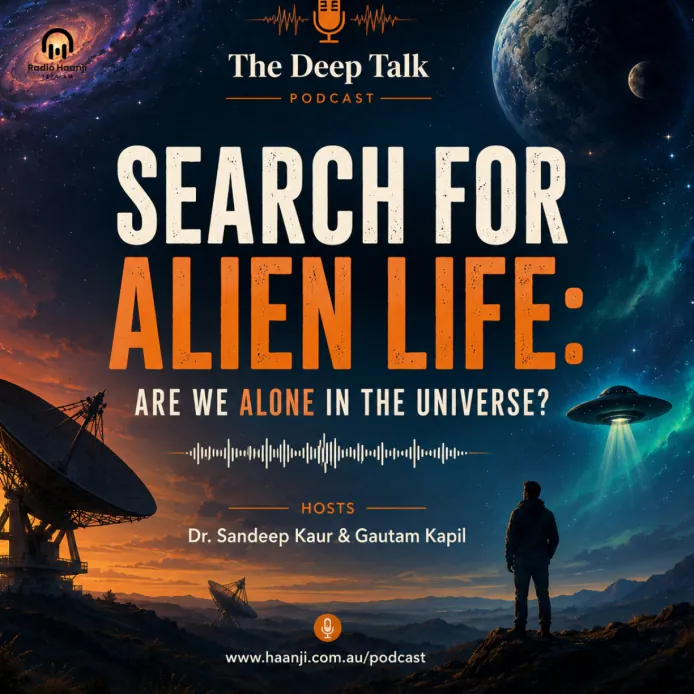
Search for Alien Life: Are We Alone in the Universe? - The Deep Talk
Host:-
 Dr. Sandeep Kaur
 Gautam Kapil
Dive into the empirical science behind the search for alien life. Explore biosignatures, habitable worlds, and the latest deep-space anomalies.
The question of whether humanity is alone in the universe is no longer confined to speculative fiction or late-night philosophy. Today, it stands as an active, rigorously funded discipline within the global scientific community. The modern search for alien life utilizes a sophisticated network of space telescopes, robotic planetary explorers, and advanced laboratory spectroscopy. By treating cosmic biology as a problem of chemistry and physics, researchers are actively decoding the interstellar quiet to determine if life is a unique earthly fluke or an inevitable cosmic consequence.
Our current baseline for understanding planetary systems has expanded exponentially over the last few decades. Data compiled by the National Aeronautics and Space Administration (NASA) indicates that there are billions of planets within our galaxy alone. The analytical lens now applied to these discoveries focuses not on seeking flying saucers, but on searching for minute modifications in the light profiles of distant solar systems. The next decade of cosmic exploration promises to transform our conceptual place in the universe from speculative isolation to verified connection.
To appreciate the true scope of this cosmic quest, one must look past historical myths and evaluate the cold, hard telemetry coming back from the edges of our solar system and beyond. The journey shifts from the nearby, dust-swept plains of Mars to the massive, atmospheric veils of distant exoplanets orbiting alien stars.
The Chemical Imprints of Distant Worlds
The core methodology driving modern astrobiology relies heavily on the study of biosignatures in astrobiology. A biosignature is any substance, element, or phenomenon that provides scientific proof of past or present life. Rather than waiting for a deliberate radio broadcast, scientists search for how primitive biological processes alter the air, water, and soil of a planet. These subtle chemical imbalances offer an undeniable signature across light-years of space.
When looking at nearby worlds, the attention remains on our immediate planetary neighbors. Planetary rovers deployed to Mars continue to examine ancient lakebeds and clay formations for indicators of past organic activity. These missions focus on uncovering fossilized micro-structures or unexpected localized concentrations of gasses like methane, which frequently point to biological active periods on Earth.
How Do Scientists Look for Biosignatures?
Direct Answer: Scientists look for biosignatures by utilizing space telescopes to capture star light filtering through a distant planet's atmosphere. This process, known as transmission spectroscopy, reveals the distinct chemical makeup of the gases present, allowing researchers to identify unexpected combinations of elements like oxygen, methane, and water vapor that could indicate biological activity.

To dive deeper into this process, consider how light functions as a data carrier across space. When an exoplanet passes directly in front of its parent star, a tiny fraction of the starlight passes through the outer fringes of the planet’s atmosphere before traveling toward Earth. Because different chemical elements absorb specific, predictable wavelengths of light, the remaining light functions as a chemical barcode.
By analyzing this barcode with ultra-sensitive instruments, astrobiologists can map out the exact atmospheric composition of an alien world. The discovery of volatile gas mixtures—such as oxygen coexisting alongside methane—signals a system completely out of chemical equilibrium. On a dead world, these gases would naturally react and cancel each other out over time. Their continuous coexistence indicates an active, ongoing replenishment source, strongly suggesting a living surface biology.
The Cosmic Map of Habitable Exoplanets
The discovery of habitable exoplanets has dramatically accelerated, largely due to deep-space observatories. Researchers no longer wonder if other planetary systems exist; instead, they are cataloging a massive variety of solar setups. Many of these newly identified systems host worlds that closely resemble Earth in mass, density, and structural composition.
Specialized focus is directed toward rocky worlds orbiting within stable systems, such as the famous TRAPPIST-1 cluster. This specific system hosts seven Earth-sized worlds, three of which orbit directly within the parameters required to maintain liquid surface water. Telemetry from these distant locations helps scientists construct dynamic planetary models, allowing them to calculate potential surface pressures, oceanic volumes, and systemic stability over billions of years.
What Is the Goldilocks Zone for Planets?
Direct Answer: The Goldilocks zone, scientifically known as the habitable zone, is the precise orbital region around a star where the surface temperature of a planet is neither too hot nor too cold, but just right to allow liquid water to exist stably on its surface.

Liquid water is globally recognized as the essential solvent required for biological life to thrive, copy, and evolve. If a world orbits too close to its host star, stellar radiation boils the oceans away into a permanent runaway greenhouse effect. Conversely, if the planet orbits too far away, the systemic warmth drops, plunging the entire planetary surface into a permanent global ice age.
However, finding a world inside the habitable zone is only the first checkbox in a complex matrix of planetary survival. The planet must also possess a protective magnetic field to shield its surface from destructive solar winds, alongside a stable atmosphere capable of regulating surface temperatures. Scientists carefully study these variables to ensure that target planets are truly capable of supporting life over geological timeframes.
Philosophical Hurdle: Breaking the Silent Cosmos
The persistent lack of contact across the cosmos presents a distinct philosophical challenge known as the Fermi Paradox. The paradox highlights a clear mathematical contradiction: the universe is incredibly old and populated by trillions of stars, yet we have found zero verified evidence of advanced interstellar civilizations. This systemic silence forces researchers to re-evaluate how common intelligent life truly is.
Proposed fermi paradox solutions vary from the deeply practical to the existential. Some researchers argue that the vast distances separating stars act as a natural quarantine, making interstellar communication practically impossible. Others suggest the "Great Filter" theory, which posits that advanced civilizations naturally encounter catastrophic bottlenecks—such as environmental collapse or nuclear war—before achieving the technology required to explore deep space.
Why Haven't We Found Alien Life Yet?
Direct Answer: We haven't found alien life yet because our technical observation methods are still incredibly limited by cosmic distances. The universe is massive, our space exploration instrumentation is relatively new, and we have only examined a microscopic fraction of our immediate galactic neighborhood, meaning our search has barely begun.

To visualize this challenge clearly, consider the scale of our current attempts. The Milky Way galaxy spans more than 100,000 light-years, yet humanity’s observable radio signature has traveled barely 200 light-years out into space. In the grand timeline of the cosmos, our technical capability to scan for life spans less than a century.
Furthermore, our best space instrumentation requires massive amounts of observation time to collect data from a single exoplanet. We are searching for a highly specific chemical needle in a massive galactic haystack, using tools that are still in their technological infancy. A true lack of evidence is not proof of total cosmic absence; it is simply a reflection of how early we are in our cosmic journey.
Anomalies and Telemetry: Grounding the UFO Narrative
Any responsible search for alien life must separate clear empirical data from modern cultural folklore. In recent years, the ufo scientific investigation has shifted away from sensationalized alien stories toward rigorous tracking by institutional agencies. Governments and scientific groups now catalog Unidentified Anomalous Phenomena (UAP) through automated data collection systems rather than anecdotal stories.
The overwhelming majority of these aerial anomalies are quickly identified as common atmospheric effects, weather balloons, standard military hardware, or sensory artifacts in tracking hardware. By eliminating these common explanations through rigorous data collection, scientists can focus exclusively on tracking authentic planetary anomalies. This objective approach ensures that our resources remain dedicated to genuine deep-space discoveries.
Key Takeaways
-
The search for alien life relies on empirical biosignatures rather than speculative close encounters.
-
Transmission spectroscopy allows astrobiologists to read the atmospheric barcode of exoplanets light-years away.
-
Orbiting within the Goldilocks zone is critical for maintaining the liquid water necessary to sustain biological life.
-
The Fermi Paradox highlights the clear mathematical contradiction between the high probability of cosmic life and the universe's current silence.
-
Humanity has only searched a tiny fraction of our immediate galactic neighborhood, leaving the vast majority of the universe completely unexplored.
References and Further Reading
-
NASA Exoplanet Science Institute — Extensive database detailing verified habitable exoplanets and cosmic telemetry.
-
The Astrobiology Journal — Peer-reviewed research papers focusing on current advancements in the search for biosignatures in astrobiology.
-
Radio Haanji "Deep Talk" Segment — Authentic audio program analyzing the cultural impact and scientific boundaries of modern space exploration.
Frequently Asked Questions
What is the difference between a biosignature and a technosignature?
Is there evidence of microbial life on Mars?
How does the James Webb Space Telescope help search for alien life?
Why is liquid water considered essential for alien life?
What is the Great Filter theory?
The modern search for alien life is a journey defined by patience, technological progress, and intellectual humility. As our telescopes look deeper into the cosmos, we are slowly building a clearer picture of our place in the universe. Whether we eventually find a living galaxy or discover that we are truly alone, the answer will fundamentally reshape our understanding of humanity, life, and the universe itself. To stay connected with these discoveries, explore our growing archive of space science write-ups, share this article with fellow enthusiasts, and sign up for our weekly newsletter to get recent cosmic updates sent directly to your inbox.
What's Your Reaction?