



































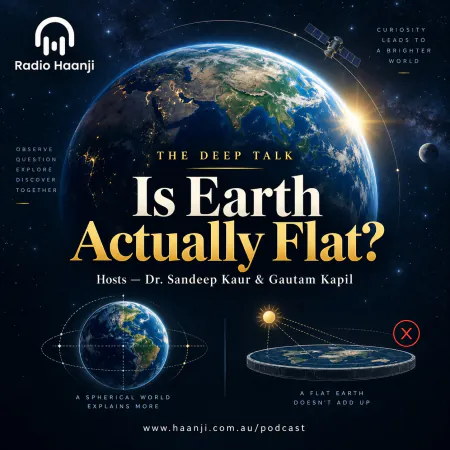
























































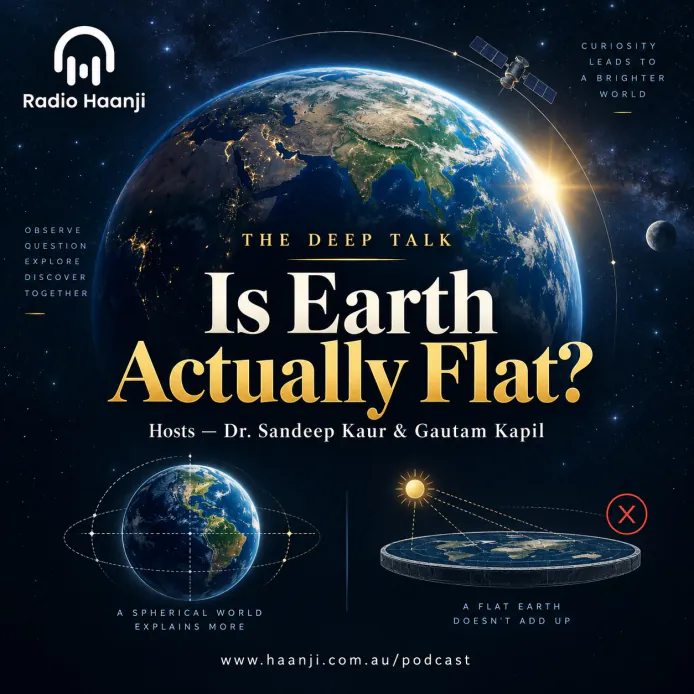
Flat Earth Debate: Science, Proofs & Planetary Reality - Dr. Sandeep Kaur & Gautam Kapil
Host:-
 Dr. Sandeep Kaur
 Gautam Kapil
Can the Earth actually be flat? Dr. Sandeep Kaur and Gautam Kapil break down the flat Earth debate on Radio Haanji's The Deep Talk. Listen now!
The modern persistence of the flat Earth debate remains one of the most intriguing cultural and scientific phenomenons of the digital age. Despite centuries of empirical evidence and space exploration, fringe theories claiming the world is a level disc continue to circulate across video platforms and online communities. On The Deep Talk, broadcast on Radio Haanji 1674AM, co-hosts Dr. Sandeep Kaur and Gautam Kapil dismantled these arguments, unpacking why the flat Earth theory collapses under direct observation, basic geometry, and gravitational physics.
Investigating the flat Earth debate reveals that questions about planetary geometry were settled long before satellites ever orbited the planet. Ancient scholars did not rely on complex machinery or government agencies; they applied straightforward geometry to shadows and watched the horizons to deduce that our world is curved. When modern navigation, telecommunications, and planetary sciences are combined with these ancient foundations, the reality of a spherical Earth becomes undeniable.
As Dr. Kaur and Kapil point out during the broadcast, the conversation surrounding flat Earth claims is also an essential lesson in scientific literacy. Understanding how scientists test hypotheses, verify calculations through peer review, and deploy space technology helps clarify the vast difference between verified consensus and social media trends built for clicks.
Where to Listen
Listen to the full episode of The Deep Talk featuring Dr. Sandeep Kaur and Gautam Kapil on Radio Haanji 1674AM. Stream the broadcast directly across these official channels:
Episode Highlights
The discussion on The Deep Talk began by examining how humanity moved away from early flat-disc mythologies over two millennia ago. Thinkers like Aristotle recognized the importance of empirical deduction, while Eratosthenes mathematically calculated the Earth's circumference using simple sticks, cast shadows, and walking distances between ancient cities. The hosts highlighted how later astronomers like Copernicus and Galileo braved cultural and religious backlash to cement our understanding of planetary mechanics.
The hosts moved into everyday physical demonstrations that contradict flat Earth arguments, such as the curved shadow Earth casts across the moon during eclipses and the way ships slip hull-first over the sea horizon. Dr. Kaur addressed common intuitive objections, such as why humans cannot feel planetary rotation, comparing Earth's steady motion to an airplane cruising smoothly at high altitude. Finally, the co-hosts evaluated what physical chaos would ensue if Earth truly were a flat disc—from collapsing atmospheres to oceans pooling toward the center—before urging audiences to trust transparent peer review over viral engagement algorithms.
How Did Classical Scholars Disprove Flat Earth Ideas?
Classical scholars disproved flat Earth ideas by analyzing the varying angles of cast shadows, tracking changing constellations, and applying geometry to natural phenomena. More than 2,000 years ago, ancient Greek natural philosophers demonstrated that a flat terrestrial plane could not account for basic physical measurements.
The most celebrated demonstration came from Eratosthenes. He observed that at noon on the summer solstice, a vertical stick in Syene cast no shadow, while a stick placed simultaneously in Alexandria cast a measurable shadow. On a flat plane illuminated by distant sunlight, both sticks would cast identical shadows. Recognizing that the ground itself was curving away, Eratosthenes measured the shadow angle, used the geographic distance between the two cities, and calculated the circumference of the Earth with remarkable precision.
Aristotle also emphasized observational reality over speculative models. Centuries later, astronomers Nicolaus Copernicus and Galileo Galilei expanded on this foundation, providing mathematical and telescopic evidence for orbital mechanics. Even when faced with house arrest and religious pushback, these early scientists demonstrated that the observable data remained consistent only when assuming curved, rotating planetary bodies.
What Simple Observations Prove the Earth Cannot Be Flat?
Simple observations that prove Earth cannot be flat include curved lunar eclipse shadows, ships disappearing hull-first over water horizons, and gravitational symmetry. In addition, the alternating day, night, and seasonal cycles across northern and southern hemispheres confirm a spherical, tilted world.
During a lunar eclipse, the Earth positions itself directly between the sun and the moon. The shadow projected across the lunar surface is consistently circular. If the Earth were a flat circular disc, it would only cast a round shadow if the sun were hitting it dead-center from beneath; at any other angle, a flat plane would cast an elliptical or flat, line-like shadow. Only a three-dimensional sphere casts a curved shadow from every single alignment.
Maritime transit provides another observable proof that anyone can test at the coast. As a ship journeys away toward the horizon, it does not merely fade into the distance as a complete, tiny silhouette. Instead, the hull vanishes beneath the water line first, followed by the mast and sails. This occurs because the ship is physically descending along the curved surface of the ocean.
Isaac Newton's laws of universal gravitation explain why this shape is inevitable in nature. Gravity pulls all mass equally inward toward the center of gravity. For massive celestial bodies, this balanced inward force pulls the structure into an equilibrium that naturally forms a sphere. Furthermore, the Earth's axial tilt of approximately 23.5 degrees creates the opposing seasons and varying day-night lengths between hemispheres—a dynamic that is physically impossible on a flat plane.
Why Don't We Feel the Earth Moving Beneath Us?
We do not feel the Earth moving because the planet, its atmosphere, and everything on the surface travel together at a uniform, constant rotational speed. The human vestibular system only detects changes in speed or direction, such as acceleration and deceleration, rather than continuous, steady motion.
On The Deep Talk, Dr. Sandeep Kaur used the analogy of riding inside a modern passenger plane. While an aircraft cruises at high speed through calm skies, passengers can pour drinks, walk down the aisle, or sleep without feeling that they are hurtling through the sky. Because the cabin air, the seats, and the passengers move together at the exact same constant velocity, there is no physical resistance or sensation of speed.
Earth functions under the exact same mechanical reality. The solid ground, the oceans, the atmosphere, and human beings are carried along together without erratic braking or sudden acceleration. Without changes in velocity, our bodies have no physical cue to register the planet's rotation, creating the illusion that the ground beneath our feet is motionless.
How Does Modern Technology Disprove the Flat Earth Model?
Modern technology disproves the flat Earth model because satellite navigation, global telecommunications, and aviation routes rely on three-dimensional orbital geometry to function. If navigation algorithms and flight plans were calculated using flat-disc mathematics, modern global travel and GPS tracking would fail completely.
Global Positioning System (GPS) infrastructure consists of a constellation of satellites circling the globe along carefully calibrated orbits. Ground receivers pinpoint their locations through signal trilateration, calculating distances to multiple satellites simultaneously. These equations must account for the Earth's curvature, gravitational field, and orbital speeds. If the planet were flat, GPS timing signals would be distorted, rendering satellite positioning systems useless.
Commercial airlines demonstrate this principle daily through international flight paths. Long-distance flights follow "great circle" routes—the shortest path between two points across the surface of a curved sphere. When plotted on flat maps, these paths appear bowed, leading flat Earth proponents to misunderstand flight trajectories. In reality, pilots use these spherical pathways to conserve fuel and minimize travel time.
Questions regarding space imagery are also addressed by technological realities. Satellites collect high-resolution digital sensor data in narrow strips as they orbit. Agencies stitch these pixel bands together into composite panoramas to map entire continents. Skeptics often point to this digital compositing to claim the images are fabricated, ignoring the fact that stitching data strips is standard technical imaging practice.
What Would Actually Happen if the Earth Were Flat?
If the Earth were a flat disc, gravity would pull everything sideways toward the center of the disc rather than downward. This would cause all global oceans and atmospheric gases to pool in the middle, leaving the outer perimeter dry, airless, and incapable of sustaining life.
On a disc-shaped world, the center of mass would reside directly in the core of the disc. Standing anywhere away from the center would cause gravity to pull at a severe horizontal angle back toward the middle. Walking toward the outer rim would feel like climbing an increasingly steep, vertical cliff, even if the terrain beneath appeared completely flat.
This central gravitational pull would cause fluid dynamics to collapse. All surface water would be dragged toward the center, submerging inner regions like the Arctic under deep seas while draining the outer continents completely dry. The atmosphere would similarly concentrate in the middle, leaving the outer rim in a vacuum without breathable air or atmospheric pressure.
Atmospheric optics would be equally unrecognizable. Without a curved atmosphere to evenly diffuse light wavelengths, sunlight scattering would change drastically. The familiar blue daylight skies and consistent sunrise and sunset sequences we experience daily would disappear, replaced by harsh, distorted lighting across the disc.
Conspiracy Algorithms vs. Global Scientific Consensus
The persistence of the flat Earth debate online illustrates how social media platforms prioritize controversial engagement over verified truth. Algorithms favor content that generates high comment counts and emotional reactions, allowing conspiratorial claims to spread rapidly regardless of scientific accuracy.
Genuine scientific research operates under an entirely different discipline. Scientific progress relies on open empirical data, reproducible experiments, and rigorous academic peer review. Before an astronomical discovery or physical model is accepted into global consensus, it must withstand scrutiny by independent physicists, university researchers, and observational observatories worldwide.
Furthermore, space exploration is not run by a single organization. Independent agencies across the globe—such as NASA in the United States, ISRO in India, CNSA in China, and ESA in Europe—operate in different geopolitical environments. Despite national rivalries and political differences, their rocket trajectories, satellite orbits, and planetary data align on the exact same physical reality: an ancient, curved Earth bound by universal physical laws.
Key Takeaways
-
Eratosthenes disproved flat-surface theories over 2,000 years ago by measuring the differing shadow angles cast simultaneously in two separate cities.
-
Lunar eclipses project a circular shadow onto the moon, an outcome that can only be produced by a spherical body.
-
Ships sailing across ocean horizons vanish hull-first, proving the water's surface is curved rather than flat.
-
We do not feel the Earth spinning because the planet, atmosphere, and surface inhabitants all travel together at a uniform, constant velocity.
-
Modern navigation networks like GPS depend on spherical orbital mechanics and would fail entirely on a flat Earth model.
-
A flat Earth disc would cause gravity to pull inward toward the center, stripping the outer perimeter of air and water.
For more evidence-based discussions on science, history, and modern culture, tune in to The Deep Talk on Radio Haanji 1674AM with Dr. Sandeep Kaur and Gautam Kapil. Listen to the full episode on your preferred podcast platform or download the official station app to stay informed with verified, expert perspectives.
Frequently Asked Questions
What started the modern flat Earth debate?
How does a lunar eclipse prove the Earth is not flat?
Why don't oceans fall off a spinning, curved Earth?
Could gravity work normally on a flat Earth?
Why do some satellite images of Earth look edited?
What's Your Reaction?