
























































































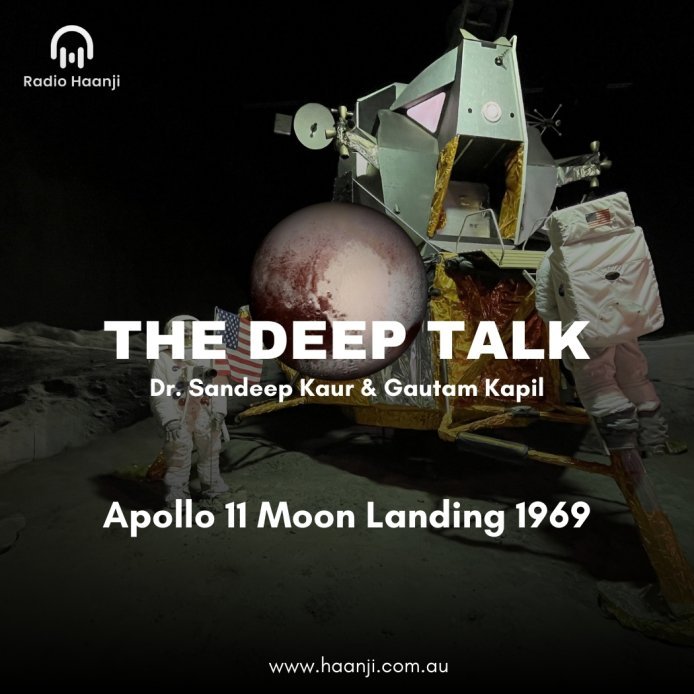


Neil Armstrong's moon landing — the facts, the doubts, the truth. The Deep Talk on Radio Haanji goes further than any headline. Free on Spotify.
Apollo 11 Moon Landing 1969: One Giant Leap for Mankind
On July 20, 1969, at exactly 4:17 p.m. EDT, humanity achieved what had been deemed impossible for all of human history: two men landed on the Moon. Commander Neil Armstrong and Lunar Module Pilot Buzz Aldrin touched down in the Sea of Tranquility while Command Module Pilot Michael Collins orbited above, waiting for their return. Six hours later, Armstrong became the first human to set foot on another world, uttering the now-immortal words: "That's one small step for man, one giant leap for mankind."
This remarkable story was recently explored in depth on The Deep Talk, a thought-provoking show on Radio Haanji 1674 AM, Australia's number 1 Indian and Punjabi radio station. Hosted by Gautam Kapil with special guest Dr. Sandeep Kaur, the episode examined not just the technical marvel of Apollo 11, but what it meant for human aspiration—a theme that resonates deeply with immigrant communities who themselves have crossed vast distances in pursuit of dreams.
Featured on The Deep Talk: This Apollo 11 history was discussed on Radio Haanji 1674 AM's The Deep Talk show, hosted by Gautam Kapil with guest Dr. Sandeep Kaur. Radio Haanji is Australia's premier Indian and Punjabi radio station, broadcasting 24/7 with educational content, cultural discussions, and the best Punjabi podcast programming. Tune to 1674 AM in Melbourne and Sydney, or stream via mobile app and all major podcast platforms.
The Mission: July 16-24, 1969
Apollo 11 was launched by a Saturn V rocket from Kennedy Space Center in Florida on July 16, 1969, at 9:32 a.m. EDT. The massive 363-foot rocket used 7.5 million pounds of thrust to propel three astronauts into space. Over a million spectators, including Vice President Spiro Agnew and former President Lyndon Johnson, watched the historic liftoff.
The three-man crew consisted of:
- Neil Armstrong (1930-2012) - Commander, civilian research pilot
- Buzz Aldrin (born 1930) - Lunar Module Pilot, Air Force colonel with doctorate from MIT
- Michael Collins (1930-2021) - Command Module Pilot, remained in orbit during moon landing
After traveling 240,000 miles in 76 hours, Apollo 11 entered lunar orbit on July 19. The journey that President John F. Kennedy had challenged America to complete in his 1961 speech was about to reach its climax.
The Landing: "The Eagle Has Landed"
On July 20, at 1:46 p.m. EDT, the lunar module Eagle, carrying Armstrong and Aldrin, separated from the command module Columbia, where Collins remained. The Eagle began its powered descent to the lunar surface at 3:08 p.m. EDT.
What happened next became one of the most dramatic moments in space exploration. As Eagle descended toward the Sea of Tranquility, Armstrong noticed the computer was guiding them toward a boulder field. With only seconds of fuel remaining, he took manual control and piloted the spacecraft to a safer landing site.
At 4:17 p.m. EDT on July 20, 1969, with just 30 seconds of fuel left, the lunar module touched down. Armstrong's calm voice announced: "Houston, Tranquility Base here. The Eagle has landed." Mission Control erupted in celebration. Humanity had reached the Moon.
One Small Step: The Moonwalk
Originally, the flight plan called for a four-hour rest period after landing, but Armstrong and Aldrin requested to begin their moonwalk immediately. At 10:39 p.m. EDT on July 20 (02:39 UTC on July 21), Armstrong opened the lunar module hatch.
He descended the ladder slowly, pulling a cord that deployed a television camera mounted on the side of the lunar module. At 10:56 p.m. EDT (02:56 UTC on July 21), Neil Armstrong pressed his left foot onto the Moon and said:
"That's one small step for man, one giant leap for mankind."
Approximately 530 million people around the world watched this historic moment live on television. Buzz Aldrin joined Armstrong on the surface 19 minutes later, famously describing the lunar landscape as "magnificent desolation."
What They Did on the Moon
During their 2.5-hour moonwalk, Armstrong and Aldrin accomplished several crucial tasks:
Scientific Instruments Deployed
Passive Seismic Experiment: A seismometer designed to detect moonquakes and meteor impacts. This instrument operated for years after Apollo 11, continuously sending data back to Earth about the Moon's internal structure.
Laser Ranging Retroreflector: An array of 100 mirrors that reflects laser beams fired from Earth, allowing scientists to measure the exact distance between Earth and Moon with millimeter precision. Remarkably, this equipment is still in use today, over 55 years later. Scientists have used it to discover that the Moon is slowly drifting away from Earth at about 3.8 centimeters per year.
Solar Wind Composition Experiment: An aluminum foil sheet that captured particles from the solar wind, helping scientists understand the composition of materials streaming from the Sun.
Lunar Samples Collected
Armstrong and Aldrin collected 47.5 pounds (21.5 kilograms) of lunar material—rocks and soil samples that revolutionized our understanding of the Moon's geology. Analysis of these samples led to the discovery of three new minerals:
- Armalcolite - Named after Armstrong, Aldrin, and Collins
- Tranquillityite - Named after the Sea of Tranquility landing site
- Pyroxferroite - An iron-bearing silicate mineral
These samples continue to be studied today, with new discoveries still being made as analytical techniques improve.
Michael Collins: Orbiting Alone
While Armstrong and Aldrin explored the lunar surface, Michael Collins remained in the Command Module Columbia, orbiting the Moon every two hours. His role was critical—he served as the communications link between the surface crew and Mission Control, photographed the lunar surface, and kept the command module ready for the rendezvous.
For portions of each orbit, when Columbia passed over the Moon's far side, Collins was completely cut off from all human contact. He was, for those moments, the loneliest human being in existence, farther from any other person than anyone had ever been—about 2,400 miles from Armstrong and Aldrin on the surface, and 240,000 miles from everyone on Earth.
Collins later wrote that if the lunar module failed to launch from the surface, he would have to return to Earth alone, leaving his crewmates stranded. Fortunately, that nightmare scenario never materialized.
The Return Journey
Armstrong and Aldrin spent a total of 21 hours and 36 minutes on the lunar surface. After a brief and uncomfortable rest period—Aldrin on the floor, Armstrong in a makeshift hammock—they prepared for liftoff.
At 1:54 p.m. EDT on July 21, the lunar module's ascent stage blasted off from the Moon's surface, leaving behind the descent stage, American flag, scientific instruments, and Neil Armstrong's famous bootprints. About 3.5 hours later, Eagle successfully docked with Columbia.
The astronauts transferred the lunar samples and equipment to the command module, then jettisoned the lunar module. On July 22, they fired Columbia's engine to begin the three-day journey home.
Apollo 11 splashed down in the Pacific Ocean on July 24, 1969, at 12:50 p.m. EDT. The crew was recovered by the USS Hornet. As a precaution against possible lunar microbes, the astronauts were immediately placed in biological isolation for 21 days—first in a mobile quarantine facility, then at the Lunar Receiving Laboratory in Houston.
Apollo 11 Mission Statistics
- Total mission duration: 8 days, 3 hours, 18 minutes, 35 seconds
- Distance to Moon: 240,000 miles (386,000 kilometers)
- Time on lunar surface: 21 hours, 36 minutes
- Moonwalk duration: 2 hours, 31 minutes
- Lunar samples collected: 47.5 pounds (21.5 kg)
- Fuel remaining at landing: 30 seconds
- Television viewers worldwide: 530 million (about 20% of world population)
- Photos taken: Over 1,400 photographs
The Deep Talk Discussion: Why Apollo 11 Still Matters
As Dr. Sandeep Kaur noted during The Deep Talk discussion on Radio Haanji, Apollo 11 represents more than just a technological achievement—it's a testament to what humans can accomplish when they commit to an audacious goal despite seemingly impossible odds.
For the Indian and Punjabi community listening to Radio Haanji in Australia, many of whom undertook their own epic journeys to build new lives far from home, the Apollo story resonates on a deeply personal level. Just as Armstrong, Aldrin, and Collins traveled 240,000 miles into the unknown with no guarantee of return, immigrants cross oceans and continents, leaving behind everything familiar to pursue opportunity and dreams in a new land.
Gautam Kapil's thoughtful exploration of the Apollo mission on The Deep Talk connected these themes beautifully, reminding listeners that exploration—whether to the Moon or to Melbourne—begins with the same fundamental human drive: the refusal to accept that our current horizons are the limits of what's possible.
The courage required isn't measured in distance but in the willingness to step into uncertainty for the possibility of something better. Armstrong's "small step" represented years of preparation, the work of 400,000 people, and a national investment of $25 billion. But it also represented the human spirit's eternal desire to explore, to discover, and to push beyond what's known into what's possible.
Legacy and Recognition
Following their return to Earth, the Apollo 11 crew received unprecedented international acclaim:
- Presidential Medal of Freedom - Awarded by President Richard Nixon
- Ticker-tape parades - New York, Chicago, and Los Angeles
- Congressional Space Medal of Honor - All three astronauts (awarded in 1978)
- 45-day world tour - Visiting 22 countries on six continents
- Collier Trophy - Aviation's most prestigious award
Neil Armstrong became a professor of aerospace engineering at the University of Cincinnati, largely avoiding the public spotlight. Buzz Aldrin continued to advocate for space exploration and wrote several books. Michael Collins became director of the National Air and Space Museum in Washington, D.C.
The Apollo Program Continues
Apollo 11 was just the beginning. Between 1969 and 1972, six Apollo missions successfully landed on the Moon:
- Apollo 11 (July 1969) - Sea of Tranquility
- Apollo 12 (November 1969) - Ocean of Storms
- Apollo 14 (February 1971) - Fra Mauro highlands
- Apollo 15 (July 1971) - Hadley Rille (first Lunar Roving Vehicle)
- Apollo 16 (April 1972) - Descartes highlands
- Apollo 17 (December 1972) - Taurus-Littrow valley (final Moon landing)
The last person to walk on the Moon was Eugene Cernan during Apollo 17 in December 1972. In total, 12 Americans walked on the Moon during the Apollo program. No human has returned to the lunar surface since then—though NASA's Artemis program plans to change that in the coming years.
Scientific Discoveries from Apollo 11
The Moon rocks and data collected during Apollo 11 led to groundbreaking scientific discoveries:
Age of the Moon: Lunar samples confirmed the Moon is approximately 4.5 billion years old, nearly as old as Earth itself.
Giant Impact Hypothesis: Analysis of lunar rocks supported the theory that the Moon formed when a Mars-sized object collided with early Earth, with debris from the impact coalescing to form the Moon.
Lunar Volcanism: The rocks from the Sea of Tranquility revealed evidence of ancient volcanic activity on the Moon, showing that the lunar "seas" are actually vast plains of solidified lava.
No Life: Extensive analysis found no evidence of past or present life on the Moon, and no organic compounds were detected in the samples.
Water Mystery: While Apollo 11 samples initially showed no water, later analysis using advanced techniques revealed trace amounts of water molecules—a discovery that has profound implications for future lunar exploration.
The Technology That Made It Possible
Apollo 11's success required revolutionary advances in multiple fields:
Saturn V Rocket: The most powerful rocket ever successfully operated, standing 363 feet tall and weighing 6.5 million pounds fully fueled. Its first stage alone burned 4.5 million pounds of propellant in just 2.5 minutes.
Apollo Guidance Computer: One of the first computers to use integrated circuits, it had less computing power than a modern smartphone but was revolutionary for its time. It could perform 85,000 operations per second and had 64 kilobytes of memory—far less than a single digital photo today.
Lunar Module: A spacecraft designed to operate only in the vacuum of space, with no need for aerodynamic design. Its descent stage carried the landing gear, scientific equipment, and descent rocket. The ascent stage would carry the astronauts back to orbit.
Space Suits: Each suit was a miniature spacecraft, providing oxygen, removing carbon dioxide, controlling temperature, and protecting against radiation and micrometeoroids. They cost $100,000 each in 1969 dollars (about $800,000 today).
Inspiring Future Generations
Today, as new missions plan to return humans to the Moon through NASA's Artemis program, the legacy of Armstrong, Aldrin, and Collins continues to inspire. Their courage, skill, and dedication to a mission larger than themselves remain a blueprint for achievement.
The first Artemis mission aims to land the first woman and first person of color on the Moon, building on Apollo's legacy while expanding who gets to be a space explorer. The lessons learned from Apollo 11—both technical and inspirational—continue to guide humanity's journey into space.
As The Deep Talk reminded Radio Haanji listeners: sometimes, the greatest journeys begin with a single small step—and the courage to take it. Whether you're reaching for the Moon, building a new life in a new country, or simply refusing to accept that your dreams are too big, the spirit of Apollo 11 reminds us that the impossible is often just the not-yet-accomplished.
????️ Listen to More Educational Content on Radio Haanji
Discover more fascinating discussions on history, science, culture, and human achievement on The Deep Talk with host Gautam Kapil and expert guests like Dr. Sandeep Kaur. Radio Haanji 1674 AM is Australia's number 1 Indian and Punjabi radio station, broadcasting 24/7 with news, music, cultural programming, and the best Punjabi podcast content in Australia.
How to Listen:
- ???? Radio: 1674 AM in Melbourne and Sydney
- ???? Mobile Apps: iOS and Android (search "Radio Haanji")
- ???? Podcasts: Apple Podcasts, Spotify, YouTube
- ???? Website: haanji.com.au
Conclusion: One Giant Leap
On July 20, 1969, when Neil Armstrong stepped onto the Moon's surface, he carried with him the dreams, hopes, and ambitions of all humanity. The Apollo 11 mission proved that with vision, determination, and collaborative effort, humans could achieve what had been considered impossible for all of history.
Armstrong, Aldrin, and Collins became the first humans to journey to another world—not for conquest, but for exploration and discovery. They left behind footprints that will remain undisturbed for millions of years, a testament to humanity's brief but remarkable visit.
More than five decades later, Apollo 11 remains a beacon of human achievement. It reminds us that our greatest accomplishments come when we dare to dream impossible dreams and then work tirelessly to make them real. As we look ahead to new missions to the Moon and eventually to Mars, we carry with us the lessons and inspiration of that summer day in 1969 when humanity took its first small step into the cosmos.
That step transformed the Moon from a distant light in the night sky into a place where humans have walked—and where, someday, we will walk again.
What's Your Reaction?