



































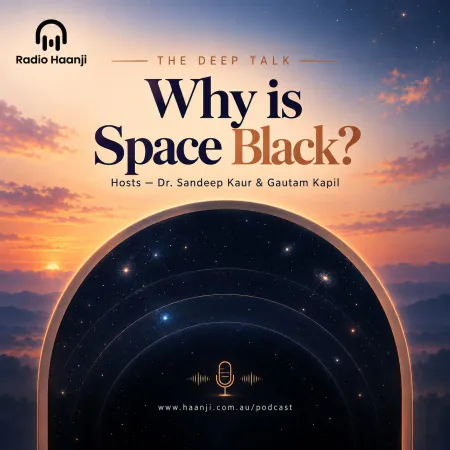

























































Why is Space Black? - Olbers' Paradox Explained - Dr. Sandeep Kaur - Gautam Kapil
Host:-
 Dr. Sandeep Kaur
 Gautam Kapil
Discover why the night sky is dark and why stars twinkle. Explore Olbers' Paradox and cosmic science with Radio Haanji's The Deep Talk Show. Listen now.
Looking up at the clear night sky is one of the most profound, universally shared human experiences. It connects us across generations, inspiring a quiet sense of wonder about our place within the vastness of the cosmos. Yet, this shared emotional bonding over stargazing often leads to a perplexing question: if the universe is infinite and filled with countless stars, why does the sky go dark at all?
On a recent broadcast of Radio Haanji 1674 AM, The Deep Talk Show host Gautam Kapil sat down with Dr. Sandeep Kaur to explore this very mystery. Rather than accepting the simple notion that the sky goes dark just because the Sun sets, their conversation delved into the profound science of Olbers' paradox explained in everyday terms. Through an engaging exploration of atmospheric distortion, human observation limits, and cosmic expansion, the episode sheds light on why we see the universe the way we do, transforming a simple glance at the heavens into a deeply connected journey through space and time.
Where to Listen
Join host Gautam Kapil and Dr. Sandeep Kaur for this fascinating exploration of the cosmos on The Deep Talk Show, broadcast on Radio Haanji 1674 AM. You can stream the full conversation and explore more episodes through the platforms below.
-
Spotify: https://open.spotify.com/show/5fhykpM6TPzerC2Yr2J1eQ
-
Apple Podcasts: https://podcasts.apple.com/at/podcast/radio-haanji-podcast/id1687047958?l=en-GB
-
Radio Haanji App: https://haanji.com.au/download-our-app
Episode Highlights
The Mystery of the Dark Sky The episode moves beyond the basic understanding of day and night to address a historical cosmic puzzle. Even though the universe contains billions and trillions of stars and galaxies, their collective light does not illuminate our night sky. The discussion unpacks Olbers' Paradox, a concept named after Heinrich Wilhelm Olbers in 1823, which fundamentally questions the absence of a uniformly glowing night sky.
Expanding Distances and Invisible Light Dr. Sandeep Kaur highlights that the universe is in a state of continuous expansion, creating immense distances between celestial bodies. Much of space remains an empty vacuum, meaning the light from the farthest stars either hasn't had the time to reach us or has diminished completely. Furthermore, human vision is restricted to the visible spectrum of rainbow colors, rendering the vast majority of cosmic radiation—such as microwaves—completely invisible to us.
The Reality of Space Visibility The conversation shifts to the stark realities of space conditions and visibility. Because space lacks a dense atmosphere to scatter light photons, the environment appears completely black to astronauts and lunar observers, regardless of whether the Sun is shining. To bypass human limitations and capture this hidden light, scientists rely on advanced instruments like the James Webb space telescope and Hubble, which are designed to detect infrared and microwave frequencies.
Atmospheric Turbulence and Twinkling Addressing another shared childhood curiosity, the episode clarifies that stars shine with a steady light and do not actually flicker. The twinkling effect is purely an optical illusion caused by Earth's turbulent atmosphere. As starlight travels through shifting temperatures, dust particles, and air currents, it refracts in zig-zag paths, making the star appear to shift in brightness and position.
Why is the night sky dark despite billions of stars?
The night sky appears dark due to the vast, expanding nature of the universe and the limits of human vision. Because cosmic distances are so immense, much of the starlight hasn't reached Earth. Furthermore, most cosmic light exists as invisible microwave radiation, leaving the sky looking black to our naked eyes.
This phenomenon is famously known as Olbers' Paradox. When we stand outside and look up, it feels intuitive that a sky packed with trillions of stars should glow brilliantly. However, the universe is continuously expanding, stretching the light from distant galaxies as it travels toward us. By the time this light arrives, it has lost significant energy and shifted out of the visible spectrum.
Because human eyes evolved to process only a very narrow band of light—the seven colors of the rainbow—we simply cannot perceive the ambient energy that fills the cosmos. If our eyes were tuned to see microwave radiation, the night sky would actually appear to glow. It is a humbling reminder that our connection to the universe is filtered entirely through our physical limitations.
Why do stars twinkle while planets do not?
Stars twinkle because their steady light must travel through Earth's turbulent atmosphere. As this light encounters shifting temperatures and air currents, it refracts in zig-zag paths, causing a flickering effect. Planets, being much closer, appear as larger disks of light that are less disrupted by this atmospheric interference.
The romanticized flickering of stars is entirely an Earth-bound illusion. Before starlight reaches our eyes, it must pass through layers of atmospheric gases, wind, and dust. This journey acts like a moving lens, constantly bending the incoming photons and causing the star's apparent brightness and position to shift rapidly.
Planets in our own solar system are significantly closer to us than distant stars. Because of this proximity, their light reaches Earth in a thicker beam, forming a small disk rather than a single pinpoint. This broader stream of light is much more resilient to atmospheric disruption, which is why planets shine with a steady, unblinking glow and are frequently the first bright objects we can spot at dusk. To entirely escape this atmospheric zig-zag, astronomers must position large telescopes on high mountain peaks or launch them directly into space.
Why does space look black to astronauts?
Space looks completely black to astronauts because it lacks a dense atmosphere. On Earth, our atmosphere contains particles that scatter sunlight, creating a bright daytime sky. In the vacuum of space, there are no particles to scatter the photons, resulting in a pitch-black background even when illuminated by the Sun.
When we experience a bright blue day on Earth, we are actually witnessing the interaction between sunlight and our atmosphere. As light hits the atmospheric gases, it scatters in all directions, filling the sky with color. Space, however, is mostly a vacuum. Without matter to interrupt and bounce the light around, the light travels straight through without illuminating the surrounding area.
This creates a highly disorienting visual experience for astronauts on spacewalks or standing on the Moon. They can see the Sun and the brilliantly lit surface of their spacecraft, but the backdrop remains an absolute, pitch-black void. It requires specialized tools like space telescopes to "see" the non-visible wavelengths that permeate this darkness.
Key Takeaways
-
The night sky is dark because the universe is expanding, and light from distant stars has not yet reached Earth or has diminished over vast distances.
-
Human vision is limited to the visible spectrum, meaning we cannot see the microwave radiation that makes up most of the cosmic background light.
-
Space appears pitch black to astronauts because there is no dense atmosphere or particles to scatter light.
-
Stars do not actually flicker; the twinkling effect is caused by Earth's turbulent atmosphere bending the light in zig-zag paths.
-
Planets do not twinkle because their closer proximity to Earth allows their light to appear as a stable disk rather than a highly disrupted pinpoint.
-
With the naked eye from a single vantage point, humans can only see approximately 3,000 stars at any given moment.
References and Further Reading
-
Olbers' Paradox (Heinrich Wilhelm Olbers, 1823) — The foundational scientific principle questioning why the night sky is not uniformly bright.
-
Hubble and James Webb Space Telescopes — Discussed as the primary instruments used by astronomers to capture non-visible wavelengths like microwaves and infrared radiation.
Looking up at the stars is a beautiful reminder of our shared existence and the enduring mysteries that surround us. Understanding the science behind the darkness and the twinkling only deepens that bond, revealing a universe that is far more dynamic and complex than our eyes can perceive. To dive deeper into these cosmic wonders and hear the full engaging breakdown, be sure to listen to this complete episode of The Deep Talk Show on the Radio Haanji App, Spotify, or Apple Podcasts.
Frequently Asked Questions
What is Olbers' Paradox?
How many stars can you see with the naked eye?
Do stars actually flicker in space?
Why are planets visible at dusk without twinkling?
Can telescopes see light that humans cannot?
What's Your Reaction?