
























































































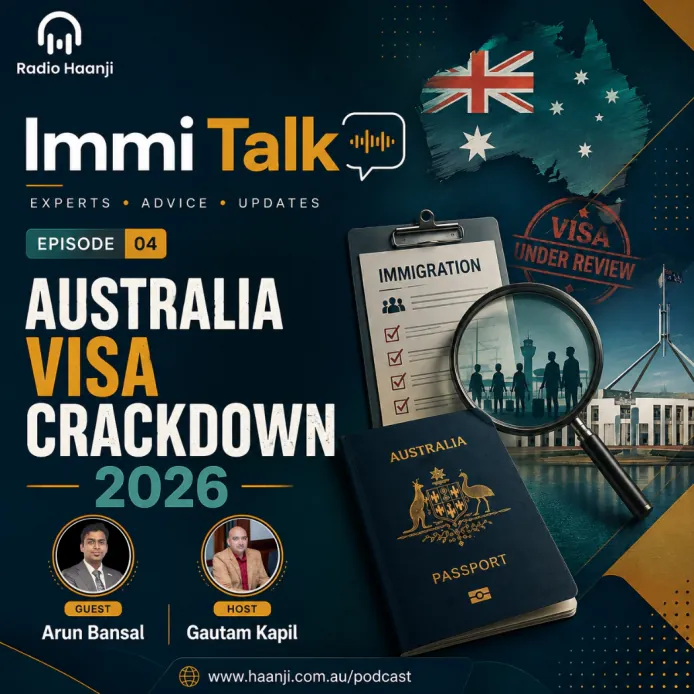
Australia Visa Crackdown 2026: What's Being Enforced - Immi Takk - Arun Bansal
Host:-
 Gautam Kapil
ABF penalties, a paused Working Holiday visa, and rising fees — Australia's immigration system is tightening enforcement in 2026. Here's what's at stake.
Australia's immigration debate keeps circling the same headline number — a target of roughly 225,000 net overseas migrants a year — while the more consequential story is happening away from the political stage. Enforcement agencies are actively pursuing fraudulent sponsorships, an entire visa program has been paused for record numbers of applicants, and assessment fees have jumped across the board.
Migration agent Arun Bansal returned to Radio Haanji's Immi Talk with host Gautam Kapil to unpack what's actually being enforced right now, as distinct from what's merely being proposed or debated. It's a useful distinction, because much of the public conversation focuses on migration targets that both major parties are contesting without, in Bansal's assessment, offering a fully worked-through plan for skill shortages or infrastructure capacity.
This article sets that political debate aside and focuses on what's concrete: Border Force penalties already being issued, a Working Holiday program already closed to new applicants from several countries, and fee and processing changes already in effect.
A System Under Enforcement, Not Just Under Debate
The net migration target of around 225,000 annually has become a political football, with parties competing over the number itself rather than the practicalities of delivering it. Bansal's view, shared on the program, is that this debate largely skips over the harder questions — which sectors actually face skill shortages, and whether infrastructure and housing can support any given target — leaving the number more useful as a talking point than as a policy framework.
While that debate continues without resolution, the operational side of the system has moved ahead regardless. Border Force enforcement, visa program pauses, and fee increases are already active, and they affect real applicants and businesses right now, independent of where the political target debate eventually lands.
Why Is Australia Cracking Down on Sponsored Visas?
Why is Australia cracking down on sponsored visas? The Australian Border Force is actively targeting fraudulent and paid employer-sponsored visa arrangements, particularly in aged care, automotive, and hospitality. Penalties include fines of up to $120,000 for non-compliant sponsoring businesses, sponsorship bans, and potential cancellation of both temporary and permanent visas obtained through non-genuine employment.
This isn't a minor compliance update — it represents a direct risk to visa holders who may not even be aware their sponsorship arrangement is considered non-genuine. A worker who paid for a sponsorship, believing it to be a legitimate pathway, can have their visa cancelled even if they personally did nothing fraudulent beyond entering into that arrangement.
For genuine employers, the practical takeaway is documentation. Sponsors in the flagged sectors should be prepared to demonstrate real operational need for the role, an authentic recruitment process, and employment terms that match what was represented in the nomination. Bansal's advice on the program was that businesses relying on informal or paid sponsorship arrangements should treat this as an active, not theoretical, enforcement risk
Is the Working Holiday Visa Still Open?
Is the Working Holiday visa still open for new applicants? Not for everyone. With more than 213,000 Working Holiday Maker (Subclass 462/417) visa holders already in Australia — a record high — applications from multiple countries have been paused or closed for the current program year. The ballot system remains active for India, China, and Vietnam, with Indonesia potentially joining that stream.
This is a significant shift for a program that many applicants have historically treated as reliably open. For applicants from paused countries, the practical options narrow considerably — either wait for the next program year's allocation to open, or explore an entirely different visa category suited to their circumstances.
For the countries still running a ballot, the lottery-style system means eligibility alone no longer guarantees an outcome. Applicants from India, China and Vietnam should treat a ballot entry as a chance-based process, not a formality, and plan a backup timeline in case the ballot doesn't come through in their preferred window.
Can You Use Visitor Visas Instead of a Parent Visa?
Authorities are tightening scrutiny on applicants who use repetitive visitor visas to achieve what amounts to de facto permanent residency in Australia, rather than applying through a formal long-stay option such as the Subclass 870 Parent Visa. This pattern — extended family stays stitched together through consecutive visitor visas — is increasingly being treated as a compliance concern rather than a workable long-term strategy.
Part of what makes this complicated for applicants is a genuine disparity in visitor visa grant lengths and conditions across different source countries, meaning two families in similar circumstances can face very different visitor visa terms depending on nationality. That inconsistency makes it harder for families to plan confidently around visitor visas as a long-term bridge.
The more durable approach, and the one Bansal pointed to on the program, is treating the Subclass 870 Parent Visa as the intended long-stay mechanism for parents rather than relying on repeat visitor visa grants, particularly as scrutiny of that workaround continues to increase.
What's Changed With VETASSESS Fees and Processing Times?
VETASSESS skills assessment fees increased from September 9, with the Full Skills Assessment rising to $1,146, Priority Processing to $863, Post-485 Skills Assessment to $891, and Assessment Renewal to $495. For applicants budgeting a migration pathway over months or years, these increases add a meaningful cost that's easy to underestimate if working from older figures.
State nomination processing shows a similar pattern of uneven movement. Tasmania and the Northern Territory are leading the new financial year, opening nomination allocations and actively working through backlogs across Subclass 190 and 491, while several other states remain delayed in opening their own programs.
Processing delays are also increasing for the Subclass 407 Training visa, particularly where sponsoring businesses fail to meet turnover or financial viability thresholds, or lack a sufficiently robust training plan. Where a 407 application is refused, employers have the option to appeal to the Administrative Review Tribunal, but doing so correctly — with a proper supporting cover letter — is what preserves the applicant's review rights, making early legal guidance important rather than optional.
Employer-sponsored permanent visa processing under Subclass 186 reflects the same prioritisation seen elsewhere in the system: Tier 1 occupations in law enforcement and Tier 2 occupations in healthcare and construction are processed well ahead of general occupations such as cooks and hospitality workers, who now face substantially slower outcomes.
Key Takeaways
- The Australian Border Force is issuing fines of up to $120,000, sponsorship bans, and visa cancellations for fraudulent or paid employer-sponsored arrangements, particularly in aged care, automotive, and hospitality.
- Working Holiday Maker visa applications have been paused or closed for multiple countries after holder numbers exceeded 213,000, though a ballot system remains active for India, China, and Vietnam.
- Authorities are increasing scrutiny on families using repeated visitor visas instead of the formal Subclass 870 Parent Visa for long-stay arrangements.
- VETASSESS assessment fees rose from September 9, with the Full Skills Assessment now costing $1,146 and Priority Processing $863.
- Tasmania and the Northern Territory are ahead of other states in opening Subclass 190 and 491 nomination allocations for the new financial year.
- Subclass 186 processing now heavily favours law enforcement, healthcare, and construction occupations, leaving general roles like cooks and hospitality workers facing significantly longer waits.
Enforcement, not just eligibility, is now the story shaping Australia's immigration system in 2026, and understanding where the real risk sits — for sponsors, workers, and families alike — matters more than tracking the political target debate alone. If you're navigating a sponsorship, a Working Holiday application, or a parent visa decision right now, share this episode with anyone in your circle who needs the full picture, and catch the complete conversation between Gautam Kapil and Arun Bansal on Immi Talk.
Frequently Asked Questions
What happens if my employer's sponsorship is found to be non-genuine?
Which countries can still apply for the Working Holiday visa in Australia?
What happens if my Subclass 407 training visa is refused?
Why are visitor visa terms different depending on which country you're from?
Is a $120,000 fine the maximum penalty for a fraudulent sponsorship?
Are hospitality and cooking occupations still viable for Subclass 186 visas?
Should I still apply for a parent visa if visitor visas have worked for my family before?
What's Your Reaction?