









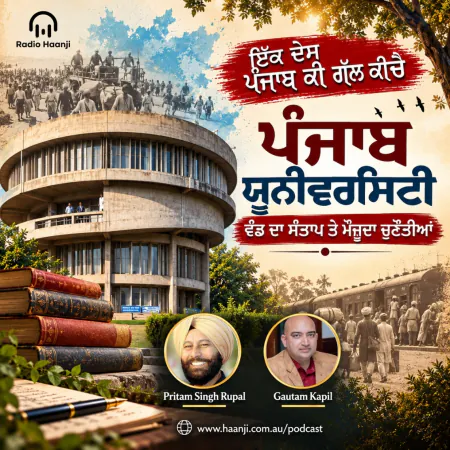


























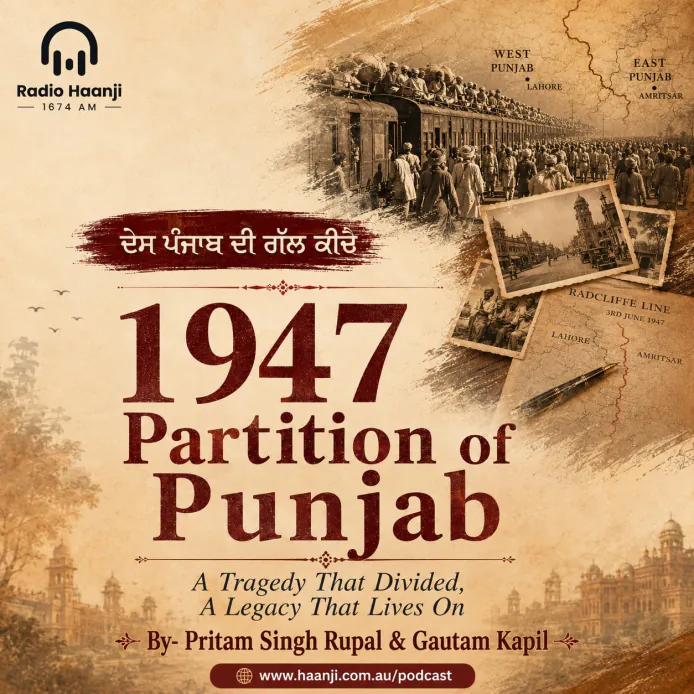
1947 Partition of Punjab - Des Punjab Ki Gal Kichai - Pritam Singh Rupal
Host:-
 Gautam Kapil
 Pritam Singh Rupal
Explore the human and cultural trauma of the 1947 Partition of Punjab as discussed by Pritam Singh Rupal and Gautam Kapil on Des Punjab Ki Gal Kichai.
Every year as August arrives, national independence celebrations dominate public discourse across South Asia. Yet, beneath the patriotic anthems lies an enduring generational trauma that refuses to fade. In an insightful episode of Des Punjab Ki Gal Kichai, hosts Pritam Singh Rupal and Gautam Kapil revisit the profound rupture of August 1947. For the land of the five rivers, it was not merely a transition of political power; it was the tearing apart of families, the erasure of centuries of syncretic culture, and the infliction of deep scars that continue to shape regional identity, literature, and cross-border relations.
A Man-Made Catastrophe Beyond Natural Calamity
Human history has witnessed countless migrations driven by floods, earthquakes, famines, and natural disasters. However, as highlighted in Des Punjab Ki Gal Kichai, the tragedy of 1947 stands apart as a deliberate, engineered political catastrophe. The drawing of the Radcliffe Line was carried out with clinical indifference to centuries-old human relationships, shared language, folklore, and neighborhood bonds.
Within weeks, tranquil villages and bustling cities turned into zones of hostility. Over one million lives were lost in the communal frenzy, and nearly fifteen million people found themselves uprooted, turning overnight into refugees in their ancestral homeland.
The Severing of a Shared Cultural Fabric
The division of Punjab went far beyond geopolitical boundary lines. Hosts Pritam Singh Rupal and Gautam Kapiloutline how it created an artificial divide across a deeply unified cultural ecosystem:
-
Separation of Cultural Hubs: Historic twin centers of Punjabi intellectual and artistic life—such as Lahore and Amritsar—were suddenly positioned on opposite sides of a heavily militarized border.
-
Loss of Sacred and Historic Heritage: East Punjab was cut off from vital religious and historical touchstones, including Sri Nankana Sahib, the administrative seats of Maharaja Ranjit Singh’s empire, and key institutions built by visionaries like Sir Ganga Ram and Dyal Singh Majithia.
-
Economic Dislocation: The division disrupted agrarian systems, trade channels, and canal irrigation networks, wiping out nearly 40 percent of the region’s traditional land revenue base.
Brutality and the Quiet Heroism of Humanity
While historical records document the unfathomable violence, targeted attacks on refugee caravans, and systemic assaults on women, another parallel truth often gets overshadowed: the quiet acts of human solidarity. Amid the communal madness, ordinary men and women risked their lives to shelter, hide, and guide their neighbors across newly erected borders.
These stories of empathy reveal that the common people were not natural enemies; rather, they were swept into a political storm engineered far above their daily lives.
Literary Echoes of a Fractured Land
The collective pain of Partition gave rise to South Asia’s most poignant literature. Writers and poets turned their grief into words that continue to resonate:
-
Amrita Pritam’s Pinjar and her haunting ode to Waris Shah captured the deep violation and silent suffering of women.
-
Khushwant Singh’s Train to Pakistan laid bare the sudden destruction of rural camaraderie.
-
Bhisham Sahni’s Tamas explored the calculated orchestration of communal hatred.
These works serve as eternal reminders that while political maps can be redrawn overnight, the emotional memory of a shared heritage cannot be erased by bureaucratic fiat.
The Modern Need for Reflection and Healing
Decades later, the physical border remains rigid, with trade routes like Attari-Wagah frequently stalled and cultural exchange held hostage to diplomatic friction. A true tribute to those lost in 1947 requires moving past inherited animosities toward honest remembrance, human empathy, and cultural reconnection.
Frequently Asked Questions
What is the focus of this Des Punjab Ki Gal Kichai episode?
Who are the hosts of Des Punjab Ki Gal Kichai?
What was the direct human impact of the 1947 Partition on Punjab?
How did the Radcliffe Line affect Punjab's shared heritage?
Why was the 1947 Partition described as a man-made tragedy rather than a natural disaster?
What was the economic impact of the Partition on East Punjab?
Were there alternative political proposals to avoid the division of Punjab?
How did ordinary citizens show humanity during the Partition riots?
How does the legacy of the 1947 Partition continue to impact modern Punjab?
Which literary works best capture the trauma of the Punjab Partition?
What's Your Reaction?