



















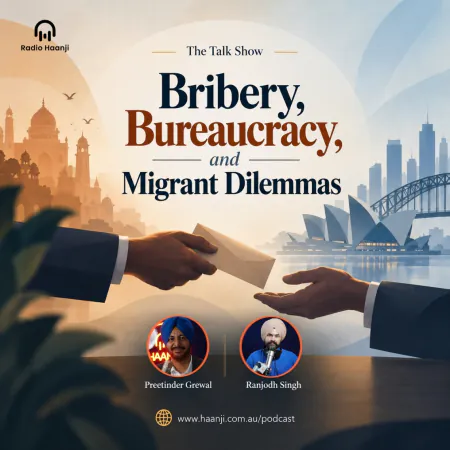




































































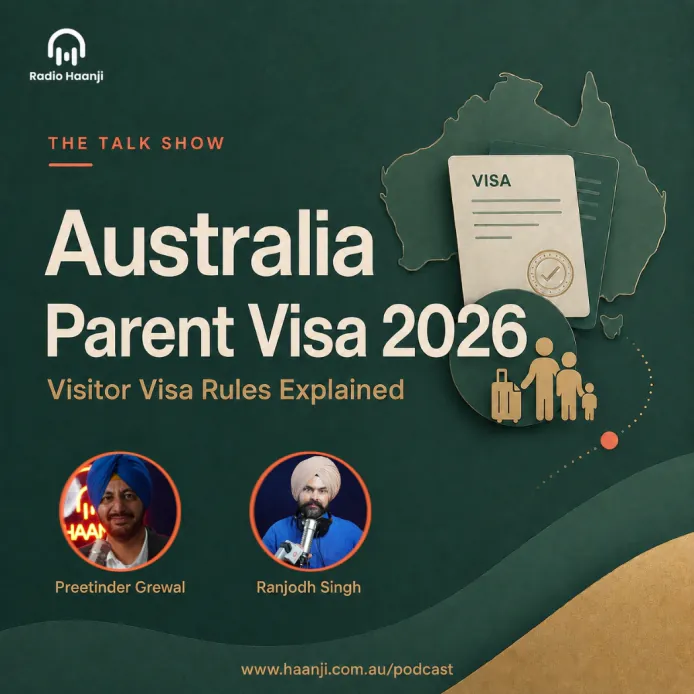
Australia Parent Visa 2026: Visitor Visa Rules Explained - The Talk Show - Preetinder Grewal - Ranjodh Singh
Host:-
 Preetinder Grewal
 Ranjodh Singh
Australia's parent and visitor visa rules are tightening in 2026. Understand Subclass 804, 870, and Condition 8503 before you apply.
Podcast - The Talk Show Host - Preetinder Pal Singh (MARA - 2418381) & Ranjodh Singh Presented By- Radio Haanji
A parent visa application in Australia is no longer just a paperwork exercise, it is increasingly a test of patience, evidence, and timing. Families sponsoring a parent are now facing a tighter visitor visa system, an onshore parent visa queue that can outlast a working career, and an offshore pathway that demands its own upfront approval. If you are trying to bring a parent to Australia in 2026, understanding how these three pieces fit together matters more than ever.
This shift has been building for a while, but it is now visible in the details: shorter visitor visa grants, more rejections, and processing estimates for the onshore parent visa stretching past three decades. None of this means the pathway is closed, but it does mean applicants need a clearer strategy and stronger evidence than in previous years.
Why Parent Visitor Visas Are Facing Tighter Scrutiny
Parent visitor visa applications are being assessed more strictly than in previous years. Case officers are looking closely at whether a visit is genuinely temporary, and a growing number of applications are either being rejected outright or granted for a much shorter period than requested, often between three and six months instead of the longer stays families have come to expect.
Where a visitor visa is approved, it is increasingly coming with Condition 8503 attached, a restriction that changes what the visa holder can do next. This tightening reflects a broader concern within the Department of Home Affairs that visitor visas are, in some cases, being used as an informal substitute for long-term caregiving or childcare arrangements rather than genuine short visits.
What Is Condition 8503 on a Visitor Visa?
Condition 8503, known as the "no further stay" condition, prevents a visitor visa holder from applying for most other visas while remaining in Australia. If it is attached to a parent's visitor visa, they generally must leave the country before lodging or being granted a subsequent visa, rather than transitioning while still with their family.
For many families, this condition is the single biggest disruption to their plans. A parent who arrives expecting to eventually apply for a longer-term visa from within Australia may instead need to fly home first, adding cost, delay, and uncertainty to what was meant to be a straightforward extension of their stay. Waivers exist in limited circumstances, such as unforeseen compelling and compassionate reasons, but they are not granted routinely and should not be relied upon as a backup plan.
How Long Does the Parent Visa Subclass 804 Take to Process?
The onshore Aged Parent visa (Subclass 804) currently carries an estimated processing time of 30 or more years due to a combination of a capped annual allocation and a backlog of applicants already in the queue. This makes it one of the slowest visa pathways in the Australian migration system.
The 804 is a non-contributory pathway, meaning it does not require the higher contributory fees, which is exactly why demand for it far outweighs the places available each year. Applicants lodge while onshore and then wait, in many cases, for the better part of a lifetime before a decision is reached. It remains a legitimate application to lodge, particularly to secure a place in the queue and access to a bridging visa, but it should not be treated as a realistic near-term solution for a family wanting a parent to live with them soon.
Understanding the Bridging Visa A While You Wait
One practical advantage of lodging a Subclass 804 application is that it typically allows the applicant to be granted a Bridging Visa A, which lets them remain lawfully in Australia while their parent visa application is processed. This does not fast-track the outcome, but it does provide legal status during what can be an exceptionally long wait.
A Bridging Visa A generally carries its own conditions, and holders should check their specific work and travel rights carefully, since these can differ from the visa they held immediately beforehand. It is also worth noting that leaving Australia while on a Bridging Visa A can affect the applicant's ability to re-enter under that same bridging arrangement, so travel plans need to be considered carefully alongside the visa conditions.
Can You Apply for the Sponsored Parent Visa 870 From Australia?
No, the Sponsored Parent (Temporary) visa, Subclass 870, cannot be lodged from within Australia. It requires the sponsor's application to be approved first, and the parent must then lodge and be granted the visa from offshore before travelling to Australia under it.
Once approved, Subclass 870 offers a temporary stay of either three or five years, which is considerably faster than waiting for the Subclass 804 to be finalised. However, it comes with its own hurdles: the sponsoring child needs to meet an income threshold, the parent is not eligible for Medicare during their stay, and the visa does not lead directly to permanent residency. For families who need a parent in Australia sooner rather than decades from now, the 870 is often the more realistic option, provided the offshore lodgement requirement is planned for in advance.
Building a Stronger Application: Financial and Home Ties
Applicants relying on host sponsorship alone are increasingly finding that this is not enough to satisfy case officers. Stronger applications tend to include clear evidence of the applicant's financial position and their ongoing ties to their home country, submitted as part of the genuine temporary entrant considerations outlined in Form 600.211.
This can include proof of property ownership, bank statements, pension income, family responsibilities remaining in the home country, or evidence of an intention to return, such as return travel bookings or ongoing employment. The underlying principle case officers are assessing is whether the applicant has a genuine reason to leave Australia again, not just a genuine reason to visit. Applicants who rely solely on their sponsoring child's income and accommodation, without demonstrating their own independent ties, are more likely to face additional scrutiny or a shorter grant period.
Key Takeaways
- Parent visitor visas are increasingly granted for shorter periods of three to six months and are more likely to carry Condition 8503, restricting onshore transitions to other visas.
- The onshore Aged Parent visa (Subclass 804) has an estimated processing time of 30 or more years due to capped annual places against a large application backlog.
- Applicants for the Subclass 804 can generally hold a Bridging Visa A while their application is processed, providing lawful status during the wait.
- The Sponsored Parent (Temporary) visa, Subclass 870, must be lodged and approved from offshore and offers a three or five year stay once granted.
- Strong applications include independent evidence of financial standing and home country ties, in line with Form 600.211 genuine temporary entrant requirements, rather than relying solely on sponsorship.
References and Further Reading
Department of Home Affairs (Australia) — the official source for current visa subclass requirements, conditions, and processing time estimates for parent and visitor visas — https://immi.homeaffairs.gov.au
For continuing coverage of migration and community news relevant to Punjabi and Indian families in Australia, see Indian Updates and Today Updates from Radio Haanji.
Have any query? Feel free to ask Preetinder Pal Singh (MARA - 2418381)
Frequently Asked Questions
Is it still worth applying for the parent visa 804 given the long wait?
Can a parent switch from a visitor visa to a parent visa while in Australia?
What happens if a parent visitor visa is refused?
Does the sponsoring child need a minimum income for the parent visa 870?
Is private health insurance compulsory for parent visa holders?
What is the difference between the Subclass 804 and Subclass 870 visas?
Can a parent work in Australia on a visitor visa or the Subclass 870?
What's Your Reaction?