








































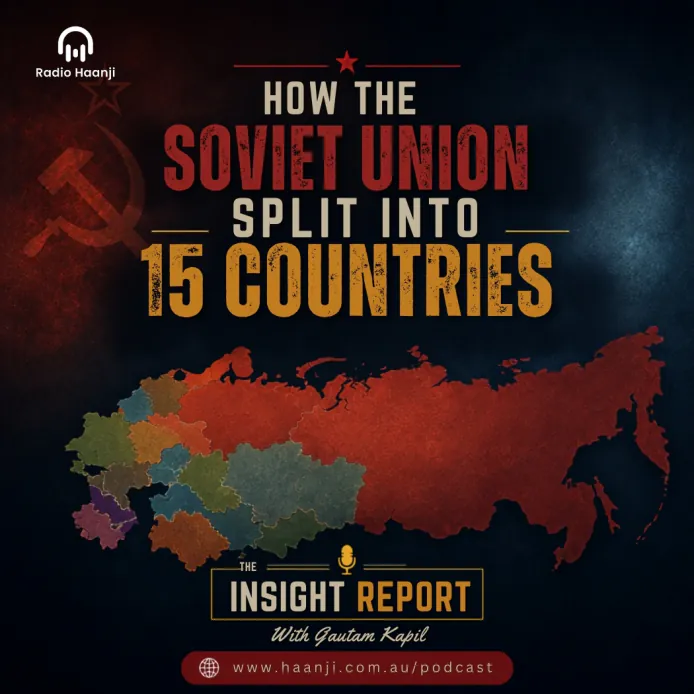
How the Soviet Union Split Into 15 Countries - The Insight Report By Gautam Kapil
Host:-
 Gautam Kapil
Discover how the USSR broke into 15 nations — from 1917 revolutions to Gorbachev's reforms and 1991 collapse. Read the full story.
Every year on August 24, Ukraine marks its Independence Day — a date that only exists because, three decades ago, a nation many assumed was permanent simply stopped existing. The Soviet Union, at its height, stretched across 15 republics and eleven time zones. By the end of 1991, it was gone, replaced by 15 separate countries drawing their own borders, printing their own currencies, and writing their own futures.
That collapse wasn't sudden. It was the product of seven decades of decisions — revolutions, wars, arms races, and reforms — each one narrowing the road until there was nowhere left to go. Understanding how the USSR broke apart means understanding how it was built, what it cost to hold together, and why the cracks, once they appeared, could not be sealed.
This piece walks through that full arc: from the 1917 revolutions that created the Soviet state, through the Cold War decades that drained it, to the reforms that were meant to save it and instead hastened its end.
Why Was the Soviet Union Formed in the First Place?
The Soviet Union was formed on December 30, 1922, after the Bolsheviks won a brutal civil war following the 1917 revolutions that toppled Tsar Nicholas II. It began as a union of four republics — Russian, Ukrainian, Belorussian, and Transcaucasian — later expanding to 15 under Joseph Stalin.
The road to that founding began in February 1917, when mounting war fatigue and economic hardship forced Tsar Nicholas II's abdication. Later that year, the October Revolution brought Vladimir Lenin and the Bolsheviks to power, promising land, peace, and bread to a population exhausted by World War I.
What followed was not immediate unity but a five-year civil war (1917–1922) between the Bolshevik Red Army, organized under Leon Trotsky, and the anti-communist White Army. The Bolsheviks' victory allowed them to formally establish the USSR at the end of 1922, though the young state's economy was in ruins.
Lenin's response was pragmatic rather than ideological: the New Economic Policy (NEP) reintroduced limited private trade to revive production, a compromise that kept the fragile union from collapsing in its first decade (Soviet economic archives). It was a reminder, early on, that the USSR's survival often depended on flexibility it wasn't always willing to repeat later.
How Did the Cold War Push the USSR to Its Limits?
The Cold War forced the USSR into a decades-long rivalry with the United States that drained its resources through military spending, proxy wars, and an unsustainable arms and space race, weakening the economy long before its political collapse.
Once World War II ended, the wartime alliance between the US and USSR unraveled almost immediately, splitting the world into two competing blocs — one capitalist, one socialist. This rivalry defined the second half of the 20th century and is also where much of today's political vocabulary, including "left-wing" and "right-wing," traces back to seating arrangements in the French Revolution, later adopted to describe this global divide.
The flashpoints came quickly and often: the Berlin Blockade of 1948–49, the Korean War, the Cuban Missile Crisis, and military interventions in Hungary in 1956 and Czechoslovakia in 1968 to suppress uprisings against Soviet control. Each crisis reinforced a pattern — the USSR would commit military and economic resources to protect its sphere of influence, whatever the cost.
Parallel to this was the space and arms race, from the launch of Sputnik and Yuri Gagarin's historic spaceflight to the eventual US Moon landing. These achievements projected Soviet strength, but the funding behind them came from an economy that could not sustain both a superpower's ambitions and its citizens' basic needs indefinitely.
The final and most costly overreach came with the Soviet–Afghan War (1979–1989), a decade-long conflict that became the USSR's equivalent of America's Vietnam. It drained military morale, funding, and public confidence simultaneously — a slow bleed the state could not fully recover from.
What Actually Caused the Soviet Union to Collapse?
The Soviet Union collapsed due to prolonged economic stagnation from excessive military spending, low foreign investment, and internal inefficiency, compounded by Mikhail Gorbachev's reforms, which unintentionally accelerated demands for independence across the republics.
By the early 1980s, the Soviet economy was buckling under its own weight. Decades of military expenditure aimed at matching the United States had crowded out investment in consumer goods, agriculture, and infrastructure. Central planning, meanwhile, struggled to adapt to a modernizing global economy that increasingly rewarded flexibility over control.
Foreign investment was minimal, largely due to Cold War isolation, and internal inefficiencies — from outdated factories to bureaucratic overreach — meant that even the resources the USSR did have were poorly used. This was not collapse from a single shock; it was structural fatigue built up over generations.
Into this weakened system stepped Mikhail Gorbachev, whose attempt to fix the economy through reform would end up doing the opposite of what he intended — not by failing outright, but by opening doors that could not be closed again.
Gorbachev's Gamble: Reform That Backfired
Gorbachev's twin policies, Glasnost (openness) and Perestroika (restructuring), were designed to modernize the Soviet system from within — allowing more honest public discourse and restructuring an economy that had grown rigid and unproductive. On paper, both were reasonable responses to genuine problems.
In practice, Glasnost gave citizens and republics newfound freedom to voice grievances that had been suppressed for decades — including long-standing resentment over centralized control from Moscow. Perestroika, meanwhile, loosened economic controls without fully replacing them with functioning market mechanisms, creating shortages and confusion rather than the intended revival.
The first cracks appeared in the Baltic states — Lithuania, Latvia, and Estonia — where independence movements gained momentum rapidly once the fear of harsh reprisal eased. Once these smaller republics demonstrated that defiance was survivable, the idea spread. Gorbachev had aimed to save the union by loosening its grip; instead, the loosened grip was what let the union slip away.
The Final Months: Coup, Collapse, and the Belovezha Accords
The Soviet Union's final dissolution came after a failed hardline coup against Gorbachev in August 1991, followed by the Belovezha Accords in December 1991, in which the leaders of Russia, Ukraine, and Belarus formally declared the USSR dissolved.
By August 1991, hardline Communist Party officials, alarmed by how far Gorbachev's reforms had gone, attempted a coup to seize control and reverse the changes. The coup collapsed within days, but the damage to central authority was irreversible — it had proven, publicly, that the old guard could no longer command the union it once ruled.
In the aftermath, Boris Yeltsin emerged as the dominant political figure in Russia, while independence movements across the remaining republics accelerated rapidly. By December, the question was no longer whether the union would survive, but how quickly it would formally end.
That answer came on December 8, 1991, when Yeltsin, alongside the leaders of Ukraine and Belarus, signed the Belovezha Accords, declaring the Soviet Union dissolved and establishing the Commonwealth of Independent States in its place. Gorbachev resigned as president on December 25, 1991, and the USSR ceased to exist as a legal entity the following day — a quiet, almost anticlimactic end to a state that had shaped world history for nearly seven decades.
Life After the Union: What Came Next
Boris Yeltsin became the first president of the newly independent Russian Federation, inheriting an economy in disarray and a political landscape with no modern precedent to guide it. His answer was rapid, aggressive economic liberalization — commonly known as "shock therapy."
The results were immediate and uneven. Rapid privatization created enormous opportunities for a small class of insiders, who became the powerful oligarchs that still shape Russian politics and business today. For most ordinary citizens, however, the transition brought inflation, unemployment, and instability.
This period also saw the eruption of internal conflicts, most notably in Chechnya, as regions tested the limits of the new Russian state's authority. Globally, the sudden vacuum left by the USSR's exit briefly positioned the United States as the world's sole superpower — a status that would itself be tested and reshaped in the decades that followed, right up to the ongoing tensions between Russia and Ukraine today.
Key Takeaways
- The Soviet Union was officially formed on December 30, 1922, beginning with four republics before expanding to 15 under Joseph Stalin.
- The Cold War rivalry with the United States, combined with costly interventions like the Soviet–Afghan War, steadily drained Soviet economic and military resources.
- Mikhail Gorbachev's reforms, Glasnost and Perestroika, were intended to modernize the USSR but instead accelerated independence movements starting in the Baltic states.
- A failed hardline coup in August 1991 permanently weakened central Soviet authority.
- The Belovezha Accords, signed by the leaders of Russia, Ukraine, and Belarus in December 1991, formally dissolved the Soviet Union.
- The USSR's collapse gave rise to 15 independent nations and reshaped global power for the following three decades.
References and Further Reading
- Office of the Historian, U.S. Department of State — Overview of Cold War diplomatic history and key flashpoints between the US and USSR.
- Encyclopaedia Britannica — Background on the 1917 Russian Revolutions and the formation of the Soviet Union.
- National Security Archive, George Washington University — Primary-source documentation on Gorbachev's reforms and the 1991 Soviet collapse.
History rarely ends with a single dramatic moment — more often, it's the slow accumulation of strain until the structure holding everything together simply gives way. The Soviet Union's story, from its founding in 1922 to its quiet dissolution in 1991, is a reminder of how quickly seven decades of power can unravel once the pressure finally exceeds what the system can bear. If this breakdown helped clarify how the USSR became 15 nations, share it with someone who's ever wondered the same thing, or explore more deep-dive history episodes from The Insight Report.
Frequently Asked Questions
Was Russia always the same as the Soviet Union?
Did any Soviet leader try to stop the union from breaking apart?
Why did the Baltic states leave the USSR first?
What is the Commonwealth of Independent States (CIS)?
How many of the 15 former Soviet republics are still politically aligned with Russia today?
Did the Soviet Union's collapse happen because the US "won" the Cold War?
What role did Ukraine specifically play in ending the USSR?
What's Your Reaction?