














































































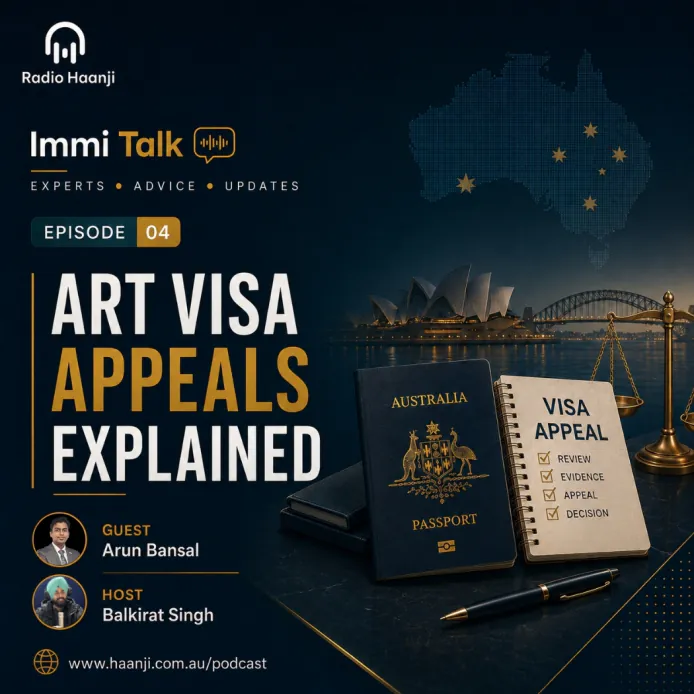

Migration expert Arun Bansal(MARN: 2418466) breaks down how Australia's Administrative Review Tribunal really works. Listen to the full Immi Talk episode
For thousands of people waiting on a visa decision across Australia, three letters have quietly replaced a name they'd grown used to hearing on the radio and in migration agents' offices: ART. In a recent episode of Immi Talk, broadcast on Radio Haanji 1674 AM, host Balkirat Aulakh sat down with migration expert Arun Bansal of Bansal Immigration Australia(MARN: 2418466) to walk listeners through exactly what the Administrative Review Tribunal is, how it replaced the Administrative Appeals Tribunal in October 2024, and — more importantly — what it actually feels like to have a case sitting in its system right now.
The conversation didn't stay theoretical for long. Bansal, who deals with ART matters regularly through his practice, used the segment to lay out the numbers that rarely make it into government explainer pages: the size of the current backlog, what an appeal really costs once fees and financial hardship provisions are factored in, and how long different visa categories are actually taking to resolve. For a caller weighing whether to lodge a review application, that kind of detail matters more than a definition ever could.
This recap draws directly from that on-air conversation, organised around the questions listeners most needed answered — not as a substitute for the interview, but as a companion to it for anyone who couldn't tune in live.
What Is the Administrative Review Tribunal?
The Administrative Review Tribunal is Australia's independent body for reviewing eligible Department of Home Affairs decisions, including visa refusals and cancellations, purely on their legal and evidentiary merits.
Bansal was direct about this point early in the interview: the ART does not weigh emotion, hardship stories or good intentions on their own. It looks at what the law says and what the evidence on file actually shows. That framing set the tone for the rest of the discussion, because it explained why so much of what followed — deadlines, documentation, hearing formats — comes back to the same principle of building a case on paper, not on persuasion.
Not every refused applicant automatically has the right to appeal. Aulakh pressed on this during the segment, and Bansal confirmed that review rights depend on factors including the visa subclass, the applicant's location at the time of refusal, and in some cases sponsorship arrangements. Anyone assuming they have an automatic right to a hearing, he noted, should check that assumption before they miss the window to act on it.
Deadlines came up as the single most unforgiving part of the process. Depending on the visa category, applicants typically have somewhere between 9 and 28 days to lodge their review application, and the Tribunal treats that window as fixed. Miss it, Bansal said plainly, and the application becomes invalid — there is no quiet extension for people who find out too late.
How Much Does It Cost to Appeal to the ART?
An ART application currently costs approximately $3,727 AUD, though a 50% fee reduction is available for applicants who can demonstrate genuine financial hardship, and bridging visa reviews linked to detention carry no fee at all.
That headline figure alone stopped the conversation for a moment on air, because it's a substantial outlay for anyone who has already spent money on their original visa application. Bansal explained that the Tribunal does build in flexibility for people who genuinely cannot afford the full amount, but the hardship reduction has to be demonstrated with evidence — it isn't granted simply because someone asks.
The refund mechanics matter just as much as the upfront cost. If a case is successful — meaning the original decision is set aside or remitted back to the Department — the applicant receives a 50% refund of the fee paid. If the appeal is unsuccessful, there is no refund at all. That structure, Bansal suggested, is worth factoring into the decision to appeal in the first place, particularly for cases with a weak evidentiary basis.
Detention-linked bridging visa matters are the one clear exception, with no application fee charged, reflecting the more urgent and often more vulnerable circumstances of those applicants.
How Long Does an ART Case Actually Take?
Roughly half of all ART matters are finalised within about 1.5 years, and 95% are resolved within 2 years and 10 months, though timeframes vary sharply by visa type, with bridging visa reviews often finishing in weeks and student or partner visa reviews sometimes running past three years.
The scale of the backlog is what gave this part of the interview its weight. Bansal cited more than 80,855 active migration cases sitting with the Tribunal, with over 47,000 new applications lodged and roughly 23,800 finalised in the period he referenced. Student visas make up the largest single share of that load — more than 67%, or over 54,000 pending cases — followed by skilled and investment visas at around 9,632, bridging and visitor visas at approximately 5,908, and family and partner visas at roughly 5,751.
Aulakh asked the obvious follow-up: why do some categories move so much faster than others? Bansal's answer came down to complexity and volume together. Bridging visa reviews, often tied to detention or urgent circumstances, get prioritised and can be resolved in as little as 12 days. Student and partner visa matters, by contrast, tend to involve more contested evidence and sit within a much larger queue, which is part of why waits stretching past three years aren't unusual for those categories.
What Happens at the Hearing?
The ART is deliberately less formal than a court. Hearings can be held in person, by phone or by video, qualified interpreters are available for non-English speakers, and some matters — particularly temporary and student visa cases — may now be decided entirely on written submissions without any oral hearing at all.
That last point was one Bansal flagged as a genuine shift from how the old AAT process felt to many applicants. A paper-based review means there is no chance to explain yourself verbally, correct a misunderstanding on the spot, or respond to a question in real time. Everything the Tribunal member sees has to already be in the file. For Bansal, that reinforces the same message he returned to throughout the interview: the strength of a case lives in its documentation, not in how well someone might perform in a hearing room.
When a decision is reached, the ART has four possible outcomes. It can affirm the original refusal, leaving it in place. It can set aside or vary the decision, effectively overturning it. It can remit the matter, sending it back to the Department with specific directions for reconsideration. Or it can dismiss the application outright, which typically happens when an applicant fails to appear or the matter falls outside the Tribunal's jurisdiction.
Can You Work or Study While Your Case Is Pending?
Lodging an ART application does not, on its own, grant any new work or study rights — whatever an applicant is permitted to do while waiting depends entirely on the conditions already attached to their active bridging visa, such as a Bridging Visa A.
This was one of the more practically urgent parts of the interview, because Bansal noted it's a common point of confusion. People sometimes assume that simply having a case before the Tribunal changes their status or unlocks new permissions. It doesn't. The bridging visa an applicant is holding at the time — and the conditions written into it from their original substantive visa application — is what governs their day-to-day rights while the review plays out, whether that's twelve days or three years.
For anyone unsure of their own bridging visa conditions, Bansal's advice on air was straightforward: check the visa grant notice directly rather than assume, since acting outside those conditions can create separate problems entirely unrelated to the ART case itself.
What Happens If the ART Affirms the Refusal?
If the Tribunal affirms a visa refusal, an applicant's remaining options generally include seeking judicial review through the Federal Court on legal or jurisdictional grounds, requesting ministerial intervention, or accepting the outcome and departing Australia voluntarily.
Bansal was careful to distinguish judicial review from the ART's own process. The Federal Court doesn't re-examine the merits of a case the way the Tribunal does — it looks only at whether a legal or jurisdictional error occurred, which is why this step almost always requires an immigration lawyer rather than a migration agent. Ministerial intervention, meanwhile, sits entirely outside any formal review structure and is granted at the Minister's discretion in exceptional circumstances, which Bansal described as a genuinely limited pathway rather than a fallback most applicants should expect to rely on.
The closing point he made on this topic doubled as the broader message of the whole interview: whichever path someone takes after an ART decision, the same rule applies as it did at the very start of the process. Outcomes are built on documented, verifiable evidence — not on how compelling or emotional the applicant's personal story is when told out loud.
Key Takeaways
- The Administrative Review Tribunal replaced the Administrative Appeals Tribunal in October 2024 and reviews Department of Home Affairs visa refusals and cancellations strictly on legal and evidentiary merit.
- Review application deadlines typically range from 9 to 28 days depending on visa category, and missing this window renders the application invalid.
- The standard ART application fee is approximately $3,727 AUD, with a 50% hardship reduction available and no fee for detention-related bridging visa reviews.
- More than 80,855 migration cases are currently active with the Tribunal, and student visa matters account for over 67% of that caseload.
- Around half of all cases are finalised within 1.5 years, while 95% are resolved within just under three years, with bridging visa reviews typically the fastest category.
- Lodging an ART application does not itself grant new work or study rights; those depend entirely on the applicant's existing bridging visa conditions.
References and Further Reading
- Administrative Review Tribunal (art.gov.au) — the Tribunal's official website, covering current fees, case guidance and how to apply for review — https://www.art.gov.au/
- Attorney-General's Department — background on the transition from the Administrative Appeals Tribunal to the Administrative Review Tribunal in October 2024 — https://www.ag.gov.au/legal-system/new-system-federal-administrative-review
If there's one thing this Immi Talk conversation made clear, it's that the Administrative Review Tribunal rewards preparation far more than it rewards persistence alone. Arun Bansal's closing message to listeners was simple: get your evidence right, respect the deadlines, and treat the process as the legal mechanism it is rather than a chance to be heard emotionally. If you found this recap useful, catch the full episode of Immi Talk on Radio Haanji 1674 AM, and share it with anyone you know currently waiting on a visa review — it might save them a costly mistake.
Frequently Asked Questions
Is the Administrative Review Tribunal the same as a court?
Do I need a migration agent or lawyer to apply to the ART?
What is the difference between "set aside" and "remit" as ART outcomes?
Why do student visa cases take longer at the ART?
Can I request my ART hearing be conducted in a language other than English?
What happens if I miss my ART application deadline?
Does applying to the ART pause any removal or departure obligations?
What's Your Reaction?







Related Posts