


























































































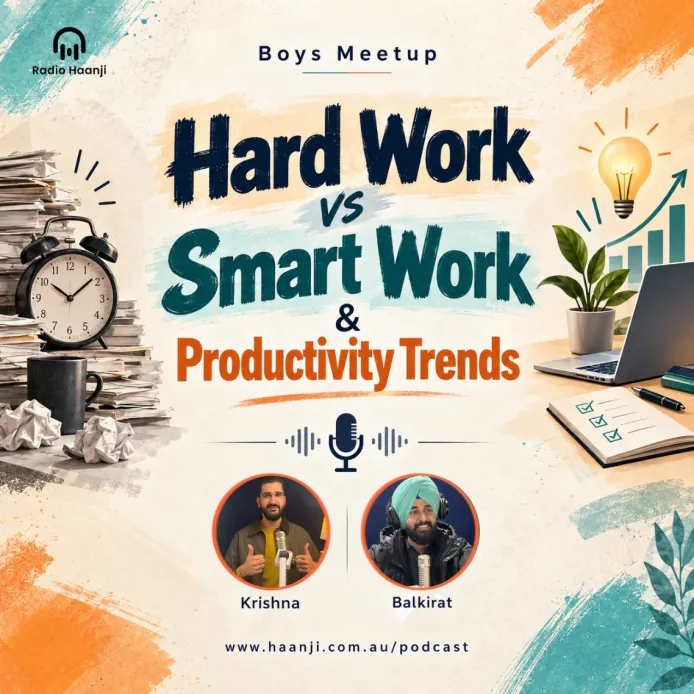
Hard Work vs Smart Work & Productivity Trends - Boys Meetup - Krishan & Balkirat
Host:-
 Balkirat Singh
 Krishna Bhardwaj
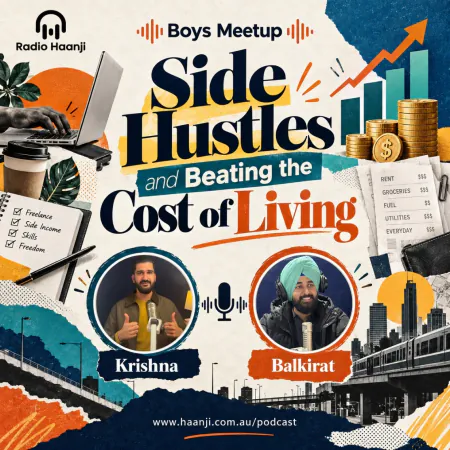
Krishna and Balkirat unpack hard work vs smart work using real data and sports psychology. Listen to the full Boys Meetup episode now.
You've probably had days where you were at your desk for eight hours straight and still felt like you got nothing done. That's not a discipline problem. According to the hosts of Boys Meetup, it's a focus problem — and the data backs them up. Pure, high-intensity concentration tends to last only about an hour to ninety minutes across an entire workday, no matter how long you're clocked in for.
In a recent episode, hosts Krishna and Balkirat pulled apart the hard work vs smart work debate using something most productivity content skips entirely: real numbers. Australian Bureau of Statistics data, sports performance psychology, and a handful of well-known self-help frameworks all get stitched together into one argument — that presence at a desk and actual output are two very different things.
This piece walks through what they covered, why it holds up, and how to actually use it.
Where to Listen
Boys Meetup, hosted by Krishna and Balkirat, airs on Radio Haanji 1674 AM. This episode digs into the hard work vs smart work debate, impostor syndrome, and the psychology of peak performance.
Catch the full episode here:
Episode Highlights
Hard Work vs. Smart Work & Productivity Trends Krishna and Balkirat open by challenging the idea that time spent equals value produced. They point to the reality that peak, high-intensity focus realistically fills only an hour to ninety minutes of a typical eight-hour day — the rest is often maintenance, distraction, or low-value busywork. They back this up with Australian workforce data: average working hours have climbed from roughly 35 to 40 hours per week, yet overall productivity has slipped by about 6% (Australian Bureau of Statistics). The takeaway isn't to work less for its own sake — it's that smart work depends on prioritisation, delegation, and using modern tools deliberately, rather than just grinding longer.
Mindset & Psychological Barriers The conversation shifts to what actually stops people from working smart even when they know better. Impostor syndrome comes up first — the guilt and self-doubt that creep in after success, where people quietly believe they don't deserve what they've achieved or that it came down to luck. Closely tied to this is tall poppy syndrome, which the hosts discuss using studies and job portal analysis from SEEK: the tendency for peers to criticise or undercut colleagues who visibly put in extra effort or stand out.
High-Leverage Focus, Explained Through Sport This is where the episode gets its sharpest angle. Krishna and Balkirat use Roger Federer's win-loss data as a case study: even at his peak, Federer wins only around 54% of total points played in a match — success comes down to how he performs in the handful of points that actually decide the outcome. They extend this to football, noting players like Messi and Ronaldo are in direct contact with the ball for only a few minutes across a 90-minute match, and to cricket, where unorthodox batters like AB de Villiers and Suryakumar Yadav succeed by pre-planning around their own strengths rather than playing textbook cricket.
Key Self-Help Frameworks Discussed The hosts close by tying the conversation to three well-known frameworks: The Compound Effect, which argues small consistent actions build exponentially over time; Atomic Habits, which focuses on shedding negative habits and improving by 1% daily; and the 80/20 Rule (Pareto Principle), which the hosts frame as identifying the single hardest, most uncomfortable task and putting 80% of your energy there first.
Why Does Working More Hours Reduce Productivity?
Direct answer: Working more hours doesn't automatically increase output because focus is a limited resource, not a scalable one. Australian workforce data shows average hours rose from about 35 to 40 per week while overall productivity fell by roughly 6% (ABS), showing that extra time often gets filled with lower-value work rather than genuine output.
This isn't just an Australian phenomenon — it's a pattern that shows up whenever "time at work" gets treated as a proxy for "value produced." The two aren't the same thing, and conflating them is exactly what Krishna and Balkirat push back against in the episode.
Part of the problem is that longer hours tend to dilute focus rather than extend it. If genuine high-intensity concentration only lasts an hour or two a day regardless of how long you're working, then adding more hours just adds more low-intensity time — meetings, admin, half-focused multitasking — without adding more of the output that actually moves things forward.
The fix the hosts land on isn't "work less and hope for the best." It's being deliberate about where your limited focus goes: clear prioritisation, delegating what doesn't need your specific attention, and using tools that remove friction rather than add to your task list.
What Is Tall Poppy Syndrome and Why Does It Hold People Back?
Direct answer: Tall poppy syndrome is the social tendency to criticise or undermine people who stand out through visible success or extra effort, particularly in the workplace. Referencing SEEK job portal analysis, the hosts note it discourages people from doing more than the bare minimum, since going above and beyond can invite resentment rather than recognition.
This connects directly to impostor syndrome, even though the two work in opposite directions. Impostor syndrome is internal — the nagging sense that your own success is undeserved or accidental. Tall poppy syndrome is external — other people actively discouraging you from standing out in the first place. Together, they create a kind of pincer effect: self-doubt on one side, social pushback on the other.
For anyone trying to apply smart work principles, this matters more than it might seem. Prioritising your highest-leverage tasks and cutting the rest often makes your output more visible, not less — and visibility is exactly what triggers tall poppy dynamics in a workplace that isn't used to it. Recognising this pattern doesn't remove it, but it does mean you're less likely to mistake social friction for evidence you're doing something wrong.
What Can Athletes Teach Us About High-Leverage Focus?
Direct answer: Elite athletes succeed not by maximising effort across every moment, but by concentrating their best performance into the few moments that decide the outcome. Roger Federer wins only around 54% of total points played across his career, illustrating that sustained, even performance matters less than delivering peak intensity when it counts most.
Federer's number is almost uncomfortable if you sit with it — a player widely considered one of the greatest of all time barely wins more points than he loses. What separates him isn't a higher baseline of effort across every point; it's an ability to elevate specifically during break points, tiebreaks, and the moments that decide sets.
Football and cricket reinforce the same idea from different angles. Messi and Ronaldo, despite being the most influential players on the pitch, are in physical contact with the ball for only a few minutes across a 90-minute match — their value comes from positioning, decision-making, and timing, not constant activity. Cricket's unorthodox batters, like AB de Villiers and Suryakumar Yadav, take this further by refusing to play by the coaching manual at all, instead pre-planning around their own specific strengths against the field they're facing.
The parallel to work is direct: showing up and grinding through every hour isn't what separates high performers. It's knowing which moments actually matter and making sure your best focus is there when it counts.
The Frameworks That Actually Make Smart Work Work
The episode doesn't leave "work smart" as a vague slogan — it grounds it in three specific frameworks. The Compound Effect argues that small, unremarkable actions repeated consistently produce outsized results over time, precisely because the effects stack rather than stay flat.
Atomic Habits takes a similar long-view but focuses on subtraction as much as addition: letting go of habits that quietly undermine your goals while aiming for something as modest as 1% improvement a day. The 1% framing matters because it's realistic — nobody sustains dramatic daily overhauls, but small, repeatable gains are far easier to actually stick with.
The 80/20 Rule, or Pareto Principle, is where the hosts get most practical. Their framing isn't the usual "80% of results come from 20% of effort" abstraction — it's a directive to identify the single hardest, most uncomfortable priority task on your list and commit 80% of your energy to solving it before touching anything easier. That ordering matters: tackling the hard thing first, while your focus is freshest, is a very different strategy than saving it for last.
Key Takeaways
- Peak, high-intensity focus realistically lasts only about 1 to 1.5 hours within an 8-hour workday, meaning presence at work does not equal productivity.
- Australian workforce data shows working hours rose from roughly 35 to 40 hours per week while productivity fell by approximately 6% (Australian Bureau of Statistics).
- Tall poppy syndrome, documented through SEEK job portal analysis, describes the social tendency to criticise colleagues who stand out or make visible extra effort.
- Roger Federer's career point-win rate of around 54% illustrates that elite performance depends on peak focus during decisive moments, not constant maximum effort.
- The 80/20 Rule, as discussed on the episode, means dedicating 80% of your energy to the single hardest priority task before addressing secondary work.
- Frameworks like The Compound Effect and Atomic Habits both argue that small, consistent actions compound into significant results over time.
Krishna and Balkirat make a case that's easy to agree with in theory but harder to actually live by: that grinding longer isn't the same as producing more. Between the ABS numbers, the SEEK research, and Federer's 54%, this episode gives you more than a slogan — it gives you a reason to actually rethink where your energy goes tomorrow morning. Listen to the full episode of Boys Meetup on Radio Haanji 1674 AM or your preferred platform, and if this reframes how you think about your own workday, share it with someone who needs to hear it too.
Frequently Asked Questions
Is working smart really better than working hard?
How can I tell if I have impostor syndrome or tall poppy syndrome affecting me?
What's a simple way to start applying the 80/20 rule at work?
Do successful people actually only focus a few hours a day?
Why do athletes make good examples for workplace productivity?
What is the Compound Effect and how is it different from Atomic Habits?
Can tall poppy syndrome actually damage a company's productivity?
What's Your Reaction?







Related Posts