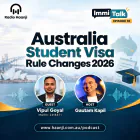






































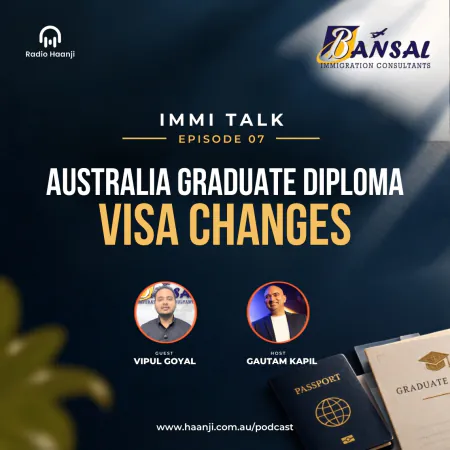












































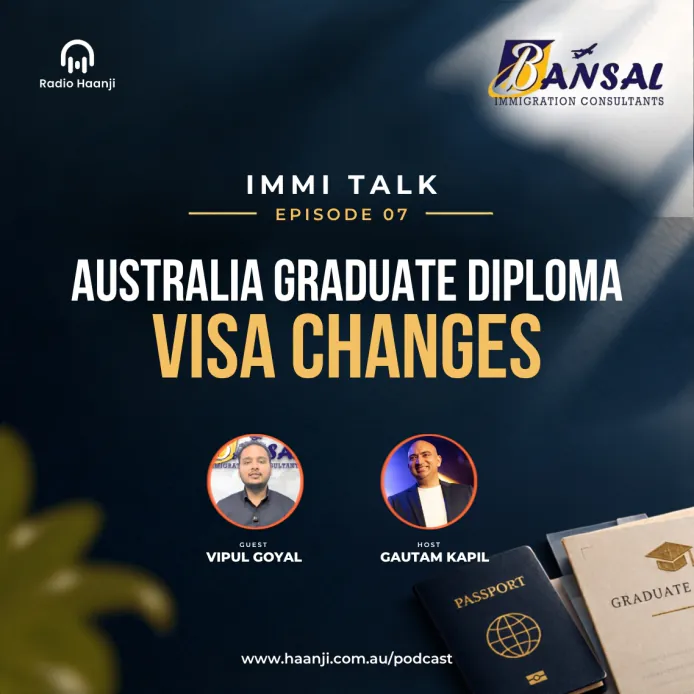
Australia Graduate Diploma Visa Changes - Immi Talk - Vipul Goyal - Gautam Kapil
Host:-
 Gautam Kapil
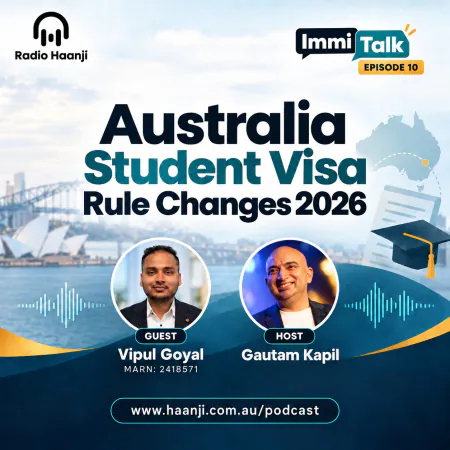
Learn how Australia graduate diploma visa changes affect CoEs and visas from Registered Migration Agent Vipul Goyal (MARN: 2418571). Listen now.
International students across Australia are facing significant administrative adjustments following federal policy interventions that reshape academic course transfers. On Episode 7 of Immi Talk, broadcast on Radio Haanji 1674 AM, host Gautam Kapil sat down with Registered Migration Agent Vipul Goyal (MARN: 2418571) from Bansal Immigration to unpack the australia graduate diploma visa changes and their immediate legal implications. In accordance with Australian law, immigration advice must be delivered by registered practitioners bound by statutory consumer protection standards, ensuring that prospective migrants receive accurate, authorized guidance.
The broadcast examined regulatory moves to stop international students from downgrading from higher education qualifications into vocational Graduate Diplomas. These shifts have triggered automated cancellations in the Department of Home Affairs' Provider Registration and International Student Management System (PRISMS), creating immediate compliance hurdles under Student Visa (Subclass 500) condition 8202.
Beyond international education reforms, the episode provided a grounded assessment of Australia's broader immigration landscape. Goyal detailed current operational timelines across General Skilled Migration (GSM) streams, multi-year backlogs in offshore partner processing, and tightening duration limits on visitor visas issued to elderly parents.
Where to Listen
Stream Episode 7 of Immi Talk featuring host Gautam Kapil and Registered Migration Agent Vipul Goyal (MARN: 2418571) across verified broadcast channels:
-
Listen on Spotify
-
Listen on Apple Podcasts
-
Stream live and on-demand via the Radio Haanji App
Episode Highlights
-
Closure of the Graduate Diploma Course Swap: Analysis of federal measures preventing students who entered Australia for higher education degrees from downgrading into cheaper vocational Graduate Diplomas.
-
The 30-Day Window & PRISMS Enrolment Cancellations: How the implementation timeframe protects students commencing within 30 days while triggering automated system cancellations for start dates further out.
-
AQF Level 7 Compliance Strategies: Steps students must take to safeguard their lawful status by securing higher education enrolments rather than risking cancellation notices under condition 8202.
-
PR Realities Across Academic Sectors: Why vocational trades and Construction Management offer more reliable skilled pathways than generic business and healthcare administration programs.
-
GSM State Allocation Update: A review of open jurisdictions—specifically the Northern Territory and Tasmania—while other states await the federal Subclass 189 invitation round.
-
Delays in Family and Dependent Visas: A look at the two-year queues for Subclass 309 partner visas, shorter visitor visa grants for parents, and the procedural benefits of the Subclass 485 dependent stream.
What Are the New Australia Graduate Diploma Visa Changes?
Australia graduate diploma visa changes restrict international students from switching out of higher education degrees into vocational Graduate Diploma programs to remain in Australia on cheaper study arrangements. Under the updated framework, future Confirmations of Enrolment starting more than 30 days after the regulatory date face automatic cancellation in PRISMS, requiring students to hold an equivalent study level.
Historically, many students enrolled in Bachelor's or Master's degrees sought to transfer into vocational institutions offering Graduate Diplomas in Management or Learning frameworks. These courses frequently offered minimal upfront fees, with initial Confirmation of Enrolment deposits ranging between $0 and $1,000. This allowed individuals to meet enrolment obligations at minimal expense while pursuing trade work or other employment.
The incoming framework imposes an unambiguous boundary. If an applicant's Graduate Diploma commences within 30 days of the rules taking effect, they are generally allowed to complete that program. However, if the start date falls beyond that 30-day window, the Department of Home Affairs will automatically cancel the registration in PRISMS. Because an active, valid CoE is a core requirement of holding a Subclass 500 visa, students whose registrations are cancelled risk severe non-compliance if they do not replace the cancelled course immediately.
How Does Course Downgrading Affect Student Visa Compliance?
Under student visa course change australia guidelines overseen by an accredited registered migration agent (MARN: 2418571), dropping to a lower Australian Qualifications Framework tier breaches condition 8202 unless the student holds an appropriate sector visa. Students must maintain continuous enrolment at the qualification level for which their visa was approved.
When a student receives a Subclass 500 Higher Education sector visa for an AQF Level 7 (Bachelor's) degree, they are legally required to maintain study at that standard or above. Enrolling in a vocational Graduate Diploma does not satisfy higher education study requirements. If a student's underlying CoE is cancelled within PRISMS, they are technically non-compliant, leaving their visa subject to potential cancellation under Section 116 of the Migration Act.
Rectifying this issue requires enrolling in an accredited, compliant course rather than relying on low-cost vocational placeholders. Obtaining a replacement Bachelor-level CoE typically requires upfront deposits ranging from $3,000 to $4,500. Affected students must act quickly, consulting their institution or registered advisor to request an intake date inside the 30-day allowance or transition into a compliant Bachelor’s degree.
Which Australian Study Courses Still Offer Viable PR Pathways?
Degrees in Construction Management, Civil Engineering, Nursing, and Social Work provide the most reliable permanent residency pathways in Australia due to acute nationwide workforce shortages. In contrast, general programs such as a Bachelor of Business or generic Healthcare Administration have low invitation rates and offer limited independent migration outcomes.
A common misconception among international applicants is that any Australian undergraduate degree guarantees a viable permanent residency outcome. In practice, general business, marketing, and entry-level health service administration programs face intense competition and rarely appear on priority state nomination lists without substantial post-study Australian employment. Many graduates end up studying entirely separate vocational trade courses later to seek alternative nomination avenues.
Conversely, technical disciplines like Construction Management align directly with infrastructure priorities across regional and metropolitan areas. While healthcare pathways like Nursing and Social Work remain viable, several administrative healthcare occupations demand up to four years of verifiable post-qualification experience before an applicant can secure a suitable migration skills assessment. Aligning initial course selections with occupations actively listed on Medium and Long-term Strategic Skills Lists prevents costly, reactive course-hopping.
State Nomination Allocations and General Skilled Migration Updates
State nomination allocations under Subclasses 190 and 491 are rolling out at varying paces across jurisdictions. Currently, only the Northern Territory and Tasmania have officially opened their registration systems and are actively accepting Registrations of Interest (ROIs). Most other states and territories have received their seat quotas but are temporarily holding off on major invitation rounds.
This pause occurs because state migration agencies frequently align their nomination schedules with federal Subclass 189 (Skilled Independent) invitation rounds, which are anticipated toward the end of September. By awaiting the federal round, state authorities avoid allocating limited nomination spots to high-scoring candidates who may receive direct invitations through SkillSelect. Skilled applicants should ensure their skills assessments, English test scores, and Expressions of Interest (EOIs) are fully updated ahead of these coordinated state openings.
Partner and Parent Visa Challenges: Processing Delays and Stricter Terms
Onshore and offshore family migration streams are experiencing heightened scrutiny and operational backlogs, requiring applicants to manage timelines meticulously.
Subclass 309 Offshore Partner Visa Backlogs
Offshore Partner Visa (Subclass 309) processing times continue to stretch beyond two years for many applicants. The extended wait has prompted couples to seek alternative strategies, including bringing partners onshore via Visitor (Subclass 600) visas before applying for an onshore Subclass 820/801 partner visa. However, migration authorities have signaled potential policy shifts to curb onshore visitor-to-partner transitions. For holders of a Subclass 485 Temporary Graduate visa wanting to bring a spouse to Australia, applying directly for a 485 subsequent entrant (dependent) visa remains significantly faster and more dependable, generally yielding an outcome within two to three months.
Parent Visa Curtailments (Subclasses 600, 804, and 864)
Sponsoring parents on tourist visas has become increasingly restrictive. The Department of Home Affairs is frequently granting Subclass 600 visitor visas with maximum validity periods of only three to six months, often capped with Condition 8503 (No Further Stay). This forces aged parents to depart Australia frequently, imposing substantial financial and travel stress on families. Concurrently, pathways for onshore Aged Parent visas (Subclass 804 and Subclass 864 contributory)—which require applicants to meet pension age (67+) and pass the Balance of Family Test—face tightening oversight, with future policy discussions considering limitations on onshore bridging rights.
Key Takeaways
-
New federal rules restrict international students from downgrading from higher education degrees to vocational Graduate Diplomas.
-
Graduate Diploma CoEs with commencement dates set beyond 30 days of the enactment face automatic cancellation in the PRISMS system.
-
Students granted a Subclass 500 visa for a Bachelor's degree (AQF Level 7) must maintain that qualification level to remain compliant with visa condition 8202.
-
Switching back to a university Bachelor’s program involves significantly higher initial Confirmation of Enrolment deposits ($3,000–$4,500) than vocational programs.
-
The Northern Territory and Tasmania are actively accepting ROIs, while other states are holding their nomination allocations until the upcoming federal Subclass 189 round in late September.
-
Offshore Subclass 309 partner visas face processing times of up to two years; 485 visa holders should consider the faster 485 dependent visa route for spouses.
-
Sponsored parent visitor visas are increasingly restricted to 3- to 6-month durations accompanied by mandatory "No Further Stay" conditions.
-
Immigration commentary and guidance must be provided by authorized professionals, such as Registered Migration Agent Vipul Goyal (MARN: 2418571), to maintain strict compliance with regulatory standards.
Navigating fast-moving migration adjustments requires reliable, legally verified guidance. Whether you are addressing an impacted course enrolment, monitoring state nomination quotas, or planning family sponsorship, early strategic planning is critical to protecting your visa status. Listen to the full analysis on Episode 7 of Immi Talk across Spotify, Apple Podcasts, or the Radio Haanji App, and consult an accredited registered migration agent to ensure your choices remain fully compliant with Australian immigration law.
Frequently Asked Questions
Can I still enroll in a Graduate Diploma of Management in Australia?
What should I do if my future Graduate Diploma CoE is cancelled?
Does switching from a Bachelor's degree to a trade course cancel my visa?
When will all Australian states open their 190 and 491 nomination rounds?
Is it better to bring my spouse on a tourist visa or a 485 dependent visa?
What are the main requirements for an onshore Aged Parent Visa (Subclass 804)?
What's Your Reaction?