

















































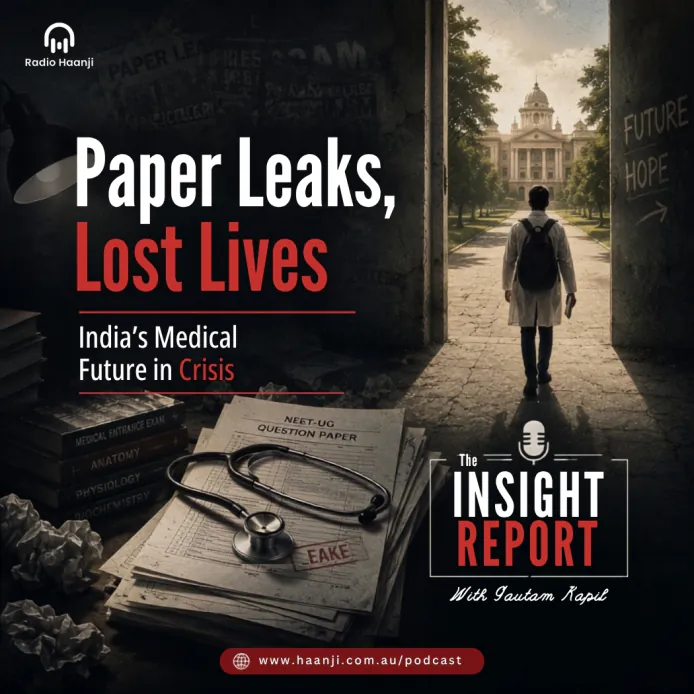
Paper Leaks, Lost Lives: India’s Medical Future in Crisis - The Insight Report - Gautam Kapil
Host:-
 Gautam Kapil
Tune into The Insight Report on Radio Haanji with Gautam Kapil as he analyzes the NEET exam paper leak controversy, student suicide tragedies, NTA flaws, and the crisis in India's medical education system.
Paper Leaks, Lost Lives: India’s Medical Future in Crisis - The Insight Report - Gautam Kapil
Every year, millions of young minds across India lock themselves in rooms with stacks of thick textbooks, harboring a shared dream: to wear the white coat and serve humanity. Parents pour their life savings, sell ancestral lands, and take heavy loans just to give their children a shot at becoming doctors. However, behind these immense personal sacrifices lies a systemic fragility that has repeatedly shattered young ambitions.
In this compelling episode of The Insight Report on Radio Haanji, hosted by Gautam Kapil, we take a deep dive into the heartbreaking crisis surrounding the NEET-UG examination. From paper leaks and test cancellations to widespread administrative failures and the devastating human toll, this show dissects why India's youth are taking to the streets to demand justice and transparency in education.
For more ongoing regional and global developments, you can also stay informed through our daily Today Updates and dedicated Indian Updates broadcasts on Radio Haanji.
Historical Echoes: Youth and Student Movements in India
Student unrest in India is not a new phenomenon. History shows that whenever the youth feel pushed into a corner by injustice, systemic failure, or broken promises, their voices ignite nationwide movements.
- 1974 JP Movement: Led by socialist leader Jayaprakash Narayan in Bihar, students rose against corruption, inflation, and unemployment, creating a political movement that eventually challenged the highest corridors of power.
- 1979 Assam Movement: Driven by the All Assam Students' Union (AASU), local youth fought for six years to protect their regional language, demographic identity, and cultural heritage against illegal immigration.
- 1990 Anti-Mandal Protests: Students across the country took to the streets in intense opposition to 27% reservations in higher education and public sector jobs, arguing for meritocracy and broader systemic reforms.
- The Modern Gen-Z Voice: Much like historical youth movements, today’s youth are organizing passionately against exam irregularities, demanding accountability from institutions like the National Testing Agency (NTA).
When young people gather to speak their mind, whether discussing serious socio-political issues or sharing candid personal stories, real change begins. If you enjoy authentic youth perspectives and casual conversations, check out our popular show Boys Meetup for engaging community discussions.
The Anatomy of the NEET-UG Examination Crisis
The National Eligibility cum Entrance Test (NEET-UG) is the single gateway for students aspiring to join medical courses like MBBS, BDS, BAMS, and BHMS across India. In a nation of over 1.4 billion people, approximately 20 to 24 lakh students compete fiercely for around 1.37 lakh seats across government and private institutions.
The intense pressure on students reached a boiling point when the May 3 examination was cancelled on May 12 following confirmed reports of question paper leaks on digital platforms like Telegram. The Central Bureau of Investigation (CBI) was brought in to investigate criminal syndicates involved in selling leaked papers. Although a re-examination was scheduled for June 21, over 4 lakh demoralized students chose not to return to the examination centers.
The controversy deepened further when the 2024 NEET results revealed unprecedented anomalies:
- An astonishing 67 candidates secured a perfect score of 720 out of 720, an event never seen before in the exam's history.
- Six of those top-ranking candidates belonged to the exact same coaching center in Jhajjar, Haryana.
- Mathematical impossibilities arose, such as students scoring 718 or 719 out of 720, which the NTA attempted to explain away using arbitrary "grace marks" for lost time.
These discrepancies shattered trust in centralized testing, raising serious doubts about whether deserving candidates are being squeezed out by fraudulent practices.
The Human Cost: Lives Lost Behind the Statistics
Beyond numbers, ranks, and political debates lie heartbreaking human stories. The emotional weight placed on these young teenagers by family expectations, financial burdens, and administrative uncertainty has led to tragic outcomes, with at least 21 students reportedly taking their own lives amidst the chaos.
Consider the story of Rehma Begum, a 20-year-old girl from a remote village in Bihar. Armed with passion and supported by her sick mother, Rehma gave her everything to clear the exam, only to see her effort invalidated by paper cancellations. During the subsequent protests, her sick mother passed away, leaving Rehma alone with her shattered dream.
In Rajasthan, Pradeep Meena, the 22-year-old son of an impoverished farmer, spent three years preparing in coaching hubs after scoring top ranks in his high school. His father, Rajesh Kumar, had sold their ancestral farmland and accumulated an 11-lakh rupee loan, working 16 hours a day in the hope that his son would pull the family out of poverty. When news of the exam cancellation arrived, Pradeep tragically ended his life inside his room, leaving his heartbroken father to light his funeral pyre.
Similarly, Rithik Mishra in Uttar Pradesh and 17-year-old S. Anitha in Tamil Nadu became symbols of this tragic crisis. Before losing her life, Anitha had filed a petition in the Supreme Court, arguing that centralized entrance exams create an unfair burden on rural and underprivileged students who cannot afford expensive private coaching institutes.
In moments of deep sorrow and national contemplation, storytelling helps process emotion and foster empathy. You can listen to inspiring narrative journeys on our audio story podcast Kitaab Kahani or reflect on life's deeper journeys with Notebook.
Centralization vs. State Autonomy: The Policy Debate
The NEET crisis has reopened critical questions about educational governance in India. Leaders from states like Tamil Nadu and Kerala have voiced strong opposition to nationwide centralized examinations, arguing that admissions to state medical colleges should be based on Class 12 board examination marks, as was done in earlier years.
While the government proposes transitioning NEET to a Computer-Based Test (CBT) mode to prevent paper leaks, critics point out that digital infrastructure in rural India remains inadequate. Moreover, digital formats bring risks of cyber hacking and server manipulation. In contrast, countries like China conduct offline examinations such as the Gaokao for over 13 million students simultaneously using advanced anti-cheating technology, wireless signal blockers, and strict legal penalties, ensuring total exam integrity without compromising fairness.
To explore broader perspectives on science, education, technology, and global policy issues, explore our dedicated exploration series The Deep Talk.
Restoring Faith in Our Healthcare and Educational System
A doctor's profession rests entirely on trust and capability. When entrance examinations are compromised by paper leaks and bribery, society risks placing human lives in the hands of unqualified individuals. Restoring absolute integrity to competitive testing is not just about fairness for students; it is about protecting the future of healthcare.
While discussing tough realities is essential, finding joy and relief in daily life is equally important for mental well-being. For lighthearted relief and family entertainment, tune in to our popular episode collection Laughter Therapy on Radio Haanji.
Conclusion
The NEET crisis highlighted on this episode of The Insight Report with Gautam Kapil is a wakeup call for policymakers, administrative bodies, and society as a whole. Behind every roll number is a young life, a family's hope, and a dream worth protecting. Systemic reform, strict accountability, and empathetic governance are urgently needed to ensure that India's medical future remains bright and trustworthy.
Tune in to Radio Haanji 1674 AM or stream online via our official app to catch the full audio episode of The Insight Report and stay connected with voices that matter.
Frequently Asked Questions
What is The Insight Report on Radio Haanji?
Who is Gautam Kapil?
What is Radio Haanji 1674 AM?
What were the main issues with the NEET-UG examination discussed in this episode?
Why do states like Tamil Nadu oppose the NEET exam?
How can listeners access Radio Haanji podcasts?
What were the main issues with the NEET-UG examination discussed in this episode?
Why do states like Tamil Nadu oppose the NEET exam?
How does China manage large-scale entrance exams like Gaokao compared to India's NEET?
What is the National Testing Agency (NTA) and why is it facing criticism?
How can listeners access Radio Haanji podcasts?
What's Your Reaction?