











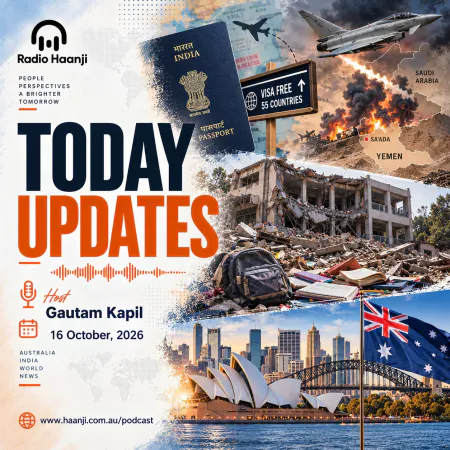




















































































Australia PR Strategy 2026: Points, 8503 & Pathways - Immi Talk - Prem Goel - Gautam Kapil
Host:-
 Gautam Kapil
Points thresholds are climbing and visitor visas are tightening. Here's how to actually strategise your Australian PR pathway in 2026. Read the breakdown.
A candidate with a genuine, verifiable skill set and 95 points can now sit in a queue behind dozens of others scoring 100 or more. That's the blunt reality of Australia's skilled migration system in 2026, and it's exactly the scenario migration agent Prem Goel walked through on Radio Haanji's Immi Talk with host Gautam Kapil.
What makes this episode different from the usual "visa rules have changed" coverage is the strategic layer underneath the policy detail. Goel didn't just list what's harder — he explained where the actual openings still are, from trade pathways with points cut-offs 30 points lower than IT, to the specific credential combinations that can shift a borderline application into an invited one.
This article works through three connected pressures shaping Australian PR in 2026: a visitor visa system that's actively restricting onshore options, a points test that now regularly sees applicants clear 100 points in saturated fields, and a state nomination landscape that rewards early, deliberate positioning over passive waiting.
Why "Just Wait and See" No Longer Works
For years, a reasonable strategy for many applicants was to lodge an application, keep documents current, and wait for the system to catch up. That approach is increasingly unviable in 2026, because three separate mechanisms — visa conditions, points competition, and state seat allocations — are all now working against passive applicants at the same time.
The visitor visa system is a good starting point for understanding this shift, because it shows how quickly what used to be a flexible bridging option has become a genuine constraint on family and long-term planning.
What Does Condition 8503 Actually Mean for You?
Condition 8503, "No Further Stay," now appears on a large proportion of visitor visas granted to applicants from India, Pakistan, Bangladesh, and Sri Lanka, and it blocks onshore applications for partner or parent visas unless a formal waiver is approved. Visitor visa durations have also shortened, often to 6 to 8 months, with single stays capped at 6 months.
The practical impact varies enormously depending on which visa an applicant eventually wants. For family-stream visas — partner and parent applications — an 8503 waiver requires compelling and compassionate circumstances, such as a sudden medical emergency, and these are genuinely difficult to obtain. Goel was direct on the program: don't plan around getting a family-stream waiver unless your circumstances are truly exceptional.
Skilled visa applicants are in a very different position. An 8503 waiver for Subclass 189, 190, 491, 186, or 482 applications is comparatively straightforward, provided the applicant holds an invitation or clearly meets the relevant criteria. This asymmetry is one of the clearest signals in the current system: Australia is making onshore flexibility easy for skilled applicants and hard for family-stream applicants, and any visitor visa planning should account for which category actually applies.
How Many Points Do You Actually Need in 2026?
How many points do I need for Australia PR in 2026? The legal minimum is 65 points, but in high-volume fields like IT, Engineering, and Nursing, competitive applicants are frequently scoring 95 to 105-plus points. Meeting the minimum threshold no longer means you're competitive — it means you're eligible to enter the queue.
This gap between "eligible" and "competitive" is where most applicants lose ground, often without realising it. Two credentials in particular can move a borderline score into a genuinely competitive one: Superior English (worth 20 points) and NAATI CCL, the community language credential (worth 5 points). Together, these can add up to 25 points — often the difference between an invitation and another year of waiting.
On timing, Goel's advice was unambiguous: lodge your Expression of Interest as soon as you clear 65 points and hold a valid skills assessment, rather than waiting to "improve the profile first." The reasoning is specific to how invitations work. EOI date of effect genuinely matters for Subclass 189 invitation rounds, where earlier lodgement at the same point score is prioritised. State nomination programs under Subclass 190 and 491 work differently — they weight local work experience and overall point ranking more heavily than simply when the EOI was lodged, so delaying doesn't protect your position the way some applicants assume.
Which Occupations Still Have a Clear Path to PR?
Not every occupation is caught in the 100-point squeeze. Construction and trades occupations currently sit at cut-offs around 65 to 70 points — a genuinely different competitive tier from IT or general business roles. The catch is evidentiary: a Trades Recognition Australia skills assessment requires verifiable work history, ideally three years of salary paid directly into a bank account with matching tax records, rather than informal cash-in-hand arrangements that can't be documented.
Healthcare and education roles — nursing, physiotherapy, occupational therapy, speech pathology, and teaching — continue to see strong demand and comparatively favourable outcomes, reflecting workforce shortages that show no sign of easing.
For students and temporary graduates stuck in saturated fields like IT or general business, Goel's recommendation was to build a genuine "Plan B" rather than hoping the points environment eases. That might mean a concurrent trade qualification, pursuing employer sponsorship directly, or shifting attention toward a regional pathway where competition is typically lower. Treating a single, saturated occupation as the only route through the system is, in his view, the single biggest strategic mistake he sees.
What's Changing at the State Nomination Level?
Tasmania has already published its 2026 allocation — 1,250 seats for Subclass 190 and 800 for Subclass 491 — with updated guidelines that heavily favour local graduates and applicants already working in their nominated occupation within the state. That local-experience weighting is becoming a broader theme, not a Tasmania-specific quirk.
The ACT has also updated its points matrix and introduced a lodging fee for matrix submissions, a small but meaningful shift that raises the cost of speculative or poorly prepared applications. Other states are progressively opening their allocations and finalising processing pipelines for the financial year, meaning the state nomination landscape will likely keep shifting over the coming months rather than settling into a fixed set of rules.
For applicants weighing state nomination against a direct Subclass 189 pathway, the practical takeaway is that local presence and occupation-specific work experience are increasingly the deciding factor, not just a strong points score on paper.
Key Takeaways
- A large share of visitor visas issued to applicants from India, Pakistan, Bangladesh, and Sri Lanka now carry Condition 8503, restricting onshore partner and parent visa applications.
- Skilled visa applicants can generally obtain an 8503 waiver with an invitation or qualifying criteria, while family-stream waivers require compelling and compassionate grounds such as a medical emergency.
- The legal points minimum is 65, but competitive scores in IT, Engineering, and Nursing frequently reach 95 to 105-plus points.
- Superior English (20 points) and NAATI CCL (5 points) are two of the most direct ways to close the gap between eligibility and competitiveness.
- Construction and trades occupations currently have points cut-offs around 65 to 70, well below saturated fields, provided applicants can document three years of verifiable, tax-recorded work experience.
- Tasmania has confirmed 1,250 Subclass 190 seats and 800 Subclass 491 seats for the current allocation, prioritising local graduates and workers in nominated occupations.
References and Further Reading
- Department of Home Affairs, Australia — source for visa condition rules, points test thresholds, and skilled occupation categories referenced throughout this article.
- Trades Recognition Australia (TRA) — the assessing authority for trade skills assessments discussed in the occupations section.
The through-line across visitor visas, points strategy, and state nomination is the same: Australia's migration system now rewards applicants who plan several moves ahead, not those who wait for their turn. If you're weighing up your own points profile or considering a state nomination pathway, listen to the full conversation between Gautam Kapil and Prem Goel on Immi Talk, and share it with anyone in your circle currently building their EOI.
Frequently Asked Questions
What does condition 8503 mean on an Australian visa?
Can I get an 8503 waiver if I'm applying for a partner visa?
Is it worth lodging an EOI before I have 65 points?
Does NAATI CCL actually make a meaningful difference to my points?
Should I choose a state nomination or wait for a Subclass 189 invitation?
Are trade occupations really an easier path to PR than IT in 2026?
Is Tasmania still a good option for state nomination in 2026?
What's Your Reaction?