



















































































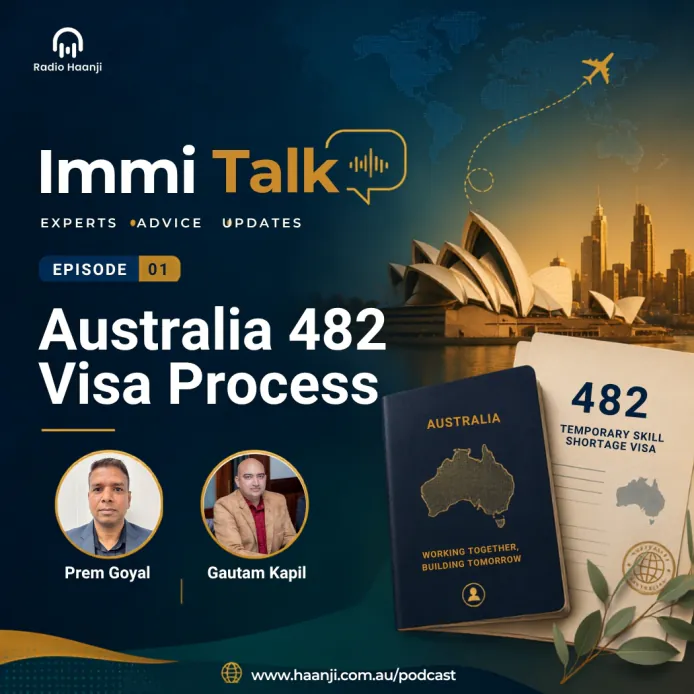
Subclass 482 Visa Australia - Complete 2026 Guide - Immi Talk - Prem Goyal - Gautam Kapil
Host:-
 Gautam Kapil
Everything about Australia's Subclass 482 visa — eligibility, salary, LMT and the PR pathway — explained by migration expert Prem Goyal. Listen or read now.
Most people searching for the Subclass 482 visa have already been told the basics and are still stuck. They know it is "the employer sponsorship one." What they don't know is why so many genuinely qualified applicants get knocked back, or why some employers quietly avoid sponsoring altogether. That gap is exactly what this episode of Immi Talkset out to close.
Host Gautam Kapil sat down with Prem Goyal, migration expert at IME Adviser, for a conversation that treated the 482 visa less like a form to fill out and more like a negotiation between three parties — the applicant, the employer, and the Department of Home Affairs — each with different pressures. The result is a clearer picture of how the visa actually works in practice, not just what the checklist says.
If you're weighing up whether the 482 is realistic for your situation, or you're an employer wondering what you're signing up for, this breakdown covers what the episode actually revealed: the true cost of sponsorship, the qualification traps that catch people out, and the exact route from a temporary visa to permanent residency.
The Employer's Half of the Equation
A recurring theme in the conversation was that the Subclass 482 visa is fundamentally an employer-driven visa. It exists so local businesses can fill genuine skill shortages, not as a general pathway for skilled migrants to choose on their own timeline.
Before any nomination can happen, the business itself has to become an approved sponsor through Standard Business Sponsorship (SBS). Prem Goyal noted that this step alone filters out a lot of would-be sponsors — it requires the business to demonstrate it is legitimately operating and financially capable of meeting its sponsorship obligations.
Once approved, the employer must nominate the specific position and prove, through Labour Market Testing, that no suitable local candidate was available. That means advertising the role for a minimum of 28 days on approved national platforms such as Seek or Workforce Australia. Employers who skip or rush this step are among the most common reasons nominations get rejected.
What Does an Applicant Actually Need to Qualify?
Direct answer: To qualify for a Subclass 482 visa, an applicant typically needs at least one year of full-time (or two years of part-time) relevant work experience, a relevant qualification such as a Certificate III for trade roles, and functional English proficiency roughly equivalent to a 5.0–5.5 IELTS band, with some exemptions available.
The experience requirement is where Prem Goyal flagged the most confusion. Full-time counts as 12 months minimum, but part-time only counts if it totals at least 20 hours a week across a two-year period — casual or sporadic work below that threshold generally won't be accepted as equivalent.
Formal qualifications matter, but they aren't always a hard stop. For trade and technical occupations, a minimum Certificate III is usually expected, though the episode noted that a lack of formal qualification can sometimes be offset by additional demonstrated work experience — often around four years total in the relevant field.
English language requirements also have more flexibility than most applicants assume. While functional English (broadly a 5.0–5.5 band equivalent) is the general standard, exemptions apply for roles with a salary above roughly $96,400 per year, as well as for applicants with certain study backgrounds completed in English. This detail alone changes the calculation for a meaningful number of applicants who assumed they needed to sit another English test.
How Long Does the 482 Visa Take to Process?
Direct answer: Overall processing for a Subclass 482 visa, from employer sponsorship approval through to visa grant, typically takes between six and eight months, though individual cases can move faster or slower depending on occupation, documentation completeness, and Department workload.
That six-to-eight month window covers three separate stages — sponsorship approval, nomination, and the visa application itself — each of which can be delayed independently. A clean, well-documented Labour Market Testing submission tends to move faster than one requiring follow-up requests.
Prem Goyal's practical advice on the episode was to treat the timeline as a planning tool, not a guarantee. Employers and applicants who start the sponsorship and nomination stages early, well before a hard start date is needed, avoid the most common source of frustration in the process.
What Happens to Your Family on a 482 Visa?
Direct answer: Spouses and dependent children can be included on a Subclass 482 visa application, and partners are granted full work and study rights in Australia for the duration of the visa, making it a genuine family relocation pathway rather than a solo work permit.
This is a detail the podcast conversation spent real time on, because it's often underappreciated in how the visa is marketed. A sponsored applicant isn't just securing their own employment pathway — they're securing a household's ability to relocate, work, and study together.
For families weighing a move, the unrestricted work rights for partners can meaningfully change the household's financial picture from day one, rather than waiting for a separate visa or work authorisation process.
How Does the 482 Visa Lead to Permanent Residency?
Direct answer: The Subclass 482 visa leads directly to permanent residency through the Subclass 186 Temporary Residence Transition (TRT) stream, available after working continuously for the same sponsoring employer for two years, with applicants generally required to be under 45 at the time of the PR application.
Gautam Kapil pushed Prem Goyal on this point specifically, because it's often the single deciding factor for people choosing the 482 over other visa routes. The two-year continuous employment requirement is with the same sponsor — a job change resets the clock for this particular pathway.
The age cutoff is worth flagging on its own. Applicants generally need to be under 45 at the time of the 186 TRT application, though the episode noted that exemptions exist for specific sectors and circumstances. Anyone close to that threshold should factor timing into their overall visa strategy well in advance, rather than discovering the constraint late in the process.
Key Takeaways
- The Subclass 482 visa requires employers to complete Standard Business Sponsorship and a minimum 28-day Labour Market Testing period before nominating a worker.
- Applicants need at least one year of full-time (or two years of part-time, minimum 20 hours/week) relevant work experience to qualify.
- Employers must offer at least the Temporary Skilled Migration Income Threshold (TSMIT) of $79,423 plus superannuation and leave entitlements.
- Overall processing time for the 482 visa typically ranges from six to eight months.
- Spouses and dependent children can be included, with partners receiving full work and study rights in Australia.
- The 482 visa offers a direct pathway to permanent residency via the Subclass 186 TRT stream after two years with the same sponsor, generally for applicants under 45.
References and Further Reading
- Australian Department of Home Affairs — Official guidance on Subclass 482 visa eligibility, sponsorship obligations and the Temporary Skilled Migration Income Threshold — https://immi.homeaffairs.gov.au/
- Workforce Australia — National job advertising platform used to satisfy Labour Market Testing requirements — https://www.workforceaustralia.gov.au/
- IME Adviser — Migration guidance featured in this episode's discussion of the 482 to 186 TRT pathway — https://imeadvisors.com/
Frequently Asked Questions
Is the Subclass 482 visa the same as the old 457 visa?
Can I change employers while on a 482 visa?
What occupations qualify for the 482 visa?
Does the 482 visa allow me to buy property in Australia?
What is the difference between the 482 and the Skills in Demand visa branding?
Can I apply for the 482 visa if I'm already in Australia on another visa?
What happens if my Labour Market Testing advertisement doesn't attract any local applicants?
What's Your Reaction?