














































































Climate Change and Our Survival: What the Science Says - Harminder Dhillon and Ranjodh Singh
Host:-
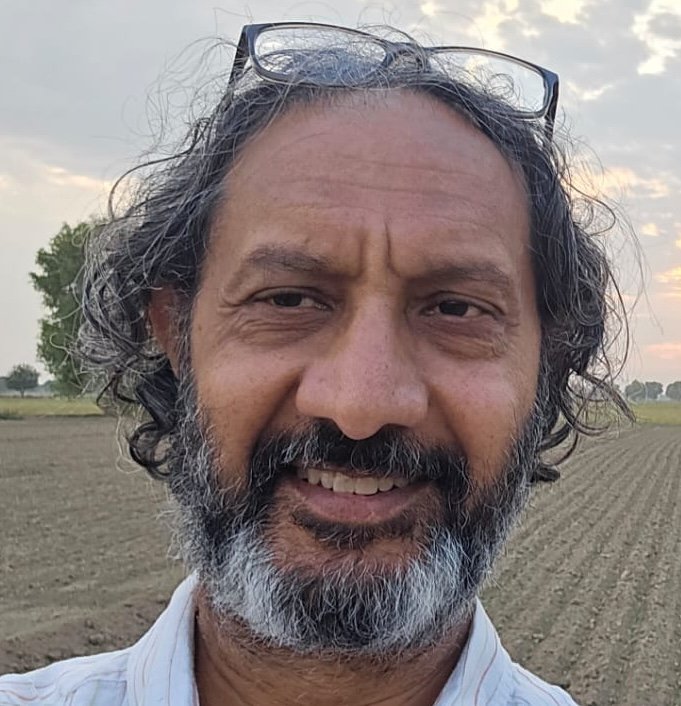 Harminder Dhillon
 Ranjodh Singh
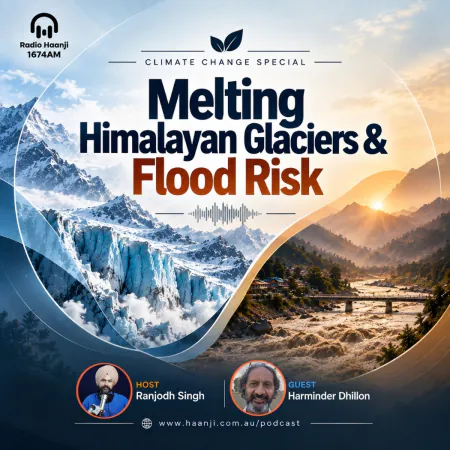
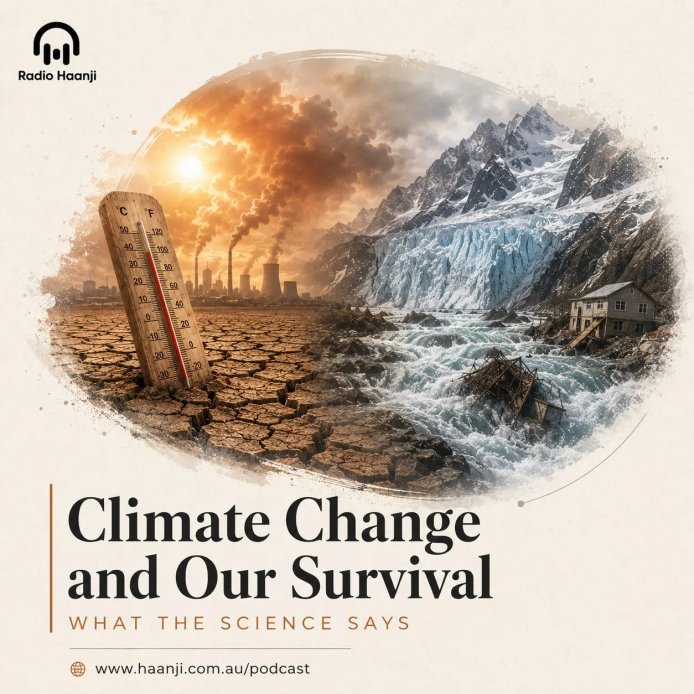
Ranjodh Singh and Harminder Dhillon discuss the real science of climate change on Radio Haanji 1674 AM Melbourne - from Himalayan glaciers to Punjab's crops and what it means for your family.
When was the last time you had a real conversation about climate change, not the kind that ends in an argument or gets brushed off as someone else's problem, but the kind that makes you stop and think? On a recent episode of the Climate Change Special on Radio Haanji 1674 AM, host Ranjodh Singh sat down with guest Harminder Dhillon for exactly that kind of conversation. What came out of it was honest, alarming, and deeply important for every Punjabi family listening in Australia and beyond.
The Numbers Behind the Crisis
It is easy to scroll past headlines about global warming. But when you put the numbers into human terms, the picture becomes impossible to ignore. Scientists project that if warming continues on its current path, the deaths over the next century to two centuries could fall anywhere between one billion and five billion people. Think about that in terms of your own household. In a family of eight people, roughly only three might survive.
A rise of just two degrees Celsius in global average temperature, which is well within current projections, could wipe out one third of the world's entire economic output. To put scale to that, an economy the size of Australia's could effectively vanish from the map.
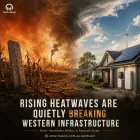
The eastern half of the United States could see summer temperatures so extreme that being outdoors even briefly could prove fatal. In the western regions, life-threatening heatwaves of that severity could stretch across six continuous months. These are not science fiction scenarios. These are outcomes that peer-reviewed climate science is already warning us about.
What Is Already Happening Right Now
Some of the most striking moments in this episode came when Harminder Dhillon connected the global data to things people in Punjab and the Indian subcontinent can already see with their own eyes.
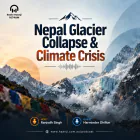
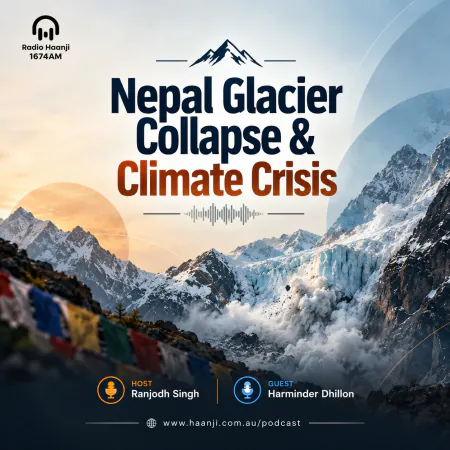
The Himalayan glaciers are melting at a pace that is shocking even to researchers who study them. This has caused water levels at the Bhakra Dam to rise roughly 35 feet above their historical average, and 20 feet higher than the same period in the previous year. The Govind Sagar lake received an estimated 300,000 crore litres of excess water from glacial melt alone. That is not a number most of us can even visualise, but it represents a massive disruption to a water system that millions of people and farmers depend on.
In Delhi, air temperature was recorded at 47 degrees Celsius. But the ground surface temperature, the surface where animals walk, where children play, where workers stand, reached 67 degrees Celsius. That is a level at which living tissue begins to fail.
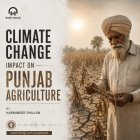
In Dadu, Sindh, temperatures hit 52.3 degrees Celsius, one of the highest surface temperatures recorded anywhere on earth. Entire communities were forced to abandon their farmlands. Closer to home for many listeners, farmers in Punjab watched their rice nursery seedlings, the paneeri, burn in the fields before they could even be transplanted. Years of planning and investment gone in days.
Why You Are Not Hearing About This
If all of this is happening, and the science is clear, why does it feel like the urgency is missing from the news we read and the conversations we have? Ranjodh Singh and Harminder Dhillon addressed this directly.
Governments around the world frequently choose to soften or suppress the severity of climate reports. The reasoning is often about preventing panic, but the effect is to leave people uninformed at exactly the moment they need to be making decisions.
At the same time, major fossil fuel companies have invested enormous sums of money into creating public doubt about climate science. This is not speculation. It is a well-documented strategy that has been studied and exposed by researchers and journalists for decades. The goal is simple: delay public pressure for change, buy time, and protect profit margins.
This disinformation does not stay in boardrooms or national newspapers. It finds its way into WhatsApp groups in rural Punjab. People end up debating whether solar panels kill birds, a rumour that has no scientific basis whatsoever, instead of asking why their groundwater is disappearing or why summers feel nothing like they did twenty years ago.
Why the Science Itself Is Trustworthy
When people hear statistics this severe, a natural response is to question the source. The episode gave clear context on this. The Intergovernmental Panel on Climate Change, the IPCC, compiles its reports using the research and review of 812 scientists drawn from countries across every continent and culture. The process is rigorous, transparent, and deliberately international so that no single government or interest group can skew the conclusions. It is, by any measure, one of the most carefully constructed scientific consensus processes in human history.
The numbers are not exaggerated for effect. If anything, history has shown that IPCC projections tend to be conservative, and the actual changes observed have frequently outpaced their earlier models.
What You Can Do From Where You Are
The conversation between Ranjodh Singh and Harminder Dhillon did not end in despair. It ended with a call to action that every listener can take up regardless of their profession, income, or background.
Each of us has a circle of people we influence, our family, our neighbours, our friends at the gurdwara, our colleagues at work. The most powerful thing any individual can do right now is have honest, grounded conversations within that circle. Not to lecture, but to share what you know. To ask questions. To push back gently when you hear misinformation. Real change in communities has always started this way, one authentic conversation at a time.
If you want to go deeper on topics like this, Radio Haanji has several other shows worth your time. the="" deep="" talk<="" a=""> explores science, space, species, and human discovery in a way that is accessible and genuinely fascinating. You can also catch today="" updates<="" a=""> and indian="" updates<="" a=""> for news that keeps the Punjabi community connected, or enjoy laughter="" therapy<="" a="">, kitaab="" kahani<="" a="">, boys="" meetup<="" a="">, and notebook<="" a=""> for a range of community programming.
Frequently Asked Questions
How many degrees of warming are considered dangerous?
Scientists consider a rise of 1.5 to 2 degrees Celsius above pre-industrial levels to be the threshold where impacts become severe and widespread. Beyond 2 degrees, the risks escalate dramatically including large-scale agricultural failure, displacement of billions of people, and significant economic collapse.
What is the IPCC and why should I trust it?
The Intergovernmental Panel on Climate Change is a United Nations body that brings together over 800 scientists from countries across every continent to review and synthesise thousands of peer-reviewed studies. It represents the broadest and most rigorously vetted scientific consensus on climate change available anywhere in the world.
How does climate change affect Punjab specifically?
Punjab is already seeing direct effects. Himalayan glacier melt is disrupting river systems that feed into Punjab's farmlands. Extreme heat is damaging crops at critical stages of growth, including rice nursery seedlings burning before they can be transplanted. Groundwater is depleting faster as farmers pump more to compensate for erratic rainfall.
Why is disinformation about climate change so widespread?
Fossil fuel industries have a strong financial interest in delaying public pressure for change. Funding doubt about climate science, even when that doubt has no scientific basis, is an effective strategy to slow policy reform. This is well documented and has been the subject of legal investigations and journalism for more than two decades.
Where can I listen to the Climate Change Special on Radio Haanji?
You can tune in on 1674 AM in Melbourne or listen online at haanji.com.au. The Climate Change Special episode with Ranjodh Singh and Harminder Dhillon is available as a podcast directly on the website.
What's Your Reaction?