































































































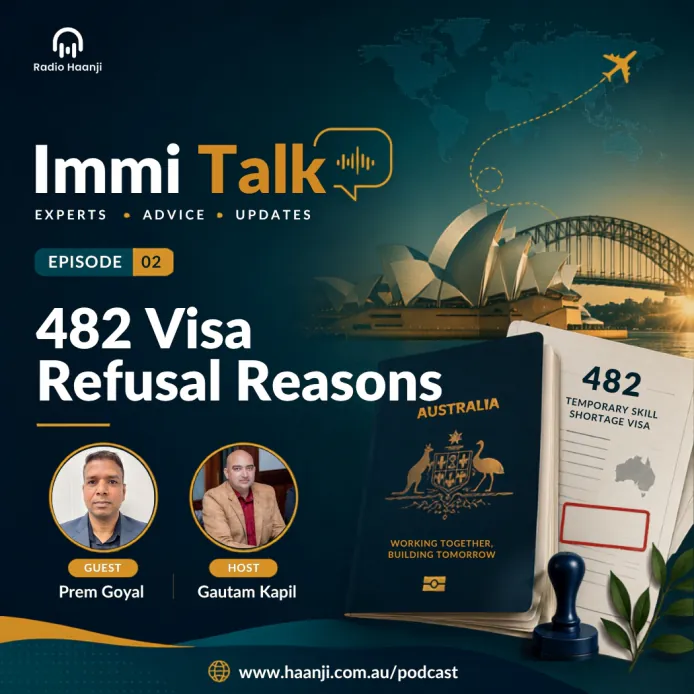
482 Visa Refusal Reasons: What Actually Goes Wrong - Immi Talk - Prem Goyal - Gautam Kapil
Host:-
 Gautam Kapil
Learn the real reasons 482 visa applications get refused, LMT rules, and how to switch employers — migration expert Prem Goyal explains. Read more.
In This Episode
- Why Do 482 Visa Nominations Get Refused?
- The Labour Market Testing Rules Nobody Reads Closely
- When the Refusal Happens at the Visa Application Stage
- How Long Do I Have to Find a New Employer on a 482 Visa?
- Does Switching Employers Reset My Path to PR?
- Key Takeaways
- References and Further Reading
- Frequently Asked Questions
A 482 visa doesn't usually fail because someone did something wrong on purpose. It fails because of a missed deadline in the Labour Market Testing window, a job ad that ran on the wrong platform, or an employer's compliance history catching up with them years later. That's the picture migration expert Prem Goyal painted in his second conversation with Immi Talk host Gautam Kapil — a follow-up to their earlier breakdown of the visa's basics, this time focused squarely on where things go wrong.
The Subclass 482 visa runs through three distinct stages — Standard Business Sponsorship, nomination, and the visa application itself — and each one carries its own failure points. Understanding which stage a refusal happens at isn't just academic. It determines what can be fixed, what can't, and how long a setback actually costs an applicant or employer.
This piece unpacks the episode's detail on Labour Market Testing compliance, the exact rules around switching employers mid-visa, and how the road to permanent residency via the Subclass 186 TRT stream actually accounts for time spent with more than one sponsor.
Why Do 482 Visa Nominations Get Refused?
Direct answer: 482 visa nominations are most commonly refused due to the position not being assessed as genuine, non-compliance with Labour Market Testing requirements, or the sponsoring employer having an adverse compliance history — such as prior underpayment findings flagged by the Australian Border Force or the Australian Taxation Office.
Prem Goyal was direct about this on the episode: a refusal at the nomination stage is rarely about the candidate at all. It's an assessment of the employer and the role itself — whether the position genuinely exists, pays appropriately, and was advertised the way the rules require.
An employer's history matters more than most applicants realise. If a business has previously been flagged for underpaying staff or breaching sponsorship obligations, that history can surface again at nomination stage, regardless of how well-qualified the current candidate is. This is one reason Prem Goyal recommends applicants ask directly about a prospective sponsor's compliance track record before accepting an offer tied to visa sponsorship.
The Labour Market Testing Rules Nobody Reads Closely
Labour Market Testing exists to prove that a genuine effort was made to hire an Australian citizen or permanent resident before looking overseas. The rules sound simple on paper, but the episode made clear that the details are where employers most often slip up.
The job ad has to run for a minimum of 28 days, and — critically — across at least two national platforms, such as Seek, Indeed or Jora. A single platform, no matter how popular, doesn't satisfy the requirement. The ad also has to follow a standard format specified by the Department, not just a generic listing.
Timing adds another layer employers often miss. Labour Market Testing has to be conducted within the four months immediately prior to lodging the nomination application — testing done too early effectively expires before it can be used.
There are exemptions, mainly under Free Trade Agreements or for genuine intra-company transfers. But Prem Goyal was specific that these exemptions don't apply universally: applicants from countries including India and Pakistan are still required to complete full Labour Market Testing regardless of the role or employer type.
When the Refusal Happens at the Visa Application Stage
Direct answer: Visa application refusals — as distinct from nomination refusals — generally result from missing or unclear supporting documentation, failed character or medical checks, or a mismatch between the candidate's qualifications and the ANZSCO or ASCO standard required for the nominated occupation.
This is a different failure point from a nomination refusal, and it's specific to the individual candidate rather than the employer or role. Documentation gaps are the most avoidable of these — missing payslips, unclear employment reference letters, or qualifications that aren't clearly mapped to the occupation code being claimed.
The ANZSCO mismatch issue deserves particular attention. Prem Goyal noted that candidates sometimes have real, relevant experience that simply isn't documented in a way that maps cleanly onto the occupation's official skill level and tasks — meaning a technically qualified applicant can still be refused if the paperwork doesn't tell that story clearly enough.
How Long Do I Have to Find a New Employer on a 482 Visa?
Direct answer: A 482 visa holder who leaves their sponsoring employer has up to six months to secure a new nomination with a different eligible employer, and does not need to lodge an entirely new visa application — the existing visa remains valid while a new nomination is processed.
This six-month window is one of the more reassuring details from the episode, since many visa holders assume losing a job means losing their visa immediately. That isn't the case. The visa itself stays valid; what changes is the nomination linking it to a specific employer.
The practical requirement is that the new employer (and, if they aren't already an approved sponsor, their SBS) needs to be approved within that six-month period. Prem Goyal's advice was to start the new employer search immediately rather than treating the six months as a comfortable buffer — SBS and nomination approvals take time, and that clock doesn't pause for job hunting.
Does Switching Employers Reset My Path to PR?
Direct answer: No — time worked across different approved employers on a 482 visa can still count towards the two years of full-time work required for the Subclass 186 Temporary Residence Transition stream, provided each period was with an eligible employer under a valid nomination.
This directly answers one of the most common anxieties Gautam Kapil raised in the conversation: does changing jobs mean starting the PR clock over? According to Prem Goyal, it doesn't, as long as the work was genuinely full-time and each employer met the visa's requirements at the time.
There is, however, a language requirement that applies specifically at the 186 TRT transition point and wasn't necessarily required for the original 482 grant: Competent English, generally evidenced by an IELTS score of 6.0 or equivalent across each test component. Applicants who qualified for the 482 under a lower English threshold or an exemption should not assume the same standard applies when they reach the PR stage.
Key Takeaways
- The Subclass 482 visa process has three stages — Standard Business Sponsorship, nomination and visa application — and refusals at each stage stem from different causes.
- Labour Market Testing requires job ads to run for a minimum of 28 days across at least two national platforms, completed within four months before the nomination is lodged.
- Applicants from countries including India and Pakistan must complete full Labour Market Testing even where certain Free Trade Agreement or intra-company transfer exemptions might otherwise apply.
- An employer's adverse compliance history, such as prior underpayment findings, can result in nomination refusal regardless of the candidate's qualifications.
- 482 visa holders have up to six months to secure a new nomination after leaving an employer, without needing to lodge a new visa application.
- Time worked across multiple approved employers counts towards the two years required for the Subclass 186 TRT pathway, which requires Competent English (IELTS 6.0 or equivalent) at the transition stage.
References and Further Reading
- Australian Department of Home Affairs — Official requirements for Labour Market Testing, nomination and the Subclass 186 TRT stream — https://immi.homeaffairs.gov.au/
- Fair Work Ombudsman — Guidance on employer compliance obligations relevant to sponsorship history, including underpayment enforcement — https://www.fairwork.gov.au/
- IME Adviser — Episode 1 of Immi Talk - Subclass 482 Visa Australia - Complete 2026 Guide - Immi Talk - Prem Goyal - Gautam Kapil - https://haanji.com.au/subclass-482-visa-australia-guide-immi-talk
Refusals rarely come down to bad luck — they come down to details that either got missed or weren't understood in the first place, and that's exactly what this conversation between Gautam Kapil and Prem Goyal set out to make clear. If you're navigating a nomination, weighing up a job change on your 482 visa, or mapping out your route to the 186 TRT stream, listen to the full episode for the context behind these rules, and share it with anyone in your network who might be sitting on a nomination they assumed was straightforward.
Frequently Asked Questions
Can I appeal a 482 visa nomination refusal?
Does Labour Market Testing need to be repeated if my nomination is refused and resubmitted?
What counts as an "eligible employer" for the six-month transfer window?
Is Competent English required for the original 482 visa, or only at the 186 TRT stage?
Can a 482 visa be refused because of the employer, even if my documents are perfect?
What is an intra-company transfer exemption for Labour Market Testing?
How do I know if my occupation qualifies under the correct ANZSCO code?
What's Your Reaction?