








































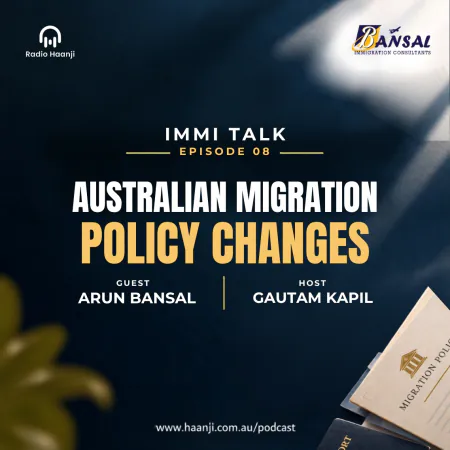

















































Australia Visa Delays 2026: What's Really Changing - Immi Talk - Arun Bansal - Gautam Kapil
Host:-
 Gautam Kapil
Parent, partner, student and work visas are all shifting in 2026. Here's what's really happening — and what to do about it. Listen the full breakdown.
Ask anyone currently in Australia's migration system a simple question — "when will my visa come through?" — and you'll rarely get a straight answer anymore. That uncertainty isn't accidental. It's the direct result of a deliberate re-ranking of who Australia lets in first, and it's reshaping outcomes for parents, partners, students and skilled workers all at once.
Migration agent Arun Bansal of Bansal Immigration Australia has spent the past year watching these shifts play out case by case, not just in policy documents. Speaking on Radio Haanji's Immi Talk with host Gautam Kapil, Bansal laid out a picture that goes well beyond the headline "visa delays" story most people have heard — it's a system quietly being rebuilt around a small number of priority sectors, with almost everyone else pushed further back in the queue.
This piece walks through what's actually changing across four visa streams — parent, partner, student, and employer-sponsored work — and what it practically means if you or your family are caught in one of them.
Why Australia's Visa System Feels Slower Than Ever in 2026
The short answer: Australia hasn't reduced its total migration intake as dramatically as headlines suggest — it has re-sorted who gets processed first. Healthcare, teaching, construction, law enforcement and defence occupations are now processed ahead of almost everything else, which pushes out timelines for every other applicant category, even when nothing about their individual application has changed.
This matters because most applicants assume a delay means something is wrong with their file. In the vast majority of cases, Bansal notes, the file is fine — it's simply sitting behind a much longer queue of higher-priority cases than it would have a few years ago.
Three visa streams illustrate this shift most clearly: parent visas, partner visas, and the employer-sponsored pathway governed by Ministerial Direction 119. Each is explored in detail below, because the reasons behind the delay — and the realistic options available — are different for each.
Parent Visas and the New Visitor Visa Squeeze
Parent visa processing times in Australia have stretched to roughly 15 years for the Contributory stream and up to 33 years for the Non-Contributory stream, according to figures discussed on the program. For families who assumed sponsoring a parent was a matter of "a few years of patience," this is a fundamentally different reality.
What's changed more recently, and arguably causes more day-to-day hardship, is the treatment of parent visitor visas. These are now commonly issued with much shorter validity — often just three to six months — and carry Condition 8503, "No Further Stay." That condition prevents a parent from applying for any further visa while in Australia, effectively forcing repeated international travel just to remain close to family for extended periods.
For families who previously relied on longer visitor visas to bridge the gap while a permanent parent visa slowly processes, this combination — shorter visitor visas plus a no-further-stay condition — closes off a workaround that many households had come to depend on. Bansal's advice on the program was blunt: don't assume your usual visitor visa pattern will be approved the same way it was two or three years ago, and check the conditions on any newly issued visa carefully before travel is booked around it.
Why Is the Partner Visa Backlog So Bad Right Now?
The partner visa backlog is severe because the annual allocation cap of roughly 40,500 places hasn't kept pace with demand, leaving over 27,000 Subclass 820 applications pending for one to two years and more than 20,000 pending beyond two years. New applicants should realistically expect a two to three year wait.
This is arguably the visa category causing the most acute stress for couples, because unlike parent visas — where the multi-year wait is at least well understood by applicants going in — partner visa applicants historically expected a much faster turnaround. Many couples built their life plans, including where to live and whether to have children, around outdated processing expectations.
The quota structure is the root cause here rather than any single administrative failure. With a fixed annual ceiling and a growing pool of applications, the backlog compounds year over year unless the allocation is increased or demand eases. Bansal noted on the show that couples currently applying should plan finances and living arrangements on the assumption of a multi-year wait, rather than treating the visa as a formality to be resolved within months.
Student Visas and the Shrinking Path to PR
What is happening to the pathway from student visa to permanent residency in Australia? The direct path is narrowing, not closing. Points thresholds for skilled PR pathways now commonly sit at 75 to 90-plus points, state nomination criteria are tightening in places like Tasmania, and reforms are being discussed to limit onshore "visa hopping" via the Subclass 485 Temporary Graduate visa.
International students who arrived expecting a relatively linear route — study, graduate, work on a 485, transition to PR — are now facing a much more competitive points environment. Reaching 75 to 90-plus points typically requires a strong combination of age, English proficiency, skilled work experience, and often a relevant state nomination, which is a materially higher bar than it was in earlier years.
State-level changes compound the difficulty. Tasmania's shift from broad average work-hour calculations to requiring strict, consistent weekly hours is a good example: it sounds like a technical adjustment, but for a student juggling coursework and part-time work, hitting a consistent weekly threshold is far harder than meeting an average over a longer period, and it can disqualify otherwise strong candidates from state nomination.
The discussion around restricting onshore visa hopping via the 485 pathway is the piece students should watch most closely. If reforms proceed as flagged, extending a stay in Australia purely by moving from one temporary visa to another — without a clear skilled or employer-sponsored pathway behind it — is likely to become significantly harder, according to Bansal.
What Is Ministerial Direction 119, and Who Does It Help?
What is Ministerial Direction 119 and which occupations does it prioritise? Direction 119 sets a new processing order for employer-sponsored Subclass 482 and 186 visas. Onshore applications in healthcare, teaching, construction, law enforcement and defence are processed first, offshore applications in those same sectors come second, and all other occupations follow — often facing two to three year delays.
This direction is the clearest evidence of Australia's current migration strategy: rather than an across-the-board slowdown, it's a targeted reprioritisation toward sectors experiencing acute domestic workforce shortages. If your occupation and location match the top two tiers, current processing is comparatively fast. If it doesn't, the wait extends significantly, regardless of how strong your individual application is.
The "lower priority" tier is broad and includes hospitality, chefs, mechanics, media professionals and general professional occupations not covered by the priority sectors — a wide range of roles that were previously processed on a fairly even footing with everything else. Applicants and sponsoring employers in these occupations should treat two to three years as the realistic current benchmark rather than an exception, and factor that into hiring and relocation planning rather than assuming an expedited outcome.
For employers, Bansal's practical takeaway was to reassess whether a role can genuinely be classified under a priority occupation before lodging, since a borderline classification decision can be the difference between months and years of waiting.
Key Takeaways
- Parent visa processing currently sits at roughly 15 years for the Contributory stream and up to 33 years for the Non-Contributory stream.
- Parent visitor visas are increasingly issued with 3 to 6 month validity and Condition 8503, preventing further onshore visa applications.
- The partner visa program is capped at around 40,500 places annually, with more than 27,000 Subclass 820 applications pending 1 to 2 years and 20,000-plus pending beyond two years.
- New partner visa applicants should expect realistic wait times of 2 to 3 years under current backlog conditions.
- Skilled PR pathways for international students now commonly require 75 to 90-plus points, and reforms are being discussed to restrict onshore transitions via the Subclass 485 visa.
- Ministerial Direction 119 gives top processing priority to onshore healthcare, teaching, construction, law enforcement and defence applications under the Subclass 482 and 186 programs, pushing most other occupations to a 2 to 3 year wait.
Australia's migration system in 2026 isn't simply "slower" — it's being deliberately re-shaped around a narrow set of national priorities, and understanding that shift is the first step to planning around it realistically. If you're navigating a parent, partner, student or skilled visa application right now, share this episode with anyone in your family or community facing the same uncertainty, and catch the full conversation between Gautam Kapil and Arun Bansal on Immi Talk for more detail on individual case strategies.
Frequently Asked Questions
How long does a parent visa actually take right now?
Can I still bring my parents on a visitor visa while their permanent visa is processing?
Is it worth applying for a partner visa now given the backlog?
Will the Subclass 485 visa still lead to permanent residency?
Which occupations benefit most from Ministerial Direction 119?
Does Direction 119 affect the 186 permanent employer-sponsored visa as well as the 482?
What can families do if they're stuck in one of these long queues?
What's Your Reaction?