




























































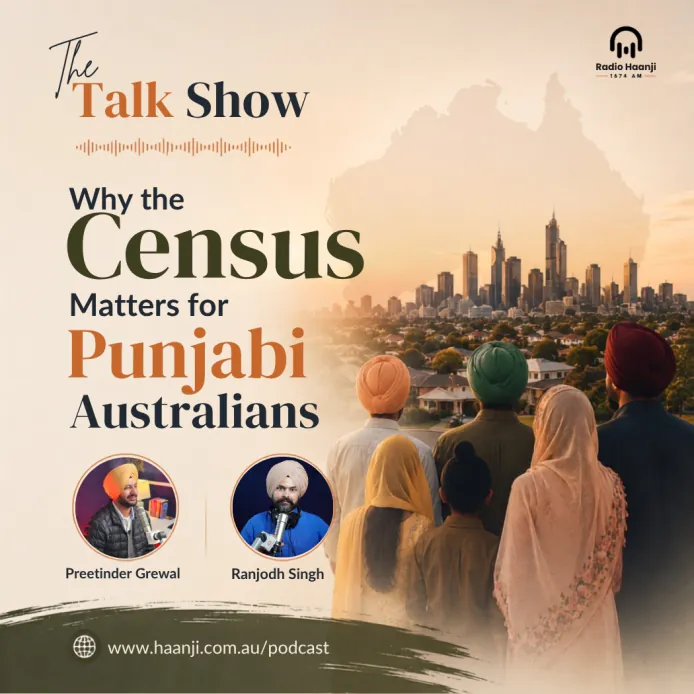
Why Every Punjabi Household Must Fill the 2026 Census - The Talk Show - Preetinder Grewal & Ranjodh Singh
Host:-
 Preetinder Grewal
 Ranjodh Singh
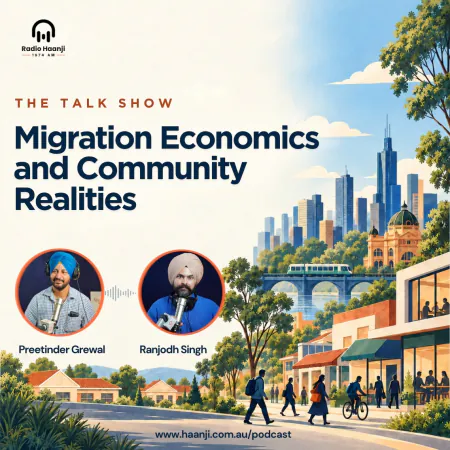
Preetinder Grewal & Ranjodh Singh break down the 2026 Australian Census rules, privacy, and why it matters for the Punjabi community. Listen now.
On this episode of The Talk Show, hosts Preetinder Grewal and Ranjodh Singh break down everything the Punjabi community in Australia needs to know before Census night on Tuesday, August 11, 2026. From who is legally required to take part to why ticking "Punjabi" as a home language actually matters for funding and representation, this episode is a practical guide for households across Melbourne and beyond.
The Australian Census runs once every five years through the Australian Bureau of Statistics (ABS), and 2026 marks another chance for the Punjabi diaspora to be counted accurately. Preetinder and Ranjodh walk through the rules, the privacy protections, and the numbers behind the community's fastest-growing suburbs, before moving into two listener requests that reflect the everyday life of the Punjabi community in Australia.
What Is the Australian Census and Who Needs to Fill It Out
The Census is a national headcount conducted every five years, and the next one falls on Tuesday, August 11, 2026. Every person physically present in Australia on Census night must be counted, and the hosts are clear that this is not limited to citizens or permanent residents.
International students, tourists passing through, and temporary workers are all required to participate. Ranjodh points out that this often catches newer arrivals off guard, since many assume the Census is only for people with permanent status. Preetinder adds that an accurate headcount depends entirely on everyone present being included, regardless of visa type or length of stay.
Is Census Data Shared With the ATO or Immigration
No. The Australian Bureau of Statistics keeps all individual Census responses strictly confidential and does not share personal information with the ATO, police, immigration, or any other government department. This is one of the most common concerns raised by the community, and the hosts address it directly on air.
Preetinder explains that this confidentiality is built into the Census Act itself, and that data is only ever released in aggregated, de-identified form for research and planning purposes. Ranjodh notes that this distinction matters for temporary visa holders in particular, some of whom worry that participating could affect their visa status. It cannot, and the hosts encourage listeners to fill out the form honestly and without hesitation.
Why the Punjabi Language Option Matters on the Census Form
The 2026 Census form includes "Punjabi" as a selectable language option, meaning respondents no longer need to write it manually under "Other." This might sound like a small administrative detail, but the hosts frame it as one of the most consequential parts of the form for the community.
When Punjabi is recorded as an official spoken language rather than buried in a write-in field, it becomes far easier for the ABS to produce clean, usable data. That data then feeds directly into decisions about interpreter services, aged care planning, and community funding. Preetinder makes the point plainly: an undercounted community is an underfunded community.
How Census Numbers Affect Funding for the Punjabi Community
Accurate language and demographic data from the Census directly shapes government funding decisions. This includes local services, healthcare provision, interpreters, aged care, childcare, and public transport planning in areas with high Punjabi populations.
Community infrastructure is also on the line. Gurdwaras, temples, and other community spaces often rely on demographic data to justify grant applications and council support. Ranjodh notes that a higher recorded population also strengthens the community's political representation and visibility among policymakers, which has flow-on effects well beyond any single funding cycle.
Where Do Most Punjabi Australians Live
Based on 2021 Census data, around 240,000 Punjabi speakers were recorded across Australia, with several suburbs standing out as major population hubs. Tarneit leads the pack, nearing 10,000 Punjabi speakers, followed by Craigieburn, Blacktown, Truganina, Clyde North, Wollert, Mickleham, Cranbourne East, Pakenham, and Point Cook.
These suburbs span both Melbourne and Sydney's growth corridors, reflecting how the community has clustered around newer housing developments over the past decade. Preetinder observes that many of these areas were relatively unknown a generation ago and have since become genuine cultural hubs with their own Gurdwaras, grocery stores, and community networks.
Education and Employment Trends in the Punjabi Community
The 2021 data also paints a picture of a highly educated and economically active community. Over 50 percent of Punjabi Australians hold higher education qualifications, including bachelor's degrees, master's degrees, or diplomas, and the community's workforce participation rate sits at 58 percent, notably higher than the national average of 47 percent.
Ranjodh links this back to family structure, noting that most Punjabi households in Australia are young families, with a growing number choosing nuclear, single-child arrangements. Preetinder suggests this pattern reflects a community still in its early settlement years, prioritising stability, education, and career building before extending family size.
Listener Requests: Flight Companions and Job Leads
As always, The Talk Show closes with community requests shared live on air. One listener is looking for a travel companion for elderly parents flying from Amritsar to Brisbane via Singapore Airlines on August 5, while another has a similar request for a flight from Delhi to Christchurch on August 7. Both are common asks for families whose older parents are not confident travelling long-haul routes alone.
A third listener used the segment to broadcast a job search, specifically looking for warehouse employment opportunities. Preetinder reminds listeners that these on-air requests are one of the most practical uses of community radio, connecting people directly with each other in ways that formal job boards or travel agencies often cannot.
Key Takeaways
- The 2026 Australian Census takes place on Tuesday, August 11, and everyone present in Australia that night must participate, regardless of visa status.
- The Australian Bureau of Statistics does not share individual Census responses with the ATO, police, or immigration authorities.
- Punjabi is available as a direct language selection on the 2026 form, improving data accuracy for the community.
- The 2021 Census recorded roughly 240,000 Punjabi speakers in Australia, with Tarneit as the leading suburb at nearly 10,000.
- Over 50 percent of Punjabi Australians hold higher education qualifications, and workforce participation stands at 58 percent, above the national average of 47 percent.
- Listener segments on The Talk Show continue to connect the community directly for travel companionship and job opportunities.
The 2026 Census is more than a form to tick off before a deadline. For the Punjabi community, it is a direct line to better funding, stronger representation, and services that actually reflect the size and needs of the population on the ground. Preetinder Grewal and Ranjodh Singh make the case clearly on this episode of The Talk Show. Listen to the full conversation on Radio Haanji, and if you have a travel companion request or community announcement of your own, get in touch to have it featured on air.
Related listening: Today Updates for daily news, Indian Updates for news from back home, and Notebook for reflective community conversations.
Frequently Asked Questions
Do international students in Australia need to complete the Census?
Can filling out the Census affect my visa application or status?
Why should I select Punjabi as my language on the Census instead of writing it under Other?
Which Australian suburbs have the largest Punjabi populations?
How does the Census benefit the Punjabi community directly?
What is the Punjabi workforce participation rate in Australia compared to the national average?
How can I get help finding a travel companion or sharing a community request like the ones mentioned on the show?
What's Your Reaction?