













































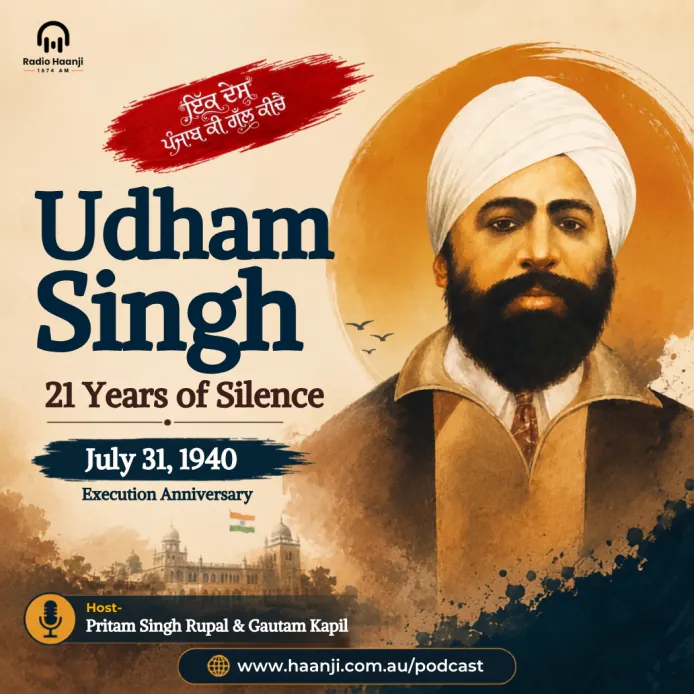
Udham Singh: The True Story Behind the Legend - Pritam Singh Rupal - Gauatam Kapil
Host:-
 Gurlal Singh
 Pritam Singh Rupal
Discover the real Udham Singh — beyond Jallianwala Bagh myths — his life in America, his politics, and why he killed Michael O'Dwyer.
In This Article
- The Man Behind the Folk Song
- Was Udham Singh Present at Jallianwala Bagh?
- An Orphan With Three Names
- Why Did Udham Singh Change His Name to Ram Mohammad Singh Azad?
- A Soldier, an Actor, a Husband: The Overseas Years
- The Making of a Revolutionary
- Who Did Udham Singh Kill, and Why?
- How Did Udham Singh Die?
- Why Has Udham Singh Been Left Out of Serious Research?
- Key Takeaways
- References and Further Reading
- Frequently Asked Questions
On July 31, 1940, a man was hanged at Pentonville Prison in London for a killing he had waited twenty-one years to carry out. That much of the Udham Singh story, most people already know. What gets lost — in folk songs, in film posters, in the handful of paragraphs textbooks devote to him — is everyone he was before that morning: an orphan, a soldier, a factory hand, an actor, a husband, and a committed revolutionary with a political vision far wider than a single act of retribution.
This distinction matters, and it was the starting point for a recent tribute discussion on Radio Haanji's podcast Ek Des Punjab Ki Gal Kiche, hosted by Gautam Kapil, with guest Pritam Singh Rupal offering a historian's corrective to the popular telling. Marking Udham Singh's death anniversary, the conversation pushed past the Caxton Hall shooting to ask a harder question: who was this man for the other forty years of his life?
What follows draws on that discussion to rebuild a fuller picture — one that keeps the courage of Caxton Hall intact, but does not let it stand in for everything else Udham Singh was.
The Man Behind the Folk Song
Popular culture has settled on a single, simplified version of Udham Singh: a young man who witnessed unspeakable horror at Jallianwala Bagh, carried a fistful of blood-soaked soil for two decades, and finally exacted revenge in London. It is a compelling story. It is also, in several important respects, not quite accurate.
According to the podcast discussion, this reduction does real damage. It flattens a man who lived across three continents, held several jobs, married outside his community, and aligned himself with an organised revolutionary movement — into a one-dimensional figure defined purely by trauma and vengeance. The result is a version of Udham Singh that is easier to put in a folk song, but harder to recognise as history.
The consequence, Rupal argued in the discussion, is that Punjab remembers the gun but forgets the ideology that pointed it.
Was Udham Singh Present at Jallianwala Bagh?
No — historical evidence indicates Udham Singh was not inside Jallianwala Bagh during the April 13, 1919 massacre. The widely repeated claim that he was serving water to victims and later collected blood-soaked soil from the site is part of popular mythology rather than documented history. He is understood to have visited the site the following day.
This is one of the most persistent myths surrounding his life, and it is worth pausing on because it changes how the rest of his story should be read. The water-carrier image casts Udham Singh as a witness whose singular purpose from that day forward was revenge — a neat, emotionally satisfying arc.
The historical record, as discussed on the podcast, suggests something closer to a young man radicalised over years, not in a single afternoon — through his orphanage upbringing, his exposure to revolutionary politics abroad, and his direct organisational links to groups actively resisting British rule. The massacre remained central to his motivation, but as a symbol of colonial violence he came to understand more fully with time and political education, not as a scene he personally survived.
An Orphan With Three Names
Udham Singh's early life was shaped by loss well before politics entered the picture. After both his parents died when he was a child, he and his brother Mukta Singh were taken in by the Central Khalsa Orphanage in Amritsar — an institution that would go on to shape his worldview, his discipline, and, indirectly, his later political consciousness.
Growing up in an orphanage in the very city where the 1919 massacre would take place placed him close to the epicentre of colonial Punjab's most defining trauma, even if he was not literally present in the garden that day. It was an upbringing without the anchor of a fixed family identity — a detail that becomes significant later, when Udham Singh deliberately chose to construct a new identity of his own.
Why Did Udham Singh Change His Name to Ram Mohammad Singh Azad?
Udham Singh adopted the name Ram Mohammad Singh Azad as a deliberate political statement, not merely an alias for evading capture. The three names — representing Hindu, Muslim, and Sikh identities — combined with "Azad" (meaning "free") were intended to project secular, communal unity against a colonial power that often exploited religious division. It was an identity, not a disguise.
This detail rarely survives in the popular retelling, which tends to focus on the pistol rather than the philosophy. But the choice of name reveals a man actively thinking about India's post-colonial future — one in which the country's major religious communities stood together rather than apart.
In an era when the British administration was frequently accused of using communal fault lines to weaken anti-colonial resistance, Udham Singh's chosen name was itself a small act of resistance: a rejection of the idea that Hindus, Muslims, and Sikhs needed separate freedom struggles.
A Soldier, an Actor, a Husband: The Overseas Years
Between the orphanage and Caxton Hall lay two decades that popular memory largely skips over — and they were anything but idle. Udham Singh served in the British Army, including an overseas posting in Basra, an experience that gave him organisational discipline and firsthand knowledge of international travel routes that would later prove useful to his revolutionary work.
His time abroad was also personal, not only political. He lived in the United States for a period, where he married a Mexican woman named Lupe Hernandez and had children with her — a family life that was disrupted when tightening American immigration laws, including the Immigration Act of 1924, forced a separation. He also worked a range of jobs across different countries, including a stint acting in British films, alongside various trades.
Taken together, this period paints a portrait very different from the singular, revenge-driven figure of popular imagination. Udham Singh built and lost a family, crossed oceans for work, and moved through ordinary working-class life in multiple countries — all while his political convictions continued to sharpen.
The Making of a Revolutionary
Udham Singh's overseas years were not politically neutral. He developed close ties to the Ghadar Party, the transnational Indian independence movement built largely among immigrant communities in North America, and he was influenced by the ideas of Bhagat Singh and the Hindustan Socialist Republican Association (HSRA).
That political trajectory had direct consequences at home. In 1927, Udham Singh was arrested in Punjab in possession of illegal arms and anti-British literature, and he served a five-year prison sentence as a result. Following his release, continuous surveillance by British intelligence made it impossible for him to operate freely in India, and he was forced to flee — travelling through Kashmir, Kabul, and Germany before eventually reaching London.
This is not the profile of a lone actor nursing a private grievance. It is the profile of a committed operative within an organised, transnational revolutionary network — one for whom Michael O'Dwyer's death would ultimately serve a political purpose larger than personal retribution.
Who Did Udham Singh Kill, and Why?
On March 13, 1940, Udham Singh shot and killed Michael O'Dwyer at Caxton Hall in London. O'Dwyer was the former Lieutenant Governor of Punjab who had approved the martial law under which the Jallianwala Bagh massacre occurred — not General Reginald Dyer, the officer who gave the direct order to fire, who had already died in 1927.
This distinction matters and is frequently confused in casual retellings. Dyer was the man on the ground; O'Dwyer was the administrator whose policy decisions created the conditions in which the massacre happened and who publicly defended it afterward. Udham Singh's target selection reflected a clear understanding of where ultimate political responsibility lay.
At his trial, Udham Singh gave a defiant courtroom statement condemning British imperialism, expressing no fear of execution and framing his act in explicitly anti-colonial political terms rather than as a personal act of vengeance. It is a speech historians point to as further evidence of his ideological clarity — a man who saw himself as a soldier in a political struggle, not simply an avenger.
How Did Udham Singh Die?
Udham Singh was executed by hanging on July 31, 1940, at Pentonville Prison in London, following his conviction for the murder of Michael O'Dwyer. His trial and the courtroom statement he delivered became, in the years since, as significant to his legacy as the shooting itself.
His death anniversary is now marked annually across Punjab and the wider Sikh diaspora, often accompanied by renewed public interest in his life story — interest that, as the podcast discussion highlights, still tends to focus disproportionately on the final act rather than the four decades that preceded it.
Why Has Udham Singh Been Left Out of Serious Research?
Indian and Punjabi academic institutions have historically produced comparatively limited, rigorous, multi-dimensional research on Udham Singh, with much of the deeper archival work instead coming from Western historians. Scholars such as Louis E. Fenech have contributed significantly to reconstructing his biography with source-based rigour that has been less consistently matched within Indian academia.
The gap has consequences. Without sustained academic attention, popular memory fills the space instead — and popular memory, shaped by folk songs and film, tends to compress complexity into a simpler, more marketable narrative. The myth of the water-carrier at Jallianwala Bagh is one product of that compression; the erasure of his secular political identity, symbolised in the name Ram Mohammad Singh Azad, is another.
The podcast discussion frames this as an ongoing loss — not just of historical accuracy, but of the intellectual and ideological dimensions of Udham Singh's life that could offer a richer model of anti-colonial resistance than the revenge narrative alone provides.
Key Takeaways
- Udham Singh was not present inside Jallianwala Bagh during the April 13, 1919 massacre and is understood to have visited the site the following day, contrary to the popular water-carrier legend.
- He was raised, along with his brother Mukta Singh, at the Central Khalsa Orphanage in Amritsar after losing both parents in childhood.
- His adopted name, Ram Mohammad Singh Azad, was a deliberate symbol of Hindu-Muslim-Sikh unity and anti-colonial freedom, not simply an alias.
- He lived and worked in the United States, married Lupe Hernandez, and had children before the Immigration Act of 1924 contributed to their separation.
- On March 13, 1940, he shot and killed Michael O'Dwyer, the former Lieutenant Governor of Punjab, at Caxton Hall in London, and was executed at Pentonville Prison on July 31, 1940.
- Western historians, including Louis E. Fenech, have produced more extensive scholarly research on Udham Singh's life than has generally emerged from Indian and Punjabi academic institutions.
Frequently Asked Questions
Was Udham Singh related to Bhagat Singh?
Why did it take Udham Singh 21 years to kill Michael O'Dwyer?
Did Udham Singh have children?
Is Udham Singh considered a martyr or a terrorist?
What is the significance of Caxton Hall in Udham Singh's story?
Why is Reginald Dyer sometimes wrongly named as Udham Singh's target?
How is Udham Singh's death anniversary commemorated today?
What's Your Reaction?







Related Posts