













































































Miri Piri Diwas: History, Meaning, and Significance in Sikhism - Didar Singh
Host:-
 Didar Singh
Discover the history and significance of Miri Piri Diwas. Learn how Guru Hargobind Sahib Ji established the two swords of spiritual and temporal power.
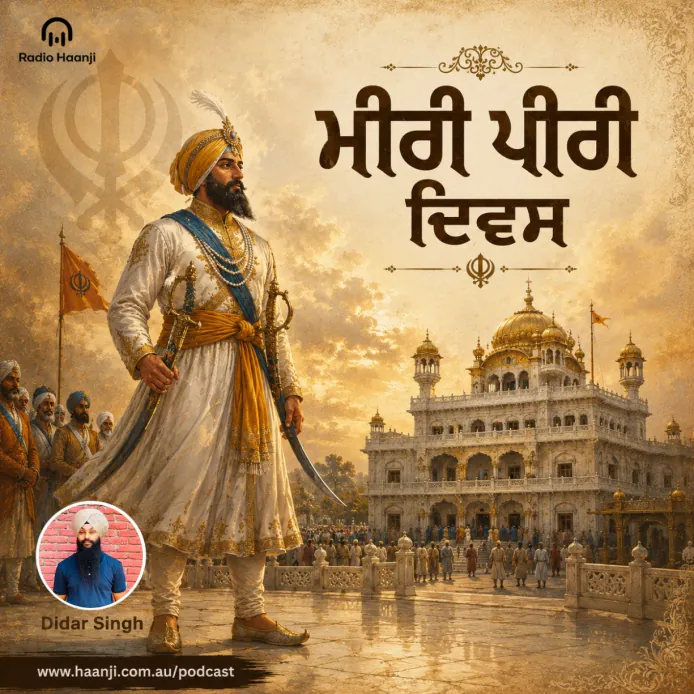
Sikh history is rooted in a profound philosophy that balances inner spiritual devotion with outer strength and sovereignty. Central to this framework is the concept of Miri Piri, established by the Sixth Sikh Guru, Guru Hargobind Sahib Ji. Celebrated annually as Miri Piri Diwas, this pivotal historical moment redefined the Sikh identity, giving rise to the concept of the Sant-Sipahi (Saint-Soldier).
Understanding the origin, linguistic roots, and spiritual importance of Miri Piri reveals why this doctrine remains vital to Sikh philosophy today.
The Etymology and Philosophy of Miri and Piri
To grasp the full essence of Miri Piri, it helps to look at the linguistic origins of both words:
-
Miri (Temporal Power): Originating from the Arabic word Amir (meaning ruler, commander, or leader), Miri represents royalty, political authority, military force, and governance.
-
Piri (Spiritual Authority): Derived from the Persian word Pir (meaning spiritual guide or saint), Piri signifies spiritual wisdom, moral purity, and inner enlightenment.
While worldly philosophy often views political authority and spiritual life as opposing forces, Sikhism unifies them. In Sikh thought, physical force (Miri) must always be guided and restrained by spiritual wisdom (Piri).
Historical Background: Guru Hargobind Sahib Ji’s Transformation
The foundation of Miri Piri emerged during a dark period of oppression in 17th-century India. Following the martyrdom of the Fifth Sikh Guru, Guru Arjan Dev Ji, in Lahore in 1606, the necessity for self-defense and resistance against injustice became clear.
When the young Guru Hargobind Sahib Ji assumed the Guruship, a traditional succession ceremony was performed by Baba Buddha Ji. In a departure from precedent, Guru Hargobind Sahib Ji requested that the traditional spiritual symbol—the Seli Topi—be placed safely in the treasury.
Instead, the Guru donned two swords:
-
The Sword of Miri: Representing worldly leadership, defense, and temporal strength.
-
The Sword of Piri: Representing spiritual leadership, grace, and moral righteousness.
Court minstrels (Dhadis) Natha Ji and Abdulla Ji immortalized this historic event in a famous ballad (Vaar), celebrating the Guru as a sovereign who wore two swords—one of spiritual mastery and one of royal command.
The Establishment of Sri Akal Takht Sahib
To give a physical form to the concept of temporal authority, Guru Hargobind Sahib Ji established Sri Akal Takht Sahib (The Throne of the Timeless One) directly opposite Sri Harmandir Sahib (The Golden Temple) in Amritsar.
During this era, Mughal Emperor Jahangir had issued a decree forbidding anyone other than the emperor from building a raised seating platform higher than two feet. Challenging this tyrannical rule, Guru Hargobind Sahib Ji constructed a 12-foot-high platform for Sri Akal Takht Sahib.
This pair of sites perfectly illustrates the Miri-Piri dynamic:
-
Sri Harmandir Sahib represents Piri—a sanctuary for devotion, prayer, and humility.
-
Sri Akal Takht Sahib represents Miri—a seat for justice, governance, and communal strategy.
Guru Hargobind Sahib Ji called upon the congregation (Sangat) to bring gifts of fine horses, armor, and weapons, urging Sikhs to develop physical strength alongside their spiritual devotion.
The Evolution into the Saint-Soldier (Sant-Sipahi)
The principle of Miri Piri laid the groundwork for the evolution of the Sikh community over the next century. In 1699, Guru Gobind Singh Ji, the Tenth Sikh Guru, institutionalized this concept through the creation of the Khalsa Panthon Vaisakhi.
Every Sikh was called to be a Sant-Sipahi (Saint-Soldier)—a person who meditates on the Divine while standing ready to protect the innocent and fight tyranny.
The Symbolism of the Two Nishan Sahibs
Visitors to Sri Akal Takht Sahib can observe two saffron flags (Nishan Sahibs) standing side by side. A closer look reveals a subtle, meaningful distinction:
-
The flag representing Piri is slightly higher than the flag representing Miri.
This intentional design carries an enduring lesson: political and physical power (Miri) must always bow to spiritual truth, ethics, and righteousness (Piri). Power without spirituality leads to tyranny, while spirituality without the strength to defend it leads to vulnerability.
Conclusion
Miri Piri Diwas is not merely a historical commemoration; it is an ongoing call to balance inner faith with social responsibility. By wearing the two swords of spiritual grace and righteous courage, Guru Hargobind Sahib Ji provided a timeless blueprint for standing firm against oppression while keeping the heart grounded in divine devotion.
Frequently Asked Questions
What is Miri Piri Diwas?
What do the words 'Miri' and 'Piri' mean?
Who introduced the concept of Miri Piri?
What is the relationship between Sri Harmandir Sahib and Sri Akal Takht Sahib?
Why is the Piri flag higher than the Miri flag at Sri Akal Takht Sahib?
What's Your Reaction?