








































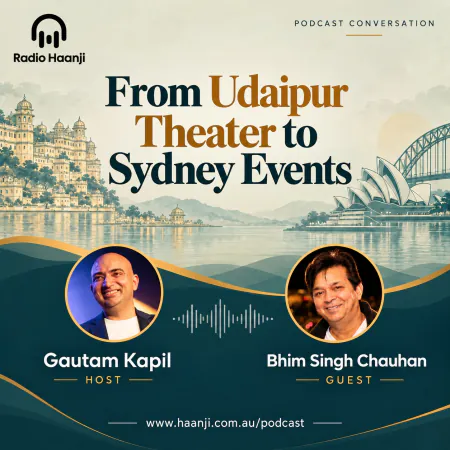















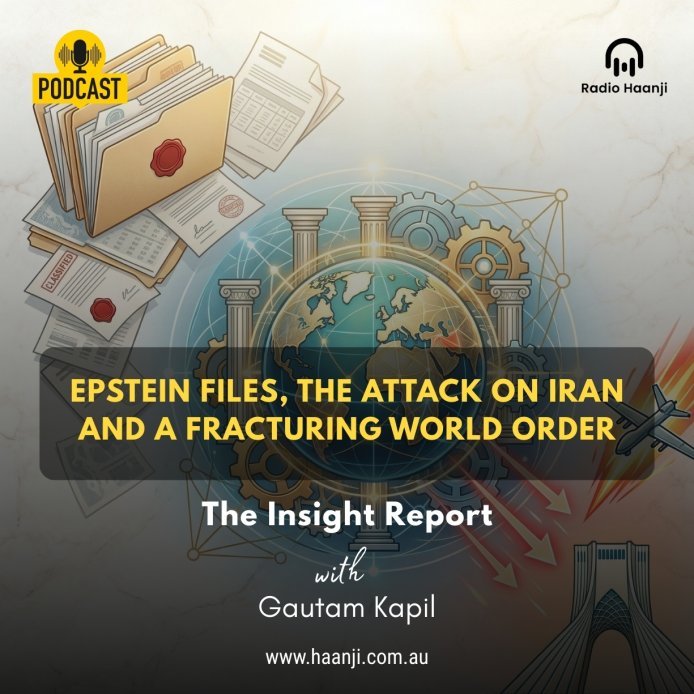
The Insight Report - Epstein Files, Iran Attack and World Order - Gautam Kapil - on Radio Haanji
Host:-
 Gautam Kapil
Did the Iran attack distract from Epstein files? Gautam Kapil unpacks global power plays on The Insight Report, Radio Haanji 1674 AM. Listen free now.
The Insight Report - March 2026 - Epstein Files, the Attack on Iran and a Fracturing World Order - Analysis on Radio Haanji
Some weeks in global politics produce more questions than answers, and this is one of them. On this week's edition of The Insight Report on Radio Haanji 1674 AM, host and political analyst Gautam Kapil takes on three of the most consequential and interconnected stories circulating in international discourse right now — the release of the Epstein files, the US and Israeli military strikes on Iran, and the accelerating erosion of the world order that has governed global affairs for the better part of a century. This is the kind of episode that reminds you why The Insight Report exists: to go where the surface-level news coverage stops and ask the questions that genuinely matter.
The Epstein Files and the Question Washington Does Not Want Asked
The release of the Epstein files has sent a sustained tremor through American political life, and the reverberations are far from over. For those still catching up, the documents in question relate to the late Jeffrey Epstein — the financier convicted of sex trafficking whose extensive connections to some of the most powerful figures in global politics, finance and entertainment have made his files among the most politically sensitive documents in recent American history.
The core question that Gautam Kapil raises this week is one that is already being asked loudly in certain political quarters in the United States: is there a connection between the timing of the Epstein files becoming a serious political liability for the current administration and the decision to launch military strikes against Iran? US Senator Ted Lieu has publicly made this very allegation, suggesting that the military action may have served, whether by design or convenience, to push the Epstein revelations off the front pages and out of the dominant news cycle.
It is worth being clear about what this allegation is and what it is not. It is not a proven fact. It is a political charge made by an elected official in the context of a deeply polarised American political environment. But the very fact that a sitting US senator felt the ground was firm enough beneath him to make such a claim publicly tells us something important about the level of distrust that currently exists at the heart of American political life.
For the Punjabi and Indian community in Australia, this is not a distant American soap opera. The decisions made in Washington — about who to strike, when and why — reshape the entire geopolitical environment within which every nation on earth, including Australia and India, must operate. The Epstein files are ultimately a story about power, its abuse and the lengths to which powerful institutions will go to protect themselves. That is a story that belongs to no single country.
Iran, the Nuclear Question and a Timeline That Demands Scrutiny
The second thread of this week's Insight Report carries its own weight of uncomfortable implications. Reports emerging from Middle Eastern media outlets have raised a pointed and so far inadequately answered question: had Iran already accepted the conditions for a nuclear treaty with the United States before the military strikes began?
If that reporting is accurate — and Gautam Kapil is careful to frame it as a claim requiring serious scrutiny rather than established fact — then the logic of the military operation becomes significantly harder to explain through conventional strategic reasoning. A diplomatic agreement on Iran's nuclear programme has been the stated goal of American foreign policy for years. If Tehran had moved meaningfully toward accepting the terms of such an agreement, then a simultaneous military strike in coordination with Israel raises questions that go well beyond standard geopolitical analysis.
This is the kind of question that The Insight Report is built to ask. Not to arrive at a predetermined conclusion, but to hold the available facts and claims up to the light and ask whether the official narrative is complete. The gap between what governments say they are doing and why, and what the underlying strategic and political motivations actually are, is often where the most important journalism lives.
Israel's role in the joint operation also deserves careful consideration. Israel has its own distinct strategic interests in relation to Iran that do not always map neatly onto Washington's. The two countries have coordinated closely on Iran-related military planning for years, but the question of who benefits most from striking now — and what each party gains from the timing — is one that analysts and policymakers across the world are actively working through.
For Indian and Punjabi listeners in Australia following this story, the Iran situation matters for reasons that are immediate and practical. India has deep economic and diplomatic ties with Iran, including the strategically important Chabahar port agreement. Every escalation in the region affects the calculations New Delhi must make, and those calculations in turn affect the broader environment within which the Indian diaspora's home country must navigate its future.
The World Order Is Being Rewritten — and the Punjabi Community Needs to Understand How
The third lens through which Gautam Kapil frames this week's episode is the broadest and in some ways the most significant: the question of world order itself. The phrase gets used so frequently in political commentary that it risks losing its meaning, but what it points to is genuinely important — the system of international institutions, norms, alliances and agreements that was constructed after World War Two and that has, with considerable imperfection, provided the framework within which nations have managed their disputes for decades.
That framework is under stress in ways that are now visible to anyone paying attention. The United Nations Security Council is functionally paralysed on the most significant conflicts of the current moment. NATO's cohesion is being tested by questions about the reliability of American commitments. The rules-based international order — a phrase that means different things depending on who is using it — is being challenged simultaneously from multiple directions, by both state and non-state actors.
What connects the Epstein files, the attack on Iran and the question of world order is this: each of them, in its own way, reflects a moment in which the gap between official justifications and underlying realities has become too wide for even mainstream audiences to ignore. When a sitting senator publicly questions whether a military strike was timed to serve domestic political purposes, when credible media reports suggest a diplomatic agreement may have been bypassed rather than built upon, and when international institutions remain silent — the architecture of the world order is not merely being tested, it is being visibly reshaped.
For the Indian and Punjabi community in Australia, understanding these shifts is not an abstract intellectual exercise. Australia is a nation deeply embedded in the Western alliance system. India is a rising power navigating its own complex path between established and emerging poles of global influence. The world that is being constructed right now — through military decisions, political scandals and diplomatic silences — is the world in which the next generation of the diaspora will build their lives. The Insight Report on Radio Haanji 1674 AM is one of the very few platforms offering the Punjabi community the analytical depth to genuinely understand what is being built and what is being torn down.
Why The Insight Report Is Essential Listening for the Indian Diaspora in Australia
There is no shortage of news available to the Indian and Punjabi community in Australia. What has historically been in short supply is quality analysis — the kind of rigorous, contextual, community-aware commentary that takes global events seriously and trusts the audience to engage with complexity. The Insight Report fills that gap with authority and consistency.
Gautam Kapil brings to each episode the kind of geopolitical literacy that comes from years of close engagement with international affairs. His analysis is not designed to tell listeners what to think — it is designed to give them the context and the questions they need to think more clearly for themselves. As an Indian political analysis podcast specifically created for the diaspora experience, The Insight Report understands that its audience is simultaneously part of Australian civic life and deeply invested in what is happening across Asia, the Middle East and the broader world.
As one of the most substantive offerings in Punjabi podcasting in Australia today, this show consistently tackles the stories that other platforms simplify or avoid entirely. Whether it is the domestic politics of a superpower, the shifting dynamics of a regional conflict or the slow transformation of global institutions, The Insight Report delivers the depth that the Indian community in Australia deserves and that Radio Haanji 1674 AM has always been committed to providing.
Listen to The Insight Report - Free, Every Week on Radio Haanji
The Insight Report is available free of charge across all major listening platforms. Here is how you can access this week's episode and subscribe so you never miss a future analysis:
Listen on Spotify — Follow The Insight Report on Spotify and have each new episode delivered directly to your library.
Listen on Apple Podcasts — Subscribe on Apple Podcasts for seamless access on any Apple device.
Download the iOS app — Stream Radio Haanji live and on-demand through the official iOS app, available free on the App Store.
Download the Android app — Android users can access The Insight Report and the full Radio Haanji archive through the app on Google Play.
The questions raised in this week's episode will not be resolved quickly, and Gautam Kapil will be back next week to continue following where the evidence and the analysis lead. Tune in to The Insight Report on Radio Haanji 1674 AM — because in a world full of noise, clear thinking has never mattered more.
What's Your Reaction?