










































































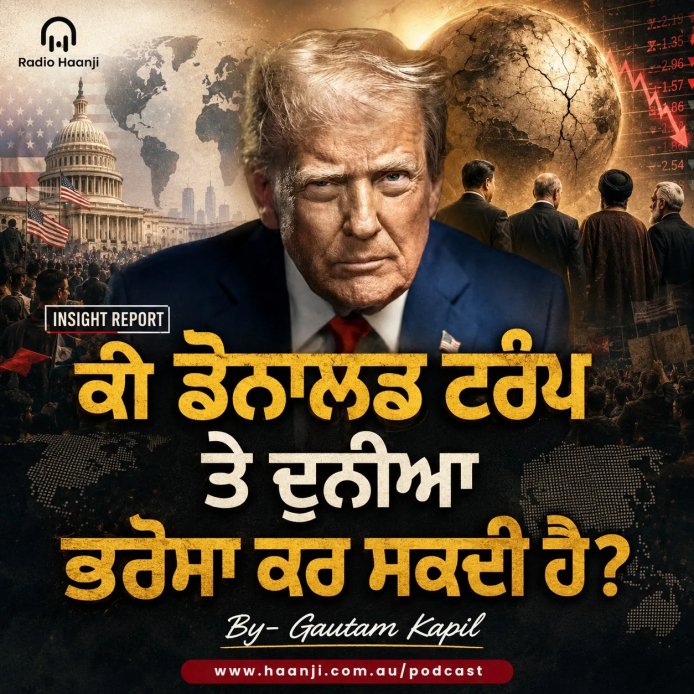

Catch the 30 June Insight Report with Gautam Kapil on Radio Haanji 1674 AM. We analyze global trust in Donald Trump through the lens of recent military and economic crises.
The predictability of international treaties has become the center of global debate as modern geopolitical alliances face severe strains. In this edition of the Insight Report on Radio Haanji 1674 AM, host Gautam Kapil brings our community a deeply analytical perspective on a critical question echoing through diplomatic corridors worldwide: ਕੀ ਡੋਨਾਲਡ ਟਰੰਪ ਤੇ ਦੁਨੀਆ ਭਰੋਸਾ ਕਰ ਸਕਦੀ ਹੈ? (Can the world trust Donald Trump?). Looking closely at the cascading impacts of historical decisions on the current regional and economic wars of 2026, this episode explores the broader concept of international trust, its connection to changing American foreign policy, and the long-term structural ripple effects felt by both allies and global rivals.
The Domino Effect of Broken Diplomatic Frameworks
To understand whether the global community can place its trust in unilateral leadership styles, one must examine the lasting structural consequences of broken agreements. Prior to the intense military escalations of early 2026, a comprehensive diplomatic understanding regarding nuclear restrictions and uranium enrichment was on the verge of finalization between Western powers and Iran in Geneva. However, this delicate process collapsed entirely, heavily influenced by a major historical trigger: the decision by the United States to unilaterally withdraw from the 2015 Joint Comprehensive Plan of Action (JCPOA) nuclear framework under a prior administration led by Donald Trump.
This structural departure from established multilateral agreements created a deep deficit of trust that directly shaped future escalations. The sudden collapse of these long-term talks showed that foreign policy shifts within major global powers can instantly overwrite years of careful diplomacy. When sudden military interventions disrupted the peace process, leading to the targeted strike on uranium enrichment infrastructure and the loss of nine prominent nuclear scientists within their homes, the global community was reminded of how quickly institutional security can vanish when foundational treaties are discarded.
Military Vulnerability and Strained Alliances: The Impact on AUKUS
The question of international trust extends far beyond adversarial relationships; it fundamentally alters how dependable a superpower appears to its closest strategic allies. Under the pretext of urgent intelligence profiles claiming rapid weapons development at facilities like Fordow, full-scale military engagements drew active U.S. defensive backing. The deployment of the elite Terminal High Altitude Area Defense (THAAD) anti-ballistic missile system was meant to project absolute security against subsequent drone and missile responses from regional proxy networks like Hezbollah and Hamas.
Instead, modern asymmetric warfare exposed severe supply vulnerabilities. Mass-produced, low-cost drone swarms rapidly saturated defensive airspaces, successfully depleting an estimated 70% to 80% of active U.S. THAAD interceptor stocks, leaving only 100 to 150 operational systems worldwide. This sudden domestic pressure to restock and develop next-generation defense technologies immediately strained foreign commitments. Under the AUKUS agreement, the United States has recently pressured Australia to accept older-model, pre-owned submarines instead of newly manufactured nuclear-powered vessels. For international observers, this shift highlights a critical lesson: when domestic pressures mount, even formal strategic pacts with trusted allies can be modified or delayed, reshaping the very definition of geopolitical trust.
Economic Realignment and the Currency Battleground
When the predictability of international leadership is called into question, major global powers do not merely react politically—they adjust their fundamental economic dependencies. The ongoing conflict sits directly upon the Strait of Hormuz, a vital maritime bottleneck controlling approximately 20% of global petroleum and liquefied natural gas (LNG) movements. With any disruption to this passage presenting an immediate 70% energy supply threat to China, the vulnerability of relying on Western-backed stability frameworks has accelerated a highly sophisticated financial currency war.
Historically, global energy markets have operated on absolute trust in the U.S. Dollar, which maintained a strict monopoly over Gulf energy transactions. However, the visible fragility of recent security guarantees has given nations like China and Russia the perfect opportunity to push alternative trade settlements. By actively shifting oil trade payments into local currencies like the Yuan and the Ruble, these global economies are purposefully building a parallel financial system. This strategic shift demonstrates that when confidence in international security policies wavers, the world rapidly moves away from centralized economic monopolies toward a fragmented, multipolar financial reality.
Frequently Asked Questions (FAQs)
Why is the 2015 nuclear framework withdrawal central to the debate on political trust?
The unilateral withdrawal of the United States from the 2015 JCPOA nuclear agreement under the prior Trump administration is a primary case study in geopolitical predictability. It demonstrated that long-term, multi-nation treaties can be abruptly discarded due to internal political shifts, making it difficult for foreign nations to rely fully on long-term diplomatic assurances from Washington.
How do domestic manufacturing delays alter international strategic agreements like AUKUS?
When a superpower faces sudden, massive consumption of critical military assets—such as the rapid depletion of THAAD interceptor inventories—its industrial base must prioritize domestic replenishment. This operational stress forces a recalculation of foreign promises, directly resulting in changes to agreements like AUKUS, where allies like Australia are asked to adjust to older-model hardware deliveries.
What happens to global economic trust when critical shipping routes are threatened?
Critical bottlenecks like the Strait of Hormuz handle nearly one-fifth of global energy traffic. When these routes face active disruption, it threatens up to 70% of major industrial economies' energy imports, such as China's. This vulnerability forces dependent nations to actively reduce their exposure to Western financial structures and look for independent security alternatives.
How does a currency shift to the Yuan or Ruble affect the global financial monopoly?
For generations, the global petrodollar system required nations to hold vast reserves of U.S. Dollars to purchase energy assets. When countries systematically move their trade settlements to alternative currencies like the Yuan and the Ruble during geopolitical crises, it weakens the absolute global monopoly of the dollar and accelerates the rise of a multipolar financial system.
For more analytical deep dives into international security, global exploration, and historic breakthroughs, listen to The Deep Talk Show. Stay informed with immediate world news analysis via Today Updates, or follow localized community perspectives through our dedicated Indian Updates hub. If you want to take a break from tracking heavy global political updates, join the conversation on Laughter Therapy Episodes, dive into captivating narrative audio journeys on Kitaab Kahani Audio Stories, or view our regular community columns on Boys Meetup and the Radio Haanji Notebook.
What's Your Reaction?