































































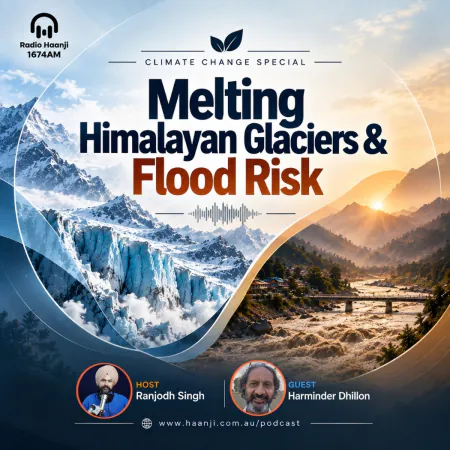




























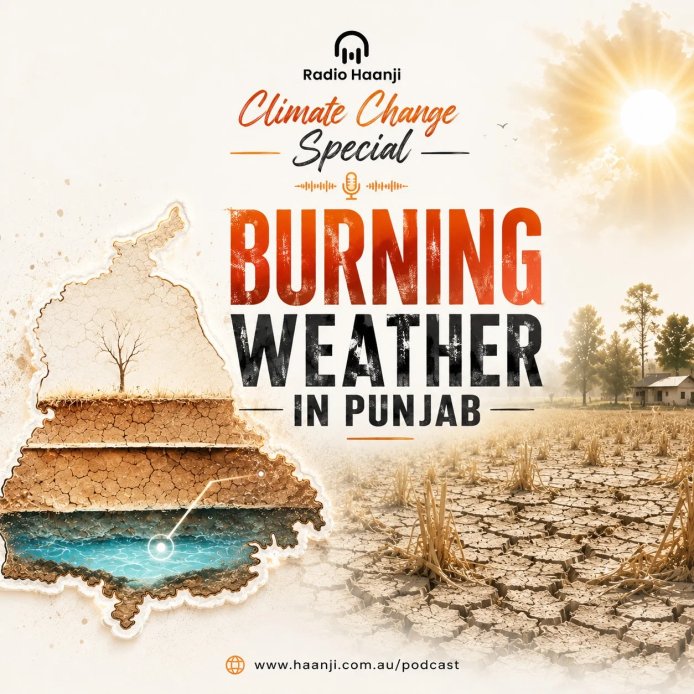
Burning Weather in Punjab - The Reality of Climate Change and the 2039 Water Crisis - Harminder Dhillon & Ranjodh Singh
Host:-
 Harminder Dhillon
 Ranjodh Singh
Record 47°C heatwaves, a depleting third aquifer layer, and silent casualties. Discover how climate change is directly impacting Punjab and India in this critical Radio Haanji podcast episode with Harminder Dhillon and Ranjodh Singh.
The climate crisis is no longer a theoretical warning hidden away in scientific journals. In the summer of 2026, it has manifested as an undeniable, punishing reality across the Indian subcontinent, hit hardest in the agricultural heartland of Punjab. On a recent episode of The Climate Change Special series on Radio Haanji, host Ranjodh Singh and guest Harminder Dhillon brought forward a sobering look at how global warming is actively reshaping life, health, and the economic future of Punjab.
As one of the very few digital spaces tackling complex environmental science entirely in the Punjabi language, this podcast bridges the gap between global climate data and grassroots reality, making it essential listening for the global Punjabi diaspora.
Severe Heatwaves and Rising Temperatures: India as a Global Hotspot
May 2026 entered the history books for all the wrong reasons. During this month, India was identified as the hottest country on Earth. For a brief, alarming window, all 100 of the hottest locations recorded across the entire planet were located simultaneously within India. In Punjab, thermometers consistently hit grueling peaks of up to 47°C, while neighboring regions like Dadu in Pakistan recorded an astonishing 52°C.
However, the most dangerous shift isn't just the daytime peak; it is the lack of nighttime cooling. Nighttime temperatures in Punjab now frequently remain as high as 32°C to 33°C. Without a drop in temperature after dark, the human body and local ecosystems are deprived of the critical recovery period needed to withstand consecutive days of extreme heat.
Historically, intense heatwaves lasted for a few days before breaking. Today, these extreme thermal patterns persist for entire months, stalling life from early May until the delayed arrival of the monsoon rains in late June or July.
The Ecological and Agricultural Toll in Punjab
The agricultural framework of Punjab is experiencing intense volatility due to these shifting weather patterns. In early May, regions such as Abohar and Fazilka suffered sudden, severe unseasonal hailstorms. Dropping stones measuring up to two inches, these storms completely flattened standing crops, wiping out months of intensive farm labor in a matter of hours.
Simultaneously, the prolonged heat is altering the local flora and fauna:
- Flora Degradation: Intense ambient heat is effectively baking fruit trees alive. Unripe jamun fruits are burning on the branches and dropping prematurely, while residential peach orchards are drying out completely.
- Wildlife Fatalities: The sky has become unsafe for local wildlife. Birds including hawks, pigeons, and bats are experiencing acute respiratory distress brought on by the combination of extreme heat and stagnant air, losing consciousness and dying mid-air.
The 2039 Groundwater Deadline
Beyond the atmospheric heat lies an even more severe ecological threat: Punjab is rapidly running out of water. Driven primarily by the water-intensive requirements of traditional paddy (rice) farming, the state has systematically drained its underground water resources.
Punjab is currently pumping from its third and final aquifer layer, located roughly 300 feet beneath the surface. Hydrological models and expert projections discussed in the interview reveal that if current extraction rates continue unchecked, Punjab’s groundwater resources could be entirely exhausted by the year 2039. A state built on agriculture faces an existential deadline less than a generation away.
The Human Cost: Unreported and Misclassified Casualties
The public health consequence of this climate shift is staggering, yet largely invisible in official data. Scientists estimate that severe heatwaves account for roughly 3,400 deaths per day across India during peak stretches. To put this into perspective, this daily loss of life surpasses the casualties seen in major historical tragedies like the 9/11 attacks.
Why is this crisis not provoking an immediate emergency response? The answer lies in data misclassification. Marginally few death certificates list "climate change" or "heat stroke" as the primary cause of death. Instead, these casualties are recorded as standard cardiac arrests, strokes, acute kidney failures, or severe blood pressure spikes. In reality, these are systemic failures caused directly by the human body’s inability to regulate its internal temperature under relentless environmental stress.
The socioeconomic divide further exacerbates this toll. Daily wage laborers, farmers, construction workers, and transport drivers have no choice but to work outdoors during peak daylight hours, bearing the direct brunt of an increasingly uninhabitable climate.
Systemic Apathy vs. Proactive Solutions
Despite the clarity of the data, political leadership in regions like Punjab continues to show significant apathy. Many local politicians lack the technical background or the long-term vision required to address global warming. Short-term election cycles, localized corruption, and immediate economic relief measures consistently take priority over passing long-term environmental policies.
While states like Tamil Nadu implemented mandatory rainwater harvesting laws as early as 1996, Punjab has lagged significantly behind in enacting or enforcing strict water conservation laws, even on modern government infrastructure.
Individual Actions and Systemic Shifts
Addressing this crisis requires a combination of macro-policy changes and direct personal accountability. As a major El Niño cycle approaches, threatening to disrupt weather patterns further, immediate action must be taken across multiple sectors:
- Clean Energy Transition: India is experiencing a massive shift toward renewable energy, with roughly 10,000 households installing solar panels daily. The current national initiative aims to scale this transition to reach 10 million (1 crore) homes by next year.
- Dietary Adjustments: Reducing global red meat consumption is critical, given that livestock farming generates a carbon footprint comparable to the entire global transportation sector.
- Conscious Consumerism: Rethinking everyday fast fashion habits can save immense resources. For context, manufacturing a single standard cotton t-shirt requires an estimated 2,700 liters of water.
Ultimately, preserving the environment must transcend political, regional, and religious divisions. No culture, economy, or society can survive on an unlivable planet. Protecting our shared home is the ultimate collective responsibility of our time.
Frequently Asked Questions (FAQs)
Why is Punjab’s groundwater depleting so quickly?
The primary driver of groundwater depletion in Punjab is the heavy cultivation of paddy (rice), a crop that requires immense amounts of standing water. Because rainfall alone cannot sustain these fields, farmers rely on deep tube wells to pump water from subterranean aquifers faster than natural rainfall can replenish them.
What is the 2039 aquifer projection for Punjab?
Environmental experts estimate that Punjab is currently extracting water from its third and final viable aquifer layer, situated at a depth of around 300 feet. At the current rate of consumption, this final reserve is projected to run completely dry by 2039, leaving the region facing absolute water scarcity.
How do heatwaves cause hidden fatalities in India?
Extreme ambient heat places immense stress on the human cardiovascular, respiratory, and renal systems. When individuals pass away from heat-induced complications, medical records often list the immediate physiological failure—such as a heart attack, stroke, or kidney failure—rather than the extreme heatwave that triggered the medical emergency.
Where can I listen to more discussions on society, science, and news?
Radio Haanji offers a diverse lineup of specialized audio programming. For global news and current events, explore our Today Updates and dedicated Indian Updates. If you are interested in deeper explorations of science, space, and planetary ecosystems, tune into The Deep Talk. For community stories, cultural commentary, and entertainment, check out the Notebook segment, Boys Meetup, our curated Kitaab Kahani Audio Stories, or enjoy lighthearted relief with our Laughter Therapy Episodes.
What's Your Reaction?