












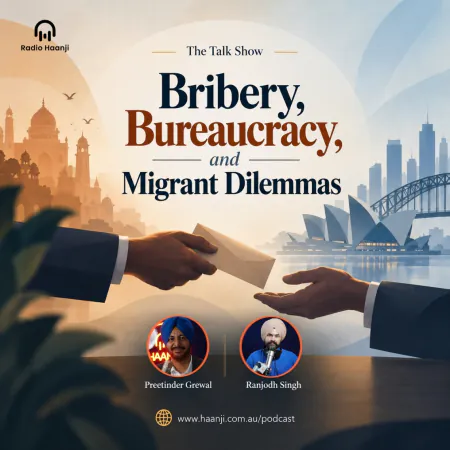



























































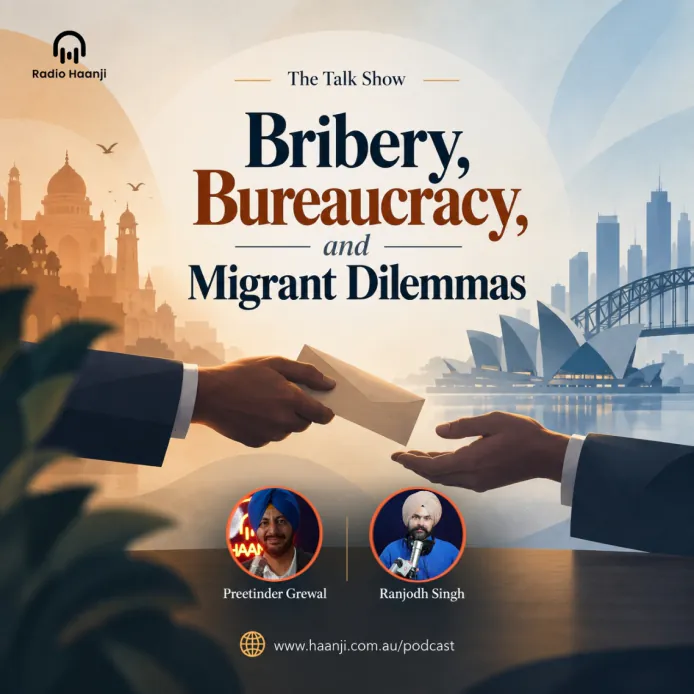
Bribery, Bureaucracy, and Migrant Dilemmas - The Talk Show - Preetinder Grewal & Ranjodh Singh
Host:-
 Preetinder Grewal
 Ranjodh Singh
Preetinder Grewal and Ranjodh Singh explore bribery, institutional corruption, and systemic gatekeeping across India and Australia on Radio Haanji 1674 AM.
The episode structured its analysis around several recurring forms of systemic extortion, beginning with the baseline operational friction experienced in public offices. Callers shared concrete encounters with local clerks, revenue collectors, and registration authorities where paperwork was deliberately misplaced or stalled until monetary facilitation occurred. These accounts highlighted how minor bureaucrats exploit structural loopholes and administrative discretion to create artificial scarcity around statutory services, leaving ordinary applicants with little recourse other than compliance.
The discussion then shifted to Western economies, particularly within Australia, where public sector clerks do not solicit cash on the street, but private industry gatekeepers extract equivalent rents. Contributors outlined how driving test instructors manipulate lesson packages and suggest backdoor examiner familiarity to inflate training costs.Similarly, tradespeople reported that commercial property and rental managers routinely demand ten to fifteen percent cuts from maintenance invoices, disguising kickbacks under the professional terminology of management and referral fees.
Finally, the hosts contextualised these personal narratives against broad socio-political principles and statistical rankings. They contrasted high-trust governance frameworks with regional administrations plagued by low salaries,inadequate digitisation, and weak whistle-blower protections. By integrating historical reflections on leadership accountability with data from international watchdog agencies, the broadcast exposed corruption as a structural disease that adapts to whichever economic tier it occupies.
Where to Listen
The Talk Show, hosted by Dr. Preetinder Grewal and Ranjodh Singh, is broadcast on Radio Haanji 1674 AM, delivering in-depth news analysis, investigative segments, and live community discussions.
-
Stream on Spotify
-
Listen on Apple Podcasts
-
Access live broadcasts and archives via the Radio Haanji App
Why Do People Pay Bribes for Routine Services?
People pay bribes for routine services primarily because administrative gatekeepers deliberately manufacture bureaucratic friction, backlogs, and delays, leaving citizens with no other viable path to access basic rights,documentation, or statutory protections within a reasonable timeframe. It operates as an involuntary survival tax imposed on ordinary individuals seeking civic efficiency.
When a citizen visits an administrative office to register property, acquire a trade certificate, or secure a basic identity document, public officials often hold absolute, unmonitored discretion over the speed of approvals. By weaponising trivial technical objections, processing clerks create an environment where adherence to standard protocols results in prolonged delays, financial loss, or personal distress. Faced with such obstacles, individuals quickly calculate that paying an informal facilitation charge is far less costly than enduring repeated interruptions to their work and daily life.
Furthermore, this dynamic frequently masquerades as cultural courtesy or voluntary appreciation. Callers noted how payments are casually labeled as sweet money, celebration expenses, or refreshment costs, masking outright extortion in polite language. This linguistic manipulation softens the social stigma for both the receiver and the giver, allowing predatory public servants to solicit unlawful funds while permitting compromised citizens to preserve a veneer of personal rectitude.
Over time, this continuous extraction erodes civic trust. Once an entire demographic internalises the idea that merit and procedural accuracy are secondary to informal payouts, compliance becomes the default behaviour. Paying under the table transforms from an emergency exception into a standard operating procedure, reinforcing the power of the corrupt bureaucrat while disenfranchising those who lack the financial means to bypass artificial checkpoints.
How Does Retail Bribery Differ From Corporate Gatekeeping?
Retail bribery involves overt, low-level cash payments made directly to individual public servants to speed up or alter routine civil actions. Corporate gatekeeping operates through institutionalised, legalistic frameworks, such as inflated referral commissions, mandatory intermediary packages, and lobbying relationships that lock out direct competitors while extracting hidden costs from the end consumer.
In developing administrative environments, everyday bureaucratic bribery is direct, personal, and immediately visible.A citizen hands physical cash to an official to secure an inspection sign-off, register a vehicle, or clear a municipal utility line. The illicit nature of the act is understood by both parties, even when wrapped in euphemistic conversation.The risk of sudden legal enforcement or bureaucratic hostility is borne directly by the individual, creating a daily life marked by constant administrative anxiety.
In advanced Western jurisdictions like Australia, civic interactions with public departments are largely insulated from cash extortion due to digital processing and institutional oversight. However, community members noted that systemic exploitation merely migrates into private industry gatekeeping. Instead of an overt shakedown, gatekeeping manifests as mandatory industry packaging, undisclosed referral percentages between service providers, and exclusivity deals that funnel business away from open, competitive markets.
A tradesperson seeking maintenance contracts from a property management firm may find that jobs are granted only if they rebate ten to fifteen percent of their gross billings back to the rental manager. Because these transactions are frequently invoiced under corporate titles like administrative overhead, priority handling, or referral fees vs bribes, they slip past standard regulatory scrutiny. The ethical rot remains identical: individual gatekeepers monetize their position of trust, adding inflated costs to property owners and tenants without delivering genuine economic value.
How Does the Corruption Index Rank Countries Globally?
The global public sector corruption index ranks nations based on perceived public sector dishonesty, assessing factors like bureaucratic transparency, judicial independence, and administrative accountability. Countries with robust digital registries and firm institutional oversight score highest, whereas nations burdened by unchecked discretion, heavy red tape, and weak enforcement sit toward the bottom.
According to data cited from the Corruption Perceptions Index (CPI), clear distinctions emerge between international administrative models:
-
Top-Performing Clean Administrations: Denmark leads the global index with a score of 89, closely trailed by Finland at 88 and Singapore at 84, demonstrating that comprehensive civic digitisation and strict legal enforcement minimize frontline friction.
-
High-Trust Western Economies: New Zealand and Norway follow with scores of 81, Sweden and Switzerland score 80, while Australia ranks 12th globally with a score of 76, reflecting low levels of retail bureaucratic bribery despite ongoing debates surrounding political donations and industry lobbying.
-
Mixed Administrative Frameworks: The United States registers a score of 64, illustrating institutional vulnerabilities where money and policy influence intersect.
-
Developing and Post-Colonial Bureaucracies: India ranks 93rd globally with a score of 39, reflecting deep systemic hurdles where underpaid frontline personnel and administrative bottlenecks sustain informal economies of facilitation fees.
These scores highlight that higher scores correlate directly with the elimination of arbitrary human discretion in day-to-day transactions. When citizen entitlements are automated through transparent online portals and backed by active anti-corruption commissions, the opportunities for public officials to extract informal rents drop dramatically. Conversely,where physical files, opaque manual approvals, and regional backlogs persist, systemic malfeasance thrives.
The Psychology of Rationalisation: From Helplessness to Complicity
The most insidious consequence of long-term exposure to administrative dishonesty is the psychological shift it forces onto honest individuals. When people discover that ethical diligence results in administrative failure while illicit facilitation delivers immediate results, moral resolve quickly gives way to functional pragmatism. Citizens begin by rationalising a single payment as an unavoidable necessity, but repeated participation gradually desensitises them to the broader damage inflicted on societal norms.
This compromise deepens when individuals advance into positions of administrative or commercial leverage themselves. An applicant who once resented paying facilitation charges to secure a license or employment credential may, once established in an agency or company, view extracting cuts from subsequent applicants as an earned privilege. The rationalisation evolves from self-defense into compensation for past hardships, ensuring that the predatory cycle perpetuates itself across generational lines.
Combating this institutional decay requires both systemic reform and uncompromising individual vigilance. Removing bureaucratic discretion through end-to-end digital processing removes the physical bottlenecks that bad actors exploit.At the same time, professionals, contractors, and civic leaders must challenge disguised kickbacks, insist on itemised transparency, and decline informal financial arrangements. Without systematic transparency in public administration,the boundary between the exploited citizen and the complicit participant eventually disappears altogether.
Key Takeaways
-
Manufactured Friction Fuels Extortion: Street-level bureaucratic bribery exists primarily because arbitrary administrative discretion creates artificial delays that force citizens to purchase efficiency as an act of survival.
-
Corruption Adapts to Economic Environments: In developing economies, corruption is personal, cash-driven,and public-facing; in advanced economies, it adopts corporate language, manifesting as hidden referral cuts,priority surcharges, and exclusive gatekeeping.
-
Global Benchmarks Reveal Governance Dividends: The Corruption Perceptions Index shows that high-trust nations like Denmark (89) and Australia (76) succeed by limiting manual approvals, whereas countries like India (39) face systemic roadblocks driven by under-resourced registries and excessive paper-based red tape.
-
Linguistic Euphemisms Normalize Exploitation: Masking bribes as celebratory gifts, handling fees, or finder's commissions strips away legal and moral culpability, easing the path toward institutional decay.
-
Digitisation Weakens Intermediary Power: Replacing manual public office processing with verifiable, open-access digital platforms eliminates the physical chokepoints where corrupt officials extract unearned rents.
Navigating institutional bureaucracy requires vigilance, ethical clarity, and an unwillingness to accept predatory gatekeeping as the price of doing business. The insights shared by Dr. Preetinder Grewal, Ranjodh Singh, and their community callers reveal that whether corruption appears as a blatant cash demand or a polished referral fee, its corrosive impact on human dignity remains identical. To explore these community perspectives in depth and follow daily discussions on civic integrity, listen to the full episode of The Talk Show on Spotify or download the Radio Haanji App.
Frequently Asked Questions
What constitutes a bribe under modern regulatory standards?
Why does frontline bribery remain common in developing public registries?
How do hidden referral fees distort fair market pricing?
Can digitisation entirely eliminate bureaucratic bribery?
What should a tradesperson do when asked for an informal management cut?
What's Your Reaction?