











































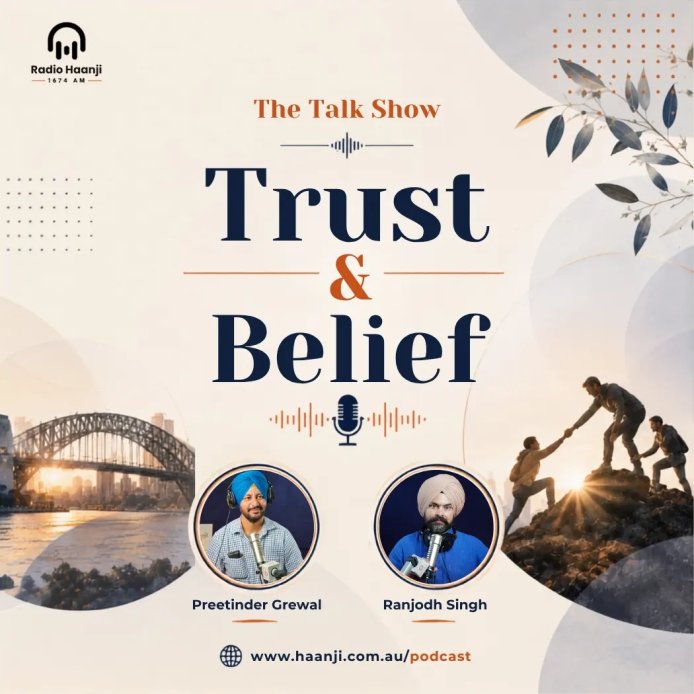
Why the World Runs on Trust and How It Can Be Broken — Preetinder Grewal & Ranjodh Singh
Host:-
 Preetinder Grewal
 Ranjodh Singh
Preetinder Grewal and Ranjodh Singh explore trust, belief, and how wealth can deceive us — on The Talk Show, Radio Haanji 1674 AM Melbourne.
Trust is not just a feeling. It is the invisible infrastructure that holds every relationship, every transaction, and every community together. On a recent episode of The Talk Show on Radio Haanji 1674 AM Melbourne, hosts Preetinder Grewal and Ranjodh Singh sat down for one of their most thought-provoking conversations yet — exploring what makes us trust, what makes us stop, and what happens to us in between.
The Foundation: A World Built on Belief
The conversation opened with a simple but striking observation: the entire world, from global finance to personal friendships, operates on trust and belief. Without these two forces, human society as we know it would collapse. Yet for something so fundamental, very few of us stop to examine how we actually decide who or what to trust.
When we meet someone for the first time, we rarely have hard data. Instead, we rely on subliminal signals — body language, tone of voice, the warmth or sharpness in someone's manner of speaking. These micro-observations happen fast, often before a single meaningful word is exchanged, and they quietly shape our first impressions far more than we realise.
The Wealth Trap: When Status Becomes a Substitute for Credibility
One of the most striking themes in this episode was what the hosts called the "wealth parameter." In modern society, there is a widespread tendency to equate displays of financial success with trustworthiness. Someone who drives an expensive car, hosts lavish gatherings, or photographs themselves alongside high-profile figures sends a signal — consciously or not — that they are credible.
For ordinary, middle-class individuals, this association can be dangerously misleading. The reasoning, often unconscious, goes something like this: a wealthy person has too much to lose to deceive me. But as Preetinder and Ranjodh pointed out, this logic is precisely what financial scams exploit. Cryptocurrency schemes, fraudulent travel agencies, and investment traps almost always come wrapped in an appearance of prosperity. The more convincingly someone performs success, the more trust they can extract — until the moment everything falls apart.
This is not a new phenomenon, but it is one that the Punjabi and Indian community in Australia, like communities everywhere, encounters regularly. The episode served as a timely reminder that wealth is a performance, not a guarantee.
What Actually Builds Lasting Trust
If wealth is an unreliable indicator, what does work? The hosts were clear: long-term trust is built on a track record. Consistent behaviour over time, an alignment between what someone says and what they do, and the ability to demonstrate integrity when it is inconvenient — these are the real building blocks.
This view was reinforced by one of the listeners who called in. He shared that his own personal parameter for trust is exactly this: the track record. Out of ten situations where he had extended trust, it worked out well eight times. Not perfect — but a meaningful, lived sample that he had reflected on carefully.
Another listener added a valuable layer. She noted that people often blindly trust others because of emotional closeness or professional authority — a family bond, a familiar name, a respected title. But emotional attachment is not evidence of reliability. She encouraged people to look past words and pay close attention to patterns of actual behaviour over time. What does this person do when things get hard? Do they follow through? Are their explanations consistent?
The Psychology Behind Who We Trust
The discussion also ventured into more personal psychological territory. One pattern the hosts identified is that people are often more inclined to trust someone who possesses a quality they feel they themselves lack. If someone struggles with patience, they may be drawn to a person who appears calm and measured — and place disproportionate faith in them. If someone lacks business acumen, they may defer entirely to someone who speaks confidently about money.
This tendency is not a character flaw. It is human. But it does create a vulnerability, because it means that certain individuals can be drawn in not by genuine compatibility or credibility, but by a mirroring of their own perceived deficiencies.
The Victim Mindset and the Greed Factor
Two more uncomfortable truths emerged in this episode. The first: when trust is broken, people sometimes adopt a victim mindset — framing the entire experience as something that was done to them, rather than examining their own role in the dynamic. This is understandable. Being deceived is painful, and the instinct to protect one's self-image is strong. But Preetinder and Ranjodh noted that honest reflection — without excessive self-blame — is essential to learning and protecting oneself in the future.
The second uncomfortable truth is the role of greed. Most financial scams do not succeed purely through deception. They succeed because the target wants what is being offered: fast returns, exclusive access, guaranteed wealth. Greed is not just a moral failing; it is a psychological lever that bad actors know how to pull. When an opportunity seems too good to be true but we want it to be real, we tend to suspend our critical judgment.
This is not about blaming people who have been scammed. It is about understanding the mechanism so we are better equipped to recognise it in the future.
Everyone Is Right From Their Own Window
The episode closed with a nuanced philosophical point: every person who experiences a breach of trust filters that experience through their own lived history, their own emotional landscape, and their own understanding of what was promised. This means that in many conflicts involving broken trust, multiple people can be simultaneously convinced they are in the right.
This does not mean the truth is always somewhere in the middle. But it does mean that the search for it requires patience, humility, and a willingness to see past one's own window onto the world.
More From Radio Haanji 1674 AM
If this episode got you thinking, there is plenty more to explore on haanji.com.au. For lighter listening, the Laughter Therapy podcast offers a dose of humour and warmth in Punjabi. If you enjoy stories, Kitaab Kahani brings audio storytelling to life in a way that is perfect for long drives or quiet evenings.
For those curious about the universe beyond human drama, The Deep Talk covers science, space, species, and exploration — the kind of conversations that make you feel small in the best possible way. If you prefer to stay current, Today Updates and Indian Updates keep you informed about what is happening locally and back home.
For something more casual and community-driven, check out Boys Meetup, and for personal reflections and journaling-style content, Notebook is a quiet corner worth visiting.
All of this and more is available free on Radio Haanji 1674 AM — the best Punjabi radio station in Melbourne for the Indian and Punjabi community in Australia.
Frequently Asked Questions
What is The Talk Show on Radio Haanji?
The Talk Show is a Punjabi podcast produced by Radio Haanji 1674 AM Melbourne, hosted by Preetinder Grewal and Ranjodh Singh. Each episode covers a real-world theme relevant to the Indian and Punjabi community in Australia, combining personal insights, listener call-ins, and honest conversation.
Where can I listen to The Talk Show?
You can listen to The Talk Show on haanji.com.au, on Spotify, and through the Radio Haanji live stream at 1674 AM in Melbourne. The podcast is free to access online from anywhere in Australia.
What did this episode of The Talk Show cover?
This episode explored the theme of trust — how we decide who to trust, why wealth displays can be misleading, the role of greed in financial scams, and how a solid track record is the most reliable indicator of trustworthiness over time.
Who are the hosts of The Talk Show?
The Talk Show is hosted by Preetinder Grewal and Ranjodh Singh, both based in Melbourne. They bring a mix of lived experience and open discussion style that resonates with the Punjabi and broader Indian diaspora community in Australia.
Is Radio Haanji 1674 AM available online?
Yes. Radio Haanji broadcasts live at 1674 AM in Melbourne and is also available to stream online at haanji.com.au, making it accessible to the Indian and Punjabi community across Australia and internationally.
What other podcasts does Radio Haanji offer?
Radio Haanji offers a wide range of Punjabi and Hindi podcasts including Laughter Therapy, Kitaab Kahani, The Deep Talk, Today Updates, Indian Updates, Boys Meetup, and Notebook — covering everything from humour and storytelling to science and community news.
What's Your Reaction?