





























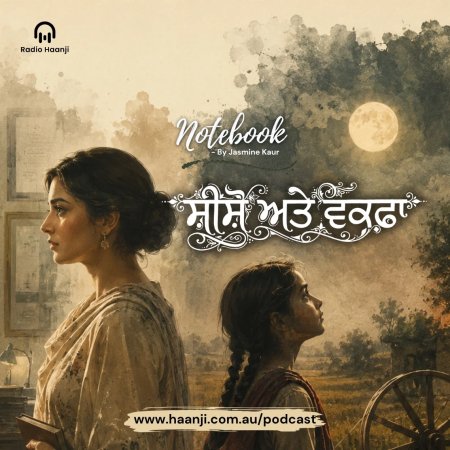




































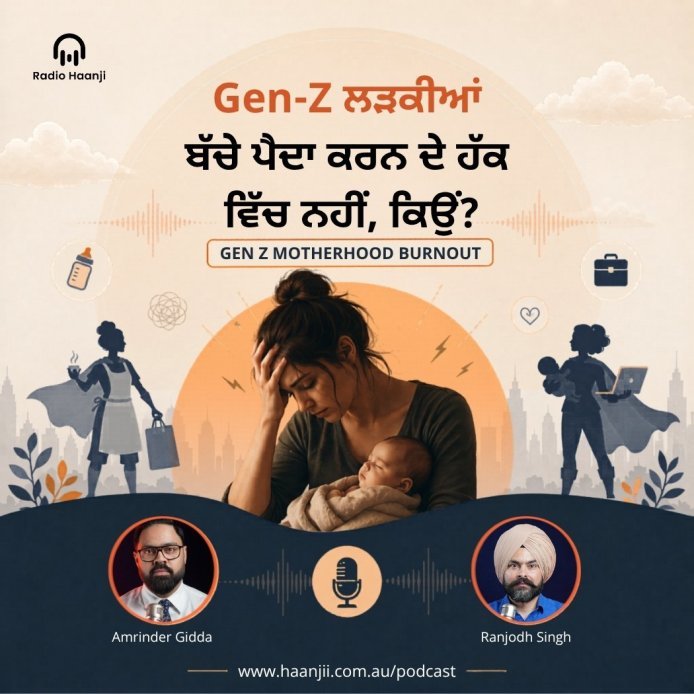
Gen-Z ਲੜਕੀਆਂ ਬੱਚੇ ਪੈਦਾ ਕਰਨ ਦੇ ਹੱਕ ਵਿੱਚ ਨਹੀਂ, ਕਿਉਂ? - Amrinder Gidda & Ranjodh Singh
Host:-
 Amrinder Gidda
 Ranjodh Singh
Why are Gen Z women walking away from marriage and kids? Explore Claire Row's research on the Superwoman Trap, hyper-parenting, and cultural burnout.
A profound cultural reallocation is occurring among Generation Z women born between 1997 and 2012. Across global urban centers and within the diaspora, the historic milestones of marriage and family are no longer viewed as default achievements. Instead, younger women are expressing a deep-seated resistance to traditional family structures, initiating an essential dialogue around gen z motherhood burnout.
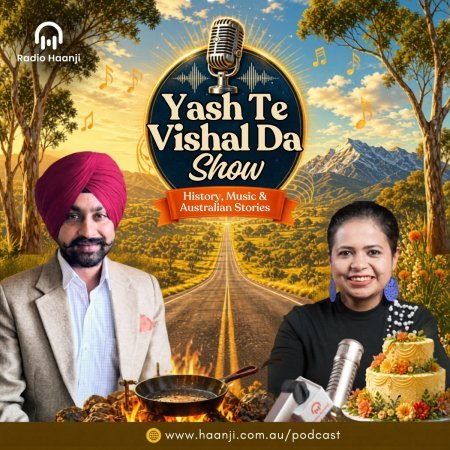
On a recent broadcast of Melbourne's premier Punjabi radio station, Radio Haanji 1674 AM, hosts Ranjodh Singh and Amrinder Gidda delved into this phenomenon. Drawing from an academic study by noted psychologist Claire Row, the conversation unraveled a complex web of psychological burnout, intense social engineering, and the systemic collapse of organic networks. The findings challenge standard economic consensus, suggesting that the modern retreat from family life is less about economic scarcity and more about a wholesale rejection of contemporary lifestyle design.
Why Are Gen Z Women Rejecting Motherhood?
Direct Answer: Generation Z women are rejecting motherhood primarily due to a profound cultural and psychological burnout. Observing previous generations collapse under the joint burdens of professional careers and unmitigated domestic labor, younger women increasingly view family life as an existential threat to their personal autonomy, mental well-being, and individual peace of mind.
While macro-economists point to inflation and housing crises to explain falling birth rates, psychological data reveals a deeper structural mutation. Gen Z women have grown up with a front-row seat to the exhausted lives of their Millennial and Gen X mothers. They have watched the women who raised them strive for the corporate glass ceiling, only to return home to an unaltered secondary shift of domestic management.
This friction has created an ideological split. A vast majority of younger women are choosing to bypass the institution of marriage entirely, viewing it as an unequal partnership that compromises their identity. Conversely, a distinct minority is opting for a complete rejection of corporate capitalism, choosing a path of selective traditional homemaking to guard their mental energy. Both responses, though opposite in execution, stem from the exact same diagnosis: the current framework of family life demands too much for too little return.
Dismantling the Superwoman Trap in Family Life
The core of this modern reluctance lies within what sociologists call the superwoman trap family life model. For decades, Western and diaspora women were told they could "have it all"—flawless careers, beautifully curated homes, and emotionally fulfilled children. In practice, this liberation simply doubled their responsibilities without altering systemic domestic dynamics.
The modern professional woman is frequently asked to balance executive choices by day and carry the entire emotional weight of a household by night. This structural fatigue is driving Gen Z to establish strict personal boundaries around their time. As explored on the Radio Haanji live podcast, this generation rejects the notion that endurance is a badge of honor. They recognize that multitasking is often just a polite term for systemic exploitation. By stepping away from these dual expectations, they are actively choosing self-preservation over societal compliance.
Is Modern Parenting Turning Into an Olympic Sport?
Direct Answer: Yes, modern parenting has transformed into a hyper-competitive, milestone-driven environment that functions like an elite sport. Mothers face immense social pressure to curate flawless childhoods, enforcing strict organic diets, developmental milestones, and intensive extracurricular schedules that turn daily caretaking into a high-stress performance.
This hyper competitive parenting culture turns everyday development into a battleground of optimization. From the pressure to serve meticulously shaped, organic-only meals to filling weekly calendars with Mandarin lessons, swimming, and competitive sports, the modern middle-class standard has become inherently unsustainable.
This perfectionism strips the joy out of early childhood and creates an immediate barrier for onlookers. Gen Z women look at this highly managed, high-stress template and recognize the psychological toll it extracts. When parenting requires the precision of a corporate logistics firm, opting out becomes a rational act of mental self-defense.
The Nostalgia Filter: What Rural Punjab Teaches Us About Community
During the best Punjabi podcast segments on haanji.com.au, the hosts contrasted this structured isolation with their personal upbringing in rural Punjab. They painted a vivid picture of a time when childhood was unmanaged, organic, and rooted in a shared communal safety net.
The co-hosts recalled the striking sensory landscapes of their school days—cycling through freezing, fog-laden Punjabi winters, guided by the booming bass of Jazzy B tracks echoing from local cassette shops. This wasn't just a nostalgic memory; it illustrated a culture where public spaces were vibrant and communal.
The loss of organic community connection is directly linked to the rise of hyper-insulated, private transit and fast-paced urban design. In the past, friendships, daily support systems, and shared domestic burdens were formed naturally during long public bus commutes or over village walls. Today's hyper-individualized architecture forces single families to shoulder the emotional and physical weight that an entire village used to carry.
The Structural Tax of a Hyper-Connected Life
The final element driving this modern exhaustion is the relentless burden of hyper connected life. With smart devices eliminating true cognitive downtime, individuals across the global diaspora are caught in an endless loop of digital noise, competitive comparison, and reactive stress.
The broadcast highlighted an insightful counter-cultural choice: one of the hosts completely bars smartphones and live news feeds from his private residence, referencing an ancestral piece of advice that removing daily political theater can add a decade to your life.
While modern society offers the illusion of deep connectivity via constant social media updates, the data shows an opposite reality. Communities talk incessantly about macro politics, inflation, and public entertainment, yet they rarely share their internal emotional weights. This dynamic leaves young women isolated at the exact moment they need real, physical support systems, cementing the realities of modern generational burnout.
Key Takeaways
-
Systemic Overload: Gen Z's rejection of traditional family structures is driven by psychological burnout and the unviable expectations of the "Superwoman" model rather than pure economic hardship.
-
Ideological Split: The cultural response to this fatigue has divided women into a protective majority that completely avoids marriage and a dedicated minority turning to traditional homemaking.
-
The Parenting Trap: Contemporary parenting has evolved into a hyper-optimized, high-stress performance that deters onlookers from entering the ecosystem.
-
Communal Erosion: The transition from spontaneous public community spaces to private, highly insulated lifestyles has eliminated the shared support networks that historically sustained family units.
-
Digital Fatigue: Constant connectivity creates a surface-level social dialogue while intensifying true emotional isolation, leaving individuals without the space to process their internal stress.
References and Further Reading
-
Claire Row Behavioral Study: An evaluation of generational shifts in family planning, female labor participation, and maternal boundary-setting across modern demographics.
-
Radio Haanji 1674 AM Broadcast Archive: Cultural commentary and diaspora interviews hosted by Ranjodh Singh and Amrinder Gidda regarding modern lifestyle fatigue. Available via haanji.com.au.
Frequently Asked Questions
What exactly is the superwoman trap in family life?
The superwoman trap refers to a cultural expectation where modern women are encouraged to pursue demanding professional careers while still carrying the full weight of traditional domestic management and emotional household labor. This creates an exhausting double-duty scenario that offers structural equality in theory, but results in severe psychological and physical burnout in practice.
Why does hyper competitive parenting culture deter Gen Z from having children?
When parenting is treated like a hyper-competitive performance metric—demanding organic-only meals, private language tutors, and endless curated extracurricular activities—it becomes an elite commitment. Gen Z women observe the intense anxiety, financial strain, and time investment required by this contemporary model and choose to protect their personal autonomy by stepping away entirely.
How does the loss of organic community connection impact new mothers?
Historically, raising children was a collective effort sustained by extended family, open neighborhoods, and spontaneous public interactions. The shift to modern, private transit and digital isolation means that families must now manage these emotional and logistical burdens alone. Without an organic village, the daily realities of caretaking become incredibly isolating.
What are the psychological benefits of cutting out daily news consumption?
Constant exposure to 24-hour news cycles and digital alerts keeps the human nervous system in a state of low-grade, perpetual panic over distant macro events. Removing these elements restores mental space, lowers cortisol production, reduces daily stress, and allows individuals to focus on their immediate physical environments and real-world relationships.
How is Radio Haanji 1674 AM changing the conversation for the Australian Punjabi diaspora?
By blending essential contemporary sociology—like Claire Row’s research on generational burnout—with rich, localized cultural memory, Radio Haanji provides a vital platform for deep community discussion. It allows the diaspora in Melbourne and across Australia to examine the pressures of Western assimilation alongside the grounding lessons of traditional Punjabi community frameworks.
The shift in how Generation Z views family life is a structural critique of a modern lifestyle design that prioritizes endless productivity over true human connection. Whether exploring these shifting societal paradigms through an academic lens or laughing along with the lighthearted IPL cricket banter on Radio Haanji Melbourne, the core lesson remains unchanged: sustainable futures require genuine community support, healthy digital boundaries, and realistic expectations. To keep exploring these vital cultural shifts, subscribe to our newsletter, listen to Radio Haanji live, and share your thoughts in the comments below.
What's Your Reaction?