


















































































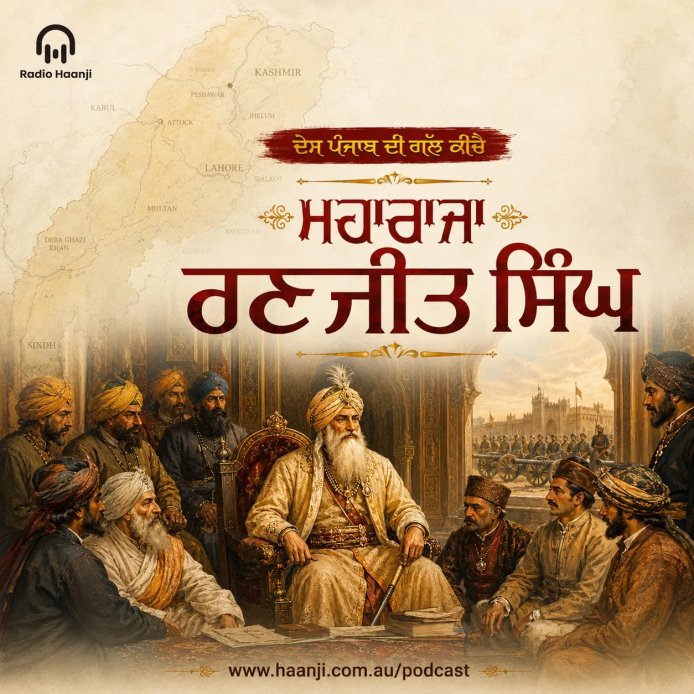
The Empire of Equity: How Maharaja Ranjit Singh United Punjab - Pritam Singh Rupal & Gautam Kapil
Host:-
 Gautam Kapil
 Pritam Singh Rupal
Discover how Maharaja Ranjit Singh built a powerful, inclusive Sikh Empire out of chaos. Explore the military innovations and internal struggles discussed by Pritam Singh Rupal and Gautam Kapil on Radio Haanji.
History is rarely a black-and-white canvas. It is often written through a selective lens, painting leaders either as flawless heroes or deeply flawed rulers. To truly understand the past, a balanced historical approach is essential. In a recent episode of the recurring segment "Ik Des Punjab Ki Gal" on the podcast Des Punjab Ki Gal Kiche, radio host Gautam Kapil and guest speaker Pritam Singh Rupal explored the multifaceted legacy of Maharaja Ranjit Singh, marking the anniversary of his passing on June 27, 1839. Their conversation shed light on the incredible rise, strategic genius, and eventual internal decline of the Sikh Empire.
Rising from Chaos: The Birth of a Unified Sikh Empire
Before Maharaja Ranjit Singh established his rule, Punjab was caught in a grueling period often described as the "Period of Blood and Terror." The decline of Mughal dominance left behind a deeply fractured landscape, split among various competing Sikh Misls (clans). Ranjit Singh recognized that unity was the only path to survival. Through strategic diplomacy and sheer political will, he successfully consolidated these fractured factions into a powerful, unified state, establishing his capital at Lahore and creating a sovereign sanctuary for his people.
Military Modernization and Strategic Innovations
One of the most remarkable traits of Maharaja Ranjit Singh was his forward-thinking approach to military logistics and combat strategy. He understood that traditional warfare tactics would not hold off expanding global empires forever. To counter British expansion and push back persistent Afghan invasions, he actively recruited foreign expertise. By bringing in French and Italian generals, such as Jean-Baptiste Ventura and Jean-François Allard, he trained his infantry and artillery to match rigorous European standards. This tactical blend of Western discipline and local bravery turned the Sikh army into a formidable force.
A Governance Built on Compassion and Inclusivity
While the empire was built on military strength, it survived through unprecedented social harmony. Demographically, the empire was majority Muslim (around 70%) and Hindu (around 23%), while Sikhs made up a small minority of about 7%. Despite this, Maharaja Ranjit Singh built a remarkably stable and inclusive administration. He placed prominent Hindu and Muslim leaders in high-ranking ministerial and military positions, including trusted figures like Diwan Mokham Chand and Fakir Azizuddin. His governance was rooted in deep empathy; during severe famines, he opened state granaries to ensure no citizen starved, earning him profound respect across all religious lines.
Internal Vulnerabilities and the Ultimate Decline
Despite his brilliant external diplomacy and military success, the empire harbored deep internal vulnerabilities. The biggest challenge lay in the court's inability to secure a stable internal lineage or curb political conspiracies. Following the Maharaja's death in 1839, the lack of a sustainable long-term succession strategy triggered rapid internal conflict and a series of tragic assassinations within the royal family. These fractures ultimately cleared the path for the British annexation of Punjab in 1849.
Furthermore, cultural conflicts persisted within the royal court. Practices like Sati, where widows immolated themselves on the Maharaja's funeral pyre, occurred despite completely contradicting the core teachings of the Sikh Gurus. This stark contrast highlights the complex reality of a state balancing political traditions with religious ideals.
Explore More Stories and Updates
For more deep dives into history, culture, and community news, check out our latest audio shows. Stay informed with our daily morning briefs on Today Updates and catch up on major developments with Indian Updates. If you are looking for engaging storytelling, listen to authentic audio stories on Kitaab Kahani or enjoy relatable banter and community discussions on Boys Meetup. For casual reflections, open the pages of our digital Notebook, or unwind with lighthearted humor by exploring all Laughter Therapy episodes. If you love deep intellectual exploration, do not miss The Deep Talk, our special show dedicated to science, space, species, and exploration.
Frequently Asked Questions
When did Maharaja Ranjit Singh pass away?
Maharaja Ranjit Singh passed away on June 27, 1839, marking the beginning of a challenging succession period for the Sikh Empire.
What was the demographic makeup of the Sikh Empire?
The empire was highly diverse, consisting of approximately 70% Muslim, 23% Hindu, and 7% Sikh citizens, which makes its governance stability even more remarkable.
How did Maharaja Ranjit Singh modernize his army?
He hired European military officers, including French and Italian generals, to train his infantry and artillery forces to match the tactics and discipline of Western armies.
Why did the Sikh Empire decline after 1839?
The decline was primarily caused by internal vulnerabilities, including the lack of a stable succession plan, internal court conspiracies, and royal assassinations, which eventually led to British annexation in 1849.
What's Your Reaction?







Related Posts