



























































































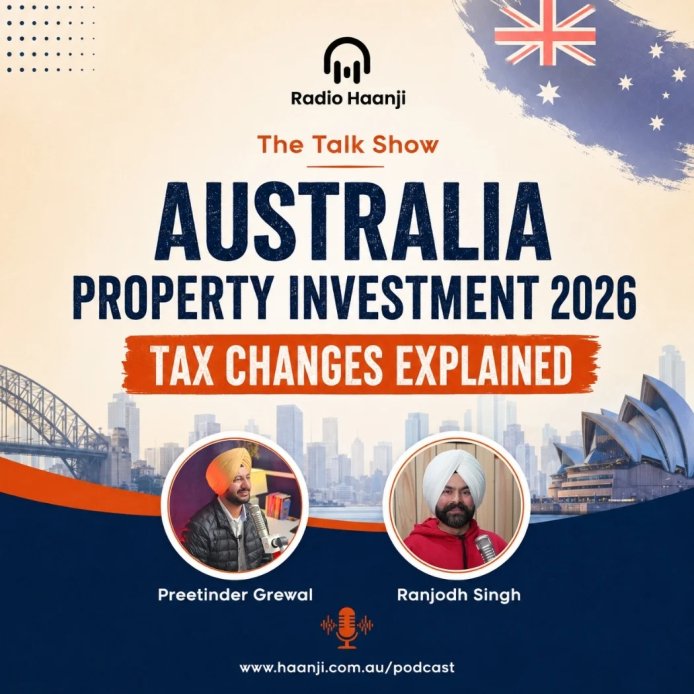
Australia Property Investment 2026: Tax Changes Explained – The Talk Show - Preetinder Grewal - Ranjod Singh
Host:-
 Preetinder Grewal
 Ranjodh Singh
Capital gains tax, negative gearing, and what "mom and dad" investors need to know about Australia's property market in 2026. Listen to The Talk Show on Radio Haanji 1674 AM.
Australia Property Investment 2026: Capital Gains Tax, Negative Gearing and What "Mom and Dad" Investors Need to Know
Property investment has always been a favourite topic of conversation in Australian Punjabi households, and on the latest episode of The Talk Show on Radio Haanji 1674 AM, hosts Preetinder Grewal and Ranjodh Singh dug into exactly what is happening in the Australian property market right now, what changes to capital gains tax and negative gearing could mean for everyday investors, and why most property owners in Australia are not the big "whales" people imagine.
Who Actually Owns Investment Properties in Australia?
One of the most interesting numbers discussed on the show comes straight from tax office data. According to this data, 71% of property investors in Australia own just one investment property. These are the everyday "mom and dad" investors, the average families who bought one extra property as a long-term plan for retirement or their children's future.
Another 19% of investors hold two properties, while only around 1% of investors, often called "whales," own six or more properties. This breakdown matters because most policy discussions and media headlines tend to focus on large-scale investors, when in reality the vast majority of the Australian Punjabi and Indian community falls into the single-property "mom and dad" category.
What Is Happening in the Property Market Right Now
The hosts pointed out that while property prices have not dropped significantly, properties are simply not selling as quickly as they used to. Many listings are sitting on the market for four to six months before finding a buyer. This slower selling time is creating pressure for people who need to sell, whether for relocation, financial reasons, or upgrading to a different home.
This shift is important context for anyone in the Punjabi community in Melbourne or across Australia who is currently thinking about buying, selling, or holding onto a property in the current climate.
Capital Gains Tax (CGT) Changes Explained
A major part of the discussion focused on capital gains tax and how it may work differently going forward. Under the older approach, investors selling a property after holding it for more than twelve months would generally receive a straightforward 50% discount on the taxable capital gain.
The hosts explained that the new approach being discussed would calculate the taxable gain by factoring in inflation over the holding period, rather than applying a flat 50% discount. In practical terms, this could mean a higher taxable gain for many investors, especially those who have held a property for a long time during a period of high inflation. Anyone planning to sell an investment property in the coming years should keep an eye on how these rules develop and speak with a registered tax professional about their specific situation.
Negative Gearing: What It Means and What Might Change
Negative gearing is a term that gets used a lot in Australian property conversations, but the hosts broke it down simply. If the rental income from a property is lower than the total expenses on that property, including loan interest, council rates, insurance, and repairs, the difference is considered a loss. This loss can then be offset against the investor's taxable income.
According to the discussion, the government appears to be making negative gearing rules easier for newly built homes, encouraging investment into new housing stock. However, for older, established properties, the rules may become less favourable. This is a significant point for the many Punjabi families across Melbourne and Australia who hold older investment properties as part of their long-term financial planning.
Caller Insights: Long-Term Thinking Wins
The Talk Show is known for bringing in real voices from the community, and this episode was no different. A caller named Gurnek Singh shared his view that if a property is bought thoughtfully, in a good location, and held for the long term, it almost always works out as a good decision regardless of short-term market noise.
Another caller, Balwant Singh, offered a slightly different angle. He compared property investment to running a side business, saying that investors should not panic every time the market moves up or down. His advice was that sometimes the best opportunities come from doing the opposite of what everyone else is doing, rather than following the crowd into the same decisions at the same time.
Why the Australian Property Market Behaves Differently
The hosts also touched on a broader point about why the Australian property market reacts the way it does. Australia has a relatively small population compared to many other countries, and this means that even a small increase in available properties can soften the market, while a small reduction in supply can push demand and prices up quickly. Understanding this basic supply and demand dynamic helps explain why the local market can feel unpredictable compared to larger global markets.
Mental Balance and Learning to "Code Switch"
Towards the end of the episode, the conversation moved away from numbers and into something just as important, mental wellbeing. The hosts spoke about the idea of learning to "code switch," meaning the ability to leave work stress, financial worries, and outside pressures at the door and not carry them into the home environment.
For many in the Punjabi community juggling jobs, businesses, property decisions, and family responsibilities, this small but powerful habit can make a real difference to family life and personal peace of mind, regardless of what the property market or tax rules are doing on any given day.
Listen to the Full Episode
This conversation is part of The Talk Show on Radio Haanji 1674 AM, hosted by Preetinder Grewal and Ranjodh Singh. If you want to hear the full discussion, including more caller stories and detailed breakdowns of these topics, you can listen for free on the Radio Haanji app or at haanji.com.au.
Explore More on Radio Haanji
If you enjoyed this episode, there is plenty more to explore on Radio Haanji. For a good laugh and some light relief, check out all episodes of Laughter Therapy. If you love stories, the audio story series on Kitaab Kahani is worth a listen.
For something more thought-provoking, The Deep Talk covers science, space, species, and exploration in a way that is easy to follow. To stay updated with the latest happenings, head over to Today Updates and Indian Updates.
If you are looking for something fun and relatable, Boys Meetup brings casual, honest conversations, while Notebook offers reflective and personal stories worth your time.
Frequently Asked Questions
What percentage of property investors in Australia own only one investment property?
According to tax office data discussed on the show, around 71% of property investors in Australia own just one investment property, making up the largest group often referred to as "mom and dad" investors.
How is capital gains tax changing for property investors?
Rather than applying a straightforward 50% discount on capital gains, the new approach being discussed would calculate the taxable gain by accounting for inflation over the holding period, which could result in a higher tax liability for many long-term investors.
What is negative gearing and how might it change?
Negative gearing occurs when the expenses on a property, such as loan interest, rates, and repairs, exceed the rental income, with the loss offsetting taxable income. The discussion suggested that rules may become easier for new homes but less favourable for older established properties.
Where can I listen to The Talk Show on Radio Haanji?
You can listen to The Talk Show, hosted by Preetinder Grewal and Ranjodh Singh, for free on the Radio Haanji app for iOS and Android, or directly at haanji.com.au.
What's Your Reaction?