


















































Dastaar: Tarsem Jassar - The Punjabi Film That Takes Sikh Story to Britain
Dastaar hits cinemas July 17, 2026. Tarsem Jassar stars in this powerful story of a Sikh immigrant in Britain — cast, plot, and everything to know before you go.
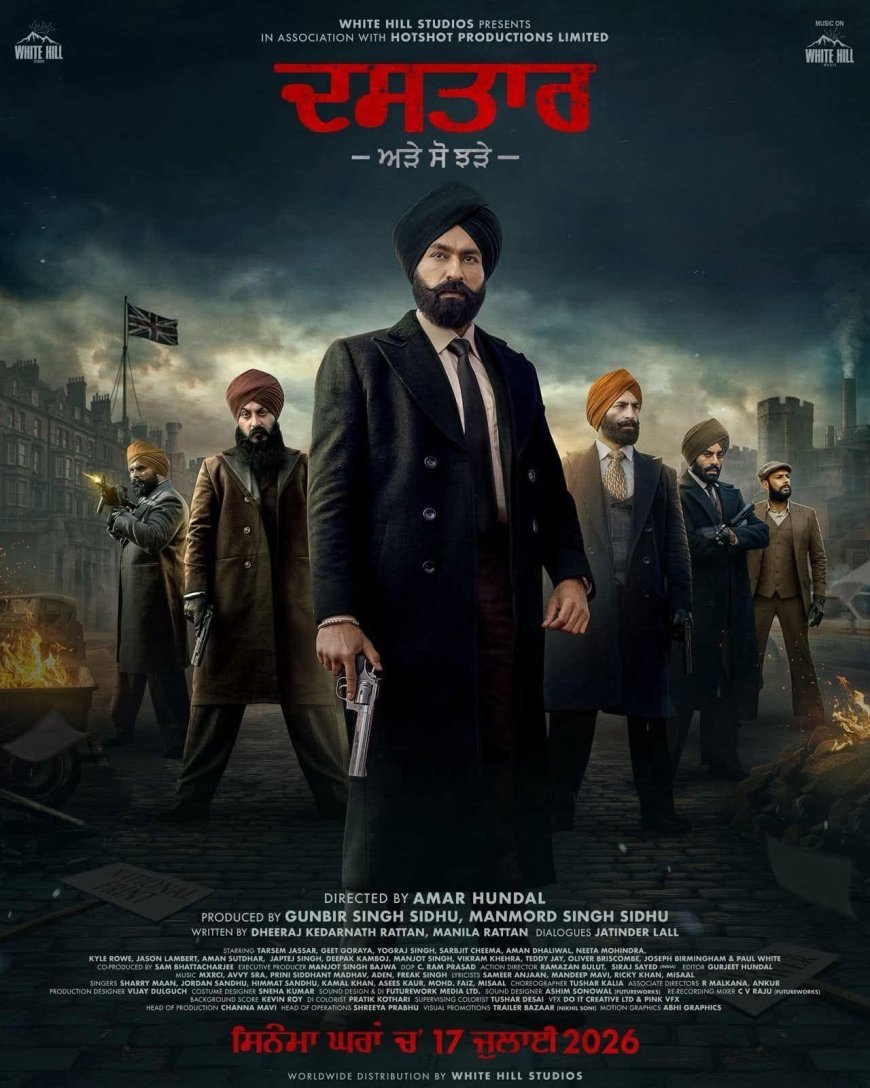
Ask any Punjabi person what a dastaar means to them, and you will get a pause before the answer. Not because they don't know — but because the word carries more than one language can hold in a single sentence. Honour. Faith. Identity. The visible declaration of who you are, even when the world around you would rather you weren't.
Tarsem Jassar's upcoming film Dastaar, releasing worldwide on July 17, 2026, takes that single loaded word and builds an entire film around it. Set in 1980s Britain, the story follows a turbaned Sikh immigrant who survives a brutal attack, loses people he loves, and then — instead of disappearing — rises to become a community leader. It is, by any measure, an ambitious story. And it is being made by a team that has earned the right to tell it.
Produced by White Hill Studios and directed by Amar Hundal, Dastaar was filmed in Hull and across the north of England — real streets, real weather, real history. The teaser dropped on May 22, 2026, and the response from audiences has been immediate and loud. Here is everything you need to know before July 17.
The Story Behind the Title — What Does Dastaar Actually Mean?
A dastaar is the Punjabi and Sikh word for a turban. But calling it simply a turban misses the point almost entirely.
Within Sikh tradition, the dastaar is among the most significant outward expressions of faith, self-respect, and identity. It is not an accessory or a style choice — it is worn as a commitment, a daily act of spiritual discipline, and a public declaration of one's values. For Sikh men and women who wear it, removing or losing a dastaar carries deep personal and community significance.
The title of this film, then, is doing a lot of work before the first frame plays. It signals immediately that this is not just a story about one man surviving trauma — it is a story about what a person holds onto when everything else is taken from them. The film's own synopsis makes this explicit: one man's turban can become the crown of a community. That is the entire arc in a single line.
For Punjabi diaspora audiences in Australia, the UK, Canada, and around the world, the title will land before they have seen a single scene. That is the kind of cultural shorthand very few films can pull off — and Dastaar appears to understand it completely.
What Is Dastaar the Movie About?
Set in 2000s Britain, Dastaar follows a turbaned Sikh immigrant who loses his closest loved ones to a violent attack. Rather than retreat or collapse, he transforms his grief into purpose — rising from a humble newcomer to a figure of strength and leadership within his community.
The story draws on broader themes of racism, resilience, faith under pressure, and the immigrant experience in Britain. Accounts from the production's casting process in the UK describe a Sikh man in 1980s Hull navigating everyday racism, going on a journey of self-discovery while holding tightly to his faith and identity. That detail — Hull, in northern England — is not incidental. Hull has its own complex history with South Asian communities, making it a grounded and specific backdrop rather than a generic "Britain" setting.
The film is described both as a poignant drama and a gritty action story, which suggests the narrative moves between emotional depth and real physical confrontation. A brutal attack drives the story's central crisis, and the journey that follows is about what a person does with grief when they refuse to let it defeat them. Themes of courage, belonging, and community leadership run through the film's premise from beginning to end.
What makes the story particularly compelling is its scope. This is not a small, interior drama — it is the story of one man's impact on an entire community, filtered through the lens of identity and faith in a country that was not always welcoming to people who looked and dressed differently.
Where Was Dastaar Filmed?
Dastaar was filmed on location in Hull and various parts of the north-east of England, as confirmed by UK production listings in early 2026.
The choice of Hull is significant. It is not the London of Bollywood imagination or the tourist-facing Britain that often stands in for the whole country in South Asian cinema. Hull is industrial, working-class, and has its own documented history of racial tension in the 1980s — the exact period the film is set in. Shooting in real streets and real locations rather than studio sets adds a layer of credibility that audiences notice even when they cannot name it.
The production is a genuine East-meets-West collaboration. The British cast members — including several UK-based actors identified in early casting — work alongside established Punjabi names, creating an on-screen texture that reflects the actual reality of Sikh communities living and building lives in northern England during that era.
Cast: Who Appears in Dastaar Alongside Tarsem Jassar?
Tarsem Jassar leads the film in the central role — a Sikh immigrant whose story spans loss, resolve, and community leadership. Alongside him, the cast includes Geet Goraya, Yograj Singh, Sarbjit Cheema, Aman Dhaliwal, Ashish Duggal, and Neeta Mohindra from the Punjabi film world, along with a significant number of British actors including Kyle Rowe, Jason Lambert, Teddy Jay, Oliver Briscombe, Joseph Birmingham, and Paul White.
Yograj Singh's presence deserves mention. A veteran of Punjabi cinema with a long career and genuine screen gravitas, he brings a quality of earned authority to any production he joins. When a film about identity and community leadership includes Yograj Singh in the cast, it signals that the emotional weight of the story is being taken seriously.
The mix of British and Punjabi actors is not just culturally appropriate — it reflects the actual reality of the film's setting. A story about a Sikh man's life in 1980s England requires British characters who feel authentic, and the casting suggests the makers understood that getting those performances right matters as much as the Punjabi leads.
Tarsem Jassar — A Career Built on Stories That Matter
Tarsem Jassar started writing lyrics before he started acting. Born in Village Jassar in Ludhiana in 1986, he went to England as a young man and worked as a labourer — a detail that, given this film's setting, carries an interesting personal resonance. He built his career first as a lyricist and singer, co-founding Vehli Janta Records with Kulbir Jhinjer in 2013, before his acting debut in Rabb Da Radio in 2017.
What distinguished his acting career almost immediately was the kind of stories he chose. Rabb Da Radio was a rural love story rooted in family values. Sardar Mohammad explored identity and resilience. Mastaney leaned into historical and cultural scale. And Guru Nanak Jahaz — his 2025 historical drama about the Komagata Maru incident — received an IMDb rating of 8.9/10, a remarkable score that reflects just how deeply that film connected with audiences.
The pattern is clear. Jassar is not drawn to easy entertainment. He gravitates toward films where the cultural stakes are real — stories that Punjabi and Sikh audiences feel in their chest rather than just in their eyes. Dastaar fits that pattern precisely. A story about faith, identity, and survival in 1980s Britain is exactly the kind of film that his career trajectory has been building toward.
He also spent time in England himself before his career took off. Whether that informs his performance in Dastaar is something only the film will reveal — but the connection is there.
Why Dastaar Could Be the Punjabi Diaspora Film of the Decade
Punjabi communities have been part of British life since the mid-twentieth century, and their history in cities like Birmingham, Coventry, Wolverhampton, Bradford, and Hull is long, layered, and often underrepresented on screen. The 1980s in particular was a decade of significant racial tension in Britain, with visible minority communities facing organised hostility, institutional indifference, and the everyday weight of building lives in a country that was frequently hostile to their presence.
Punjabi cinema has not told this story often — and almost never from the inside, with Punjabi-language dialogue, Sikh cultural detail, and a Punjabi lead. Most dramatic portrayals of the South Asian experience in 1980s Britain have come from British-produced English-language films or television. Dastaar appears positioned to tell this story in Punjabi, for Punjabi audiences, with the cultural texture that only insiders can bring.
For the diaspora specifically — audiences in Australia, Canada, the UK, the US — this is a film that speaks directly to a shared inherited experience. The immigrant who faces violence and chooses to build rather than break is not an abstract figure. For millions of people whose grandparents or parents made exactly that journey, it is personal.
The teaser's reception on social media — described by BritAsia TV as generating "major excitement" with audiences praising its "emotional intensity" and "strong cultural themes" — suggests that expectation is already high. When a Punjabi film's teaser generates that kind of response a full six weeks before release, it means the audience recognises something of themselves in it.
Is Dastaar Worth Watching?
If you follow Punjabi cinema even casually, Dastaar is one of the most compelling releases of 2026 — and not just for fans of Tarsem Jassar.
The story is genuinely distinctive within Pollywood. It is set in Britain rather than Punjab. It deals with racism and immigrant identity rather than romance or village politics. Its runtime of 135 minutes gives it room to breathe. And the creative team — director Amar Hundal, producers Gunbir Singh Sidhu and Manmord Sidhu of White Hill Studios — brings a production background that consistently delivers quality.
The risk in a film like this is always tonal. A story about loss, racism, and resilience can tip into melodrama if the direction doesn't stay disciplined. But Amar Hundal's track record — which includes directing Sardar Ji 3 and Warning 2 — suggests a filmmaker who can manage that balance. And Tarsem Jassar's previous performances in emotionally demanding roles give confidence that the central performance will hold.
For diaspora audiences especially, the honest answer is: this film was made for you. Not in a marketing sense, but in the sense that the story — a Sikh man holding onto his identity in a country that tried to erase it — is one that resonates directly with the experience many families have lived. That kind of relevance is rare in any cinema. When it arrives, it is worth showing up for.
Key Takeaways
- Dastaar is a Punjabi drama releasing worldwide in theatres on July 17, 2026, produced by White Hill Studios and directed by Amar Hundal.
- The film stars Tarsem Jassar as a turbaned Sikh immigrant in 1980s Britain who survives a brutal attack and rises to become a community leader — a story about identity, faith, and resilience.
- The cast includes Yograj Singh, Geet Goraya, Sarbjit Cheema, Ashish Duggal, and Neeta Mohindra alongside a significant number of British actors, reflecting the film's genuine UK production setting.
- Dastaar was filmed on location in Hull and across northern England, making it one of the most geographically authentic Punjabi films set in Britain.
- Tarsem Jassar has spent his career choosing culturally significant stories — from Rabb Da Radio to the critically acclaimed Guru Nanak Jahaz — making Dastaar a natural next step in that trajectory.
- The title itself — dastaar, meaning turban in Punjabi — signals the film's central theme before the first frame: a story about what a person holds onto when everything else is taken from them.
References and Further Reading
External Sources:
- BritAsia TV — Official teaser coverage with confirmed cast, release date, and audience reaction details — https://britasia.tv/tarsem-jassars-dastaar-teaser-officially-released/
- HOYTS Cinemas (Australia) — Official Dastaar listing with confirmed synopsis, cast, runtime (135 min), and July 17 release date — https://www.hoyts.com.au/movies/dastaar-punjabi-eng-sub
- Spotlight UK — Production listing confirming Hull filming location, racist themes, and Amar Hundal's direction — https://www.spotlight.com/news-and-advice/the-industry/whats-filming-in-the-uk-and-ireland-february-2026/
Frequently Asked Questions
When and where does Dastaar release?
Dastaar releases worldwide in cinemas on July 17, 2026. The release is confirmed across India, Australia, the United Kingdom, Canada, and numerous other international markets simultaneously. HOYTS cinemas in Australia have already listed the film with English subtitles for the Punjabi-language feature. Check your local cinema listings for advance booking availability as the date approaches.
Who produces Dastaar and which studio is behind it?
Dastaar is produced by Gunbir Singh Sidhu and Manmord Sidhu under White Hill Studios — one of Punjabi cinema's most active and respected production houses, responsible for a consistent run of commercially successful Pollywood films over the past decade. The film is directed by Amar Hundal, whose previous credits include Warning 2 and Sardar Ji 3.
Who wrote the screenplay for Dastaar?
The screenplay is written by Jatinder Lall, Dheeraj Kedarnath Rattan, and Manila Rattan — a writing team of three, which for a story this culturally layered makes sense. The multiple writing credits suggest a collaborative effort to get both the Punjabi cultural authenticity and the British setting right simultaneously.
Does Dastaar have English subtitles for international audiences?
Yes. International theatrical screenings, including those confirmed at HOYTS cinemas in Australia, are listed as Punjabi with English subtitles. Given that the film is set in Britain and features a significant number of British English-speaking cast members, some scenes are also likely to include English dialogue within the Punjabi-language film.
How is Dastaar different from other Tarsem Jassar films?
Dastaar is the first Tarsem Jassar film set entirely outside of India. While films like Rabb Da Radio and Guru Nanak Jahaz explored Punjabi and Sikh identity within or connected to the subcontinent, Dastaar places a Sikh protagonist at the centre of a British racial history story — a setting that makes it genuinely new territory for both Jassar and Punjabi cinema more broadly.
Why is the film titled Dastaar?
The word dastaar means turban in Punjabi, and within Sikh tradition it represents far more than head covering — it symbolises honour, faith, self-respect, and identity. The film's synopsis makes the connection explicit: the story is about how one man's turban becomes the symbol of an entire community's pride. The title is also the film's thesis: that identity held firmly under pressure can become a form of leadership.
Is there an OTT streaming release date confirmed for Dastaar?
No official streaming release date has been announced as of June 2026. Punjabi films typically move to digital platforms eight to twelve weeks after their theatrical run. White Hill Studios films have historically appeared on major streaming platforms, so a digital release in late 2026 is likely. Follow the studio's official channels for confirmed announcements.
Cinema can do something that no history book or documentary quite manages — it makes you feel the stakes of another person's life as your own. Dastaar arrives in theatres on July 17 carrying exactly that kind of weight: a story about faith, survival, and community that has been waiting to be told in Punjabi, for Punjabi audiences, for a long time. Whether you grew up in Ludhiana, Hull, Melbourne, or Toronto, there is something in this film that belongs to you. Book your tickets, bring someone who matters to you, and let the story land the way it was meant to. If you watched it and want to share your thoughts, drop a comment — we would love to hear how Dastaar resonated with you.
What's Your Reaction?