








































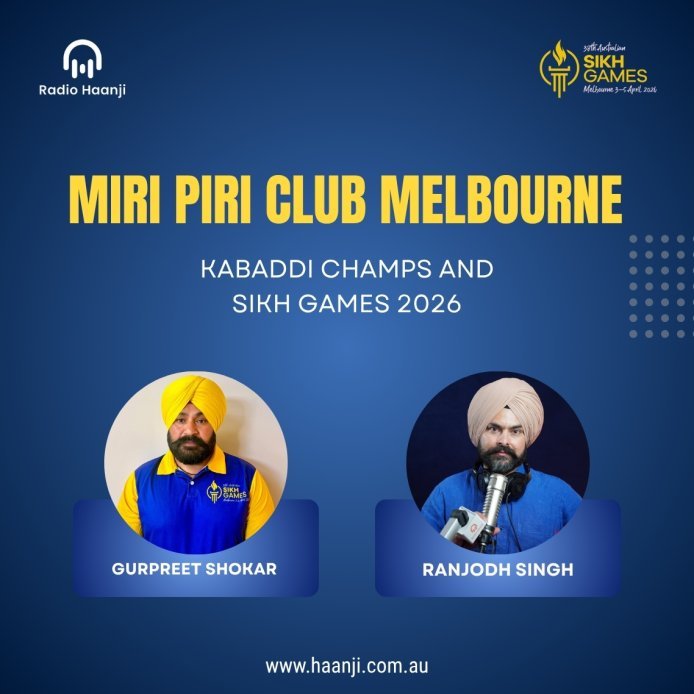

The 2024 kabaddi champions and Sikh Games VP speaks to Radio Haanji: 1,200+ athletics entries, local talent push and what's at stake in April.
Miri Piri Sports Club Melbourne — Kabaddi Champions, Sikh Games Organisers and the Push to Build a Homegrown Sporting Culture
When Gurpreet Singh Shokar speaks about the 38th Australian Sikh Games Melbourne 2026, he is not speaking as an outside observer or even as a competing athlete. He is speaking as the man helping to run it. As Vice President of the 2026 Australian Sikh Games and President of Miri Piri Sports and Cultural Club Melbourne, Shokar occupies a position that is arguably unique in this year's event — simultaneously one of the most decorated club leaders in Australian kabaddi and one of the key architects of the Games themselves.
In a recent conversation on Radio Haanji 1674 AM with host Ranjodh Singh, Shokar opened up about the club's journey, its ambitions for April, and a deliberate strategic shift that sets this year's Sikh Games apart from every edition that preceded it.
From Before 2013 to 2024 National Champions — The Miri Piri Story
Miri Piri Sports and Cultural Club Melbourne was formally registered in 2019, but the story begins much earlier. The core group of people who would eventually build the club had already been active in Melbourne's Punjabi sporting community since before 2013 — organising, competing, and cultivating a culture of excellence in kabaddi long before there was a registered structure to hold it. When the club was finally formalised, it had the advantage that most new clubs never get: it was built by people who already knew exactly what they were doing.
Based at 1710–1718 Melton Highway in Plumpton in Melbourne's western suburbs, Miri Piri quickly established itself as one of the most competitive kabaddi clubs in Australia. By 2024, the results had become impossible to overlook. The club was named Season Champion by the National Kabaddi Federation of Australia (ANSSACC) — recording 12 wins across the national competition. That same year, the club won the Sikh Games Adelaide tournament, the Miri Piri Kabaddi Cup, and the Royal Azad Tournament. It was runner-up at both the Perth Tournament and the Mildura Tournament. The 2023 season was equally decorated, with victories at the Miri Piri Kabaddi Cup, the Azaad Kabaddi Cup, and runner-up placement at the Young Kabaddi Cup.
These are not the results of a club that stumbled into success. They are the results of disciplined recruitment, consistent training, and the kind of club culture that produces champions systematically rather than by accident. Miri Piri's star raiders and stoppers are among the most recognisable names in Australian kabaddi: Ravi Kailram (187 points), Harman Bullet (152 points), and Meshy Harkhowal (137 points) lead the attacking roster, while Mann Singh Dirba (105 points), Guri Dhaler (105 points), and Yadha Surkhpur anchor the defence. The numbers reflect a squad that is balanced, deep, and built to compete across a full season, not just a single tournament.
A Club That Does Far More Than Kabaddi
What makes Miri Piri unusual among kabaddi clubs is the breadth of what it actually does. While kabaddi remains its primary competitive sport and the foundation of its national and international reputation, the club has deliberately expanded its programme to include cricket, basketball, volleyball, badminton, powerlifting, and wrestling. This expansion is not incidental — it is strategic. As Gurpreet Singh Shokar explained to Ranjodh Singh on Radio Haanji, the club's goal is to reach as wide a cross-section of Melbourne's Punjabi youth as possible. Not every child is built to be a kabaddi raider. Some will find their game in basketball. Some in wrestling. By offering multiple pathways into the club, Miri Piri casts a wider net — and catches more of the young talent that would otherwise fall through the cracks of a single-sport programme.
Currently, the club works with between 100 and 130 young people — a figure that reflects years of deliberate community outreach and relationship-building in Melbourne's western suburbs. The mission, as Shokar articulates it, is explicit: to give children a platform to develop their skills with the genuine ambition of seeing them represent their sport at state and national levels in Australia. This is not aspiration for its own sake. It is a structured developmental philosophy backed by the club's track record of producing competitive athletes.
Every year since 2019, the club has also organised its own annual sports tournament and Khed Mela — a community festival that draws between 15,000 and 20,000 people, with food stalls, cultural performances, and sports competitions running across the day. For context, that is not a community picnic. That is a professionally organised event, run entirely by volunteers, that rivals many government-funded multicultural festivals in scale and impact. The fact that Miri Piri has delivered it annually, without fail, since 2019 speaks to an organisational capacity that goes well beyond simply fielding a kabaddi team.
The Vice President Speaks — Inside the 2026 Sikh Games
The most significant thing Gurpreet Singh Shokar brings to the Radio Haanji interview is not just the club's perspective — it is the organiser's perspective. As Vice President of the 38th Australian Sikh Games Melbourne 2026, Shokar has access to information about the event that no external commentator possesses.
What he reveals is striking. Athletics registrations for the 2026 Games have already passed 1,200 entries — a record-breaking figure that reflects both the scale of interest in this year's Melbourne event and the extraordinary organisational effort that has gone into making participation accessible to athletes across the country. The City of Melbourne recognises the Sikh Games as one of Australia's largest multicultural sporting festivals — and the registration numbers suggest that the 2026 edition is on track to be the biggest in the event's 38-year history.
The logistics conversation in the Radio Haanji interview is one that every attending family needs to hear. With venues across Parkville and Essendon, and crowd numbers expected to be enormous over the Easter long weekend of April 3–5, Shokar's advice is direct: use public transport. The venues are accessible by tram and train from Melbourne's CBD, and the combination of Easter weekend traffic, limited parking, and a crowd that could approach 100,000 over three days makes the car a genuinely poor choice. For visitors from interstate, the proximity of the Parkville venue to Melbourne's CBD accommodation strip means that most attendees can walk or take a short tram ride rather than driving at all.
For everything you need to know about the venue, schedule, sports programme, parking, and how to register, Radio Haanji's own Australian Sikh Games 2026 complete guide covers it comprehensively. And for those planning to attend the cultural gala evening, the Bhangra and Giddha competition at Crown Palladium on the evening of April 5 is an event that deserves its own preparation.
The Shift That Defines 2026: Local Talent Over International Stars
Perhaps the most analytically interesting point in Gurpreet Singh Shokar's Radio Haanji interview is a deliberate policy decision that he describes clearly and without hesitation: for the 2026 Sikh Games, Miri Piri Sports Club is prioritising and showcasing Australian-based talent, moving away from the previous reliance on international players.
This is a significant cultural statement. For years, one of the features of Australian Sikh Games kabaddi — and some other sports — was the import of high-profile international players, often from India's professional kabaddi circuit, to compete under club colours. The spectacle it produced was undeniable. The players were elite, the competition was fierce, and the crowds responded accordingly. But the long-term consequence of that model was the displacement of local athletes, who could watch international stars perform but who had limited pathways to the elite competition themselves.
Miri Piri's decision to shift away from that model in 2026 is a bet on the future. The argument is straightforward: if you want to build a genuine homegrown sporting culture — if you want Australian-raised Punjabi and Sikh athletes to one day represent Australia in their sports at the national and international level — you have to give them the competitive platform first. You cannot develop elite athletes by consistently replacing them with better-paid overseas professionals. You develop them by putting them on the field, giving them the experience of high-stakes competition, and investing in their growth over years rather than optimising for tournament results in any single season.
This philosophy is shared, in different ways, by other clubs preparing for the 2026 Games. Sikh United Melbourne has articulated a similar commitment to youth development pathways. The coaches across the Sikh sporting community reinforced the same message at the Sikh Games 2026 Coaches Conference. And Diamond Sports Club Melbourne, preparing their basketball and volleyball squads, is built on the same principle of developing local talent from the ground up. But Miri Piri — as the defending national kabaddi champion — has made this call from the highest point in the Australian game. That carries weight that other clubs' commitments, however sincere, simply cannot match.
Miri Piri's Kabaddi at the 2026 Sikh Games — What to Watch For
Kabaddi at the Australian Sikh Games is not just a sport. It is the event within the event — the competition that draws the biggest crowds, generates the most intense rivalry, and produces the moments that communities talk about for years. Kabaddi Australia Live lists Miri Piri among the premier clubs in the national competition, alongside Melbourne Kabaddi Academy, Melbourne United Sports and Cultural Club, and others — and the tournament at the 2026 Games will bring all of them together in Melbourne for the highest-stakes competition of the year.
Miri Piri arrive as defending national champions. Their squad is deep with proven match-winners. And this year, with a deliberate commitment to fielding local talent, the club has something to prove beyond the scoreline: that the future of Australian kabaddi is already here, already developed, and already capable of winning at the top level without international reinforcements.
For spectators, the kabaddi sessions at Princes Park State Sport Centres in Parkville will be among the most anticipated moments of the entire three-day programme. If you have never watched competitive kabaddi live, the Sikh Games is the best possible introduction — the energy, speed, and physicality of the sport at club level is something that no broadcast fully captures.
Miri Piri's Community Identity — Why It Matters Beyond Sport
The Miri Piri name itself carries significance. In Sikh theology and history, Miri and Piri represent the dual mandate of temporal and spiritual authority — the sword and the saint, earthly power and spiritual wisdom, held together rather than separated. It is a concept associated directly with Guru Hargobind Sahib Ji, the sixth Sikh Guru, who wore two swords — one representing Miri, one Piri — as a declaration that the Sikh community must engage fully with the world while remaining anchored in its spiritual values.
A sports club that carries that name is not merely choosing a recognisable Punjabi brand. It is making a statement about what it believes sport should be: not just physical achievement, but the development of character, discipline, cultural pride, and community service. Gurpreet Singh Shokar's description of the club's mission — developing young athletes, running community events, giving back through the Khed Mela, and now helping organise the Games themselves — is a lived expression of that philosophy.
For the Punjabi and Indian community in Australia, clubs like Miri Piri are doing something that governments and institutions rarely manage to do at all: they are building belonging from the ground up, weekend by weekend, training session by training session, until a community of 100-plus young people has a reason to show up, a reason to stay, and a reason to be proud of who they are.
Miri Piri Sports & Cultural Club — At a Glance
| Detail | Information |
|---|---|
| Full Name | Miri Piri Sports and Cultural Club Melbourne |
| Established | 2019 (active since pre-2013) |
| Location | Plumpton, Melbourne, Victoria |
| President | Gurpreet Singh Shokar |
| Primary Sport | Kabaddi |
| Other Sports | Cricket, Basketball, Volleyball, Badminton, Powerlifting, Wrestling |
| Youth Members | 100–130 active youth |
| 2024 Achievement | NKFA Season Champion (12 wins) |
| Annual Event | Khed Mela — 15,000–20,000 attendees |
| Website | miripirisportsclub.com.au |
| Contact | +61 410 666 034 |
Frequently Asked Questions
Who is Gurpreet Singh Shokar?
Gurpreet Singh Shokar is the Founder and President of Miri Piri Sports and Cultural Club Melbourne and the Vice President of the 38th Australian Sikh Games Melbourne 2026. He has been involved in Melbourne's Punjabi sporting community since before 2013 and led Miri Piri to the 2024 NKFA Season Championship — 12 wins and multiple major tournament victories across Australia.
What sports does Miri Piri Sports Club Melbourne compete in?
Miri Piri Sports and Cultural Club Melbourne competes primarily in kabaddi — where they are the 2024 national season champions — and also fields teams in cricket, basketball, volleyball, badminton, powerlifting, and wrestling. The club currently involves 100 to 130 young people and is actively developing local Australian talent for state and national-level competition.
Is Miri Piri Sports Club involved in organising the Sikh Games 2026?
Yes. Miri Piri's President, Gurpreet Singh Shokar, serves as Vice President of the 38th Australian Sikh Games Melbourne 2026. He revealed in a Radio Haanji interview that athletics registrations have already exceeded 1,200 entries — a record for the event — and urged the community to use public transport due to expected high attendance across the Parkville and Essendon venues on April 3–5.
Where and when are the Australian Sikh Games 2026?
The 38th Australian Sikh Games Melbourne 2026 are held from Friday 3 April to Sunday 5 April 2026 — Easter long weekend — at the Princes Park State Sport Centres, Parkville, Melbourne. The cultural gala, Jashan Di Raat, is held on the evening of Sunday 5 April at Crown Palladium, Southbank. Entry to the sporting venues is free or minimal for spectators.
What is the Khed Mela run by Miri Piri Sports Club?
The Khed Mela is an annual community sports festival that Miri Piri Sports and Cultural Club Melbourne has organised every year since 2019. It attracts between 15,000 and 20,000 attendees and features sports competitions, cultural performances, and food stalls. It is one of the largest community-run sporting events in Melbourne's Punjabi community calendar.
Listen to the Full Interview on Radio Haanji
The full conversation with Gurpreet Singh Shokar was broadcast on Radio Haanji 1674 AM, hosted by Ranjodh Singh. Listen free on all platforms:
Radio Haanji 1674 AM — Free to listen at haanji.com.au. Melbourne's Punjabi Voice, the official media partner of the Australian Sikh Games 2026.
Radio Haanji 1674 AM is Austalia's Punjabi community radio station.
Listen free at haanji.com.au | Spotify | Apple Podcasts | iOS App | Android App
Serving the Punjabi community in Australia, Canada, Singapore and world wide.
What's Your Reaction?







Related Posts