



















































Brisbane Punjabi Community Club (BPCC) at Australian Sikh Games 2026 Melbourne - Preetindet Grewal
Host:-
 Preetinder Grewal
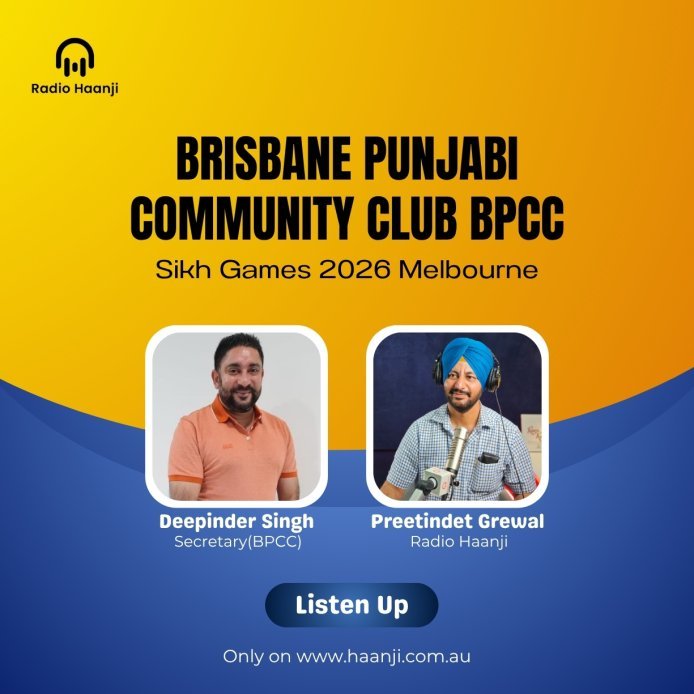
Brisbane Punjabi Community Club heads to Melbourne for Sikh Games 2026. Football teams, youth pathways, and a call to the Queensland community — Radio Haanji interview with Deepinder Singh.
Published: 25 March 2026 | By: Preetinder Grewal - Radio Haanji 1674 AM | Category: Australian Sikh Games 2026, Community Sport, Punjabi Australia
In a conversation that brought the energy of Brisbane all the way to Melbourne, Radio Haanji 1674 AM host Preetinder Singh Grewal sat down with Deepinder Singh, Secretary of the Brisbane Punjabi Community Club (BPCC) Calamvale, to talk about the club's grand preparations for the 38th Australian Sikh Games 2026, to be held in Melbourne from 3–5 April 2026.
With Queensland's most prominent Punjabi sporting club gearing up for what promises to be an exceptional campaign on the football fields of Melbourne, this conversation offered a revealing look at what it takes to build and sustain one of Australia's great community sporting institutions — and why BPCC's journey from Calamvale to Crown Palladium is about far more than winning trophies.
Radio Haanji 1674 AM is bringing you all live updates and exclusive coverage from the Australian Sikh Games 2026 Melbourne. For full event details, sports schedules, and how to attend, read our complete guide to the Australian Sikh Games 2026.
BPCC Calamvale: Queensland's Powerhouse Punjabi Club
Established in 2009, the Brisbane Punjabi Community Club has grown to become one of Australia's largest Punjabi community clubs, with a footprint that spans multiple sports categories, age groups, and community programs across Queensland.
Based in Calamvale, a southern Brisbane suburb with a strong South Asian community, BPCC is a proud member of ANSSACC (the Australian National Sikh Sports and Cultural Council), the governing body that organises the Australian Sikh Games each year. That long-standing affiliation has meant BPCC regularly sends some of the highest team numbers at the Games — from Under-7 juniors all the way through to Over-50 and women's teams.
In the 16 years since its founding, the club has built its identity on three pillars that Deepinder Singh returned to throughout his Radio Haanji interview: discipline, teamwork, and consistency. These are not just motivational phrases at BPCC — they are embedded in the club's training culture, its selection process, and its approach to community events.
With over 2,700 followers on Facebook and active programs running year-round, BPCC is far more than a seasonal competition club. It is a community institution that has helped hundreds of Queensland's Punjabi youth find their footing in Australian sport.
Football Focus: Multiple Categories, Maximum Ambition
At the 38th Australian Sikh Games in Melbourne, BPCC is targeting strong performances across multiple football categories. While specific draws and fixtures are managed by ANSSACC closer to the event, Deepinder Singh confirmed that the club will field teams across junior and senior divisions — continuing a tradition of comprehensive, multi-team participation that sets BPCC apart from smaller clubs.
Football (soccer) is the cornerstone sport at BPCC. The club runs structured age-group programs from Under-7 through to open men's and women's teams, ensuring that players develop within a consistent coaching environment from their earliest years through to senior competition. This approach to player pathways means BPCC doesn't simply enter teams at the Sikh Games — it enters teams with genuine preparation behind them.
The Australian Sikh Games football competition is among the most fiercely contested events on the Punjabi-Australian sporting calendar. With clubs travelling from Adelaide, Perth, Sydney, Melbourne, and now Brisbane, the inter-state rivalry adds an extra edge that players and supporters relish. For BPCC players, the opportunity to represent Queensland on a national stage — in front of crowds that can exceed 100,000 over the three-day event — is a powerful motivator.
Other clubs competing at the Melbourne 2026 Games include Diamond Sports Club Melbourne (basketball and volleyball), and a strong contingent from South Australia's Punjab Lion Club Adelaide. For the full sporting picture, Radio Haanji has been covering every angle — from Majha Youth Club's preparations to the inaugural international coaches conference.
Youth Pathways: From Grassroots to the Games Stage
One of the most striking aspects of BPCC's model is the deliberate investment in youth development. Deepinder Singh emphasised that the club's junior programs are not just a feeder system for the senior teams — they are a genuine community service.
BPCC's junior football programs enrol players from Under-7 to Under-17, including a dedicated Under-15 girls team, and open men's and women's sections. This comprehensive structure ensures that young Punjabi-Australians in Brisbane and the surrounding suburbs have access to skilled coaching, regular competitive fixtures, and a culturally connected sporting environment from a very young age.
The value of this cannot be overstated. Research consistently shows that children from migrant communities who participate in structured sports are more likely to develop stronger social networks, higher self-esteem, and better academic engagement. For Queensland's Punjabi community, BPCC serves as that bridge — between cultural heritage and mainstream Australian sporting life.
At the Sikh Games level, this investment pays visible dividends. Junior players who have trained through the BPCC system for years arrive at the national stage with technical foundations that allow them to compete at a high level. And when they watch their seniors compete with discipline and composure, they see the pathway clearly mapped out in front of them.
The Sikh United Melbourne model, covered separately by Radio Haanji, offers a comparable approach from a Victorian perspective — taken together, these two club profiles illustrate how Punjabi community sports organisations across Australia are independently arriving at the same conclusion: structured youth pathways are the foundation of long-term community success.
Committee Coordination: The Engine Behind the Club
Running a club of BPCC's scale and ambition requires significant behind-the-scenes coordination. As Secretary, Deepinder Singh plays a central role in that infrastructure — managing team logistics, liaising with ANSSACC, coordinating travel and accommodation for out-of-state events like the Melbourne Games, and ensuring the club's broader administrative functions run smoothly.
He confirmed in the Radio Haanji interview that he, along with other committee members, will be personally present in Melbourne to coordinate and support team participation across the competition schedule. This kind of hands-on committee involvement — where the leadership doesn't just plan and delegate but also shows up on the ground — reflects the volunteer-driven character that has defined community sporting clubs in Australia for decades.
The committee's role extends beyond tournament logistics. BPCC's leaders are also responsible for maintaining the club's inclusive culture, its fitness programs, and its increasingly important focus on mental wellbeing. Deepinder Singh's mention of inclusivity and mental health as explicit club priorities signals a maturing of the community sports model — one that recognises athletes are whole people, not just competitors.
Inclusivity, Fitness, and Mental Wellbeing: A Holistic Sporting Vision
One of the standout elements of Deepinder Singh's conversation with Radio Haanji was his articulation of BPCC's commitment to inclusivity, fitness, and mental well-being as core values — not afterthoughts.
In practice, this means the club actively welcomes players of varying skill levels, not just elite or semi-elite athletes. It means creating spaces where both men and women can participate competitively (the club's dedicated women's and girls' programs are evidence of this). And it means acknowledging that sport is one of the most powerful tools for maintaining mental health in a migrant community that sometimes faces isolation, cultural dislocation, and the pressures of building a new life in Australia.
The Punjabi community in Queensland, while deeply connected, is also geographically spread. BPCC acts as a gathering point — the training sessions, the committee meetings, the Sikh Games preparations — all provide a social scaffold that supports mental wellness alongside physical fitness.
This holistic approach is increasingly recognised as essential in community sport, particularly for culturally and linguistically diverse (CALD) communities. Football Queensland's multicultural programs, which have reached over 900 participants from CALD communities, reflect the same understanding at the state level. BPCC's model demonstrates that community clubs can drive this agenda organically, from the ground up, without waiting for government programs to arrive.
A Call to the Community: Players, Volunteers, and Supporters Needed
Deepinder Singh closed his Radio Haanji interview with a direct and passionate appeal to the broader Queensland Punjabi community: come forward for the Sikh Games — whether as a player, a supporter, or a volunteer.
This call matters for several reasons. The Australian Sikh Games is not just a sporting competition — it is one of the largest Punjabi community gatherings in the Southern Hemisphere. Its success depends on the collective effort of clubs, volunteers, and community members across the country. For BPCC, being a strong participant in Melbourne means showing up in numbers, not just on the pitch.
If you are based in Brisbane or Queensland and are interested in connecting with BPCC ahead of the Games, the club can be reached through bpcccalamvale.com.au or their active Facebook community.
For those making the trip to Melbourne, the Games will be held across the Parkville Precinct from 3–5 April, with the cultural gala night at Crown Palladium on 5 April. Full event details, including registration and EOI forms, are available at the official Australian Sikh Games Melbourne 2026 website. The Games are governed by ANSSACC, the Australian National Sikh Sports and Cultural Council.
Don't miss the Bhangra and Giddha Cultural Night on 5 April — a spectacular evening of Punjabi folk performance that is one of the most beloved events of the entire Games weekend.
Radio Haanji Covers Every Moment of the Sikh Games 2026
Radio Haanji 1674 AM — Australia's first 24/7 Punjabi community radio station, broadcasting from Melbourne since 2015 — is your home for complete Australian Sikh Games 2026 coverage. From pre-Games interviews with club leaders and coaches, to live updates during competition days, to post-event analysis and highlights, Radio Haanji is the voice of the Punjabi-Australian community throughout this historic Easter weekend.
Listen live at haanji.com.au or on the Radio Haanji app. Tune in on 1674 AM in Melbourne.
Frequently Asked Questions: BPCC and Australian Sikh Games 2026
What is the Brisbane Punjabi Community Club (BPCC)?
The Brisbane Punjabi Community Club, based in Calamvale, Queensland, is one of Australia's largest Punjabi community sporting clubs. Established in 2009, BPCC is a member of ANSSACC and runs football programs for players aged Under-7 through to seniors, including women's and girls' teams.
When and where is the Australian Sikh Games 2026?
The 38th Australian Sikh Games will be held in Melbourne from 3–5 April 2026 (Easter weekend). Sports competitions take place across the Parkville Precinct, with the cultural gala night at Crown Palladium, Southbank on 5 April.
What sports will BPCC compete in at the 2026 Sikh Games?
BPCC will compete primarily in football (soccer) at the 2026 Australian Sikh Games, fielding teams across multiple categories including junior and open divisions.
Who is Deepinder Singh and what is his role at BPCC?
Deepinder Singh is the Secretary of the Brisbane Punjabi Community Club Calamvale. He plays a key administrative and coordination role, and will be personally present in Melbourne to support team participation across the Sikh Games competition schedule.
How can I join BPCC or support them at the Sikh Games?
You can connect with BPCC Calamvale through their official website at bpcccalamvale.com.au or via their Facebook page. The club welcomes players, volunteers, and community supporters — especially as the Sikh Games in Melbourne approach.
How has BPCC contributed to Punjabi youth development in Queensland?
BPCC runs structured football programs for players from Under-7 to Under-17, including a girls' Under-15 team. These programs provide culturally connected sporting pathways for Brisbane's Punjabi youth, supporting physical fitness, social development, and mental well-being.
Where can I listen to Radio Haanji's Sikh Games coverage?
You can listen live on 1674 AM in Melbourne, stream online at haanji.com.au, or download the Radio Haanji app. All Sikh Games podcasts and interviews are available in the Punjabi podcast section of the website.
This article is part of Radio Haanji 1674 AM's ongoing coverage of the 38th Australian Sikh Games 2026. Read all our Sikh Games articles at haanji.com.au.
Radio Haanji 1674 AM is Austalia's Punjabi community radio station.
Listen free at haanji.com.au | Spotify | Apple Podcasts | iOS App | Android App
Serving the Punjabi community in Australia, Canada, Singapore and world wide.
What's Your Reaction?







Related Posts