














































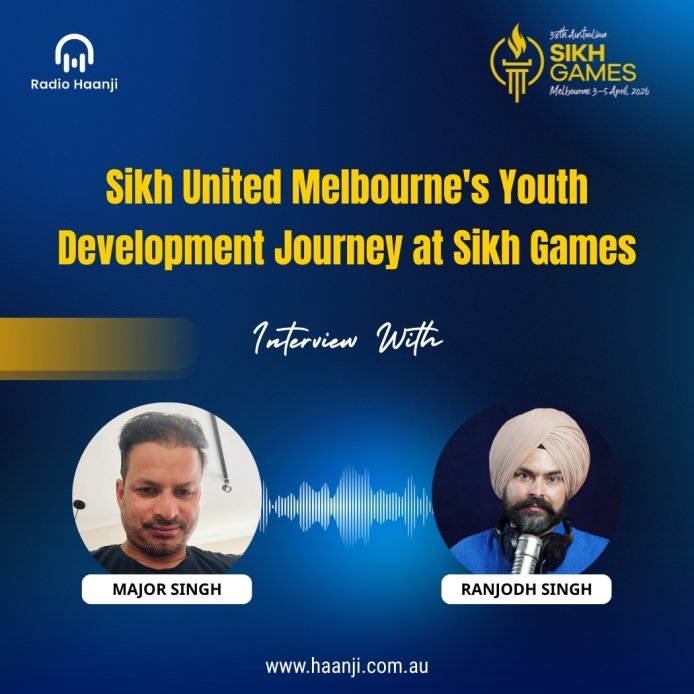
Sikh United Melbourne Club: Youth Development for Sikh Games 2026 - Major Singh - Ranjodh Singh
Host:-
 Ranjodh Singh
Sikh United Melbourne's youth development journey: community courts to national teams. Interview with Major Singh. 50 volleyball teams at Sikh Games 2026 Melbourne April 3-5.
Sikh Games 2026 Melbourne | April 3-5, 2026 | Interview with Major Singh, President, Sikh United Melbourne Club
Every Sunday morning at Coburg Bank, something happens that doesn't make headlines but changes lives. Fifty kids—some barely tall enough to spike a volleyball, others already towering with state-level experience—show up for training. Their coach is Major Singh, a man whose sons went from playground beginners to representing Australia internationally. His club, Sikh United Melbourne, doesn't just enter teams in tournaments. It builds a pathway.
With the 38th Australian Sikh Games less than two weeks away (April 3-5, 2026, Melbourne), Radio Haanji sat down with Major Singh to understand what it actually takes to turn community-level athletes into state and national representatives—and why this year's games will see double the expected volleyball teams competing.
The Interview: What Major Singh Actually Said About Building Champions
"My goal is simple," Major Singh told us. "A kid starts with us at the community level. They train in our Sunday sessions. Then they play for their school teams. If their basics are clear—height, skills, dedication—they represent Victoria. And from there? Australia."
It sounds straightforward. The reality is messier, harder, and more rewarding than any simple progression chart suggests.
Success Stories: When the Pathway Actually Works
Major Singh's elder son, Jaspreet (everyone calls him Jassu), started training at age 5 or 6. Not structured coaching—just showing up when his dad went to play. Watching. Trying. Failing. Learning.
By his teenage years, Jassu was representing Victoria in volleyball. Then came selection to a wing program in Canberra. Then a year representing Australia, competing in Thailand. He's now playing Under-21.
His younger brother, Jagpreet (Jaggi), is 16 and already representing Victoria at Under-17 level. Different kid, same pathway: community training → school teams → state selection → national prospects.
"I didn't train them differently than anyone else," Major Singh insists. "Same drills. Same Sunday sessions. Same expectations. The difference? They showed up every week. They listened. They wanted it."
Beyond His Own Kids: The Wider Success
Arsh, whose father Jaskaran plays at the national level as a lifter, can't even compete in the Sikh Games due to international player restrictions. His younger brother represents Australia from the USA, where he's studying on a sports scholarship.
Players from Baba Budha Ji Club and Singh Sabha Club have represented Victoria through similar pathways. The system works—when kids commit and parents support.
From Sikh United Melbourne specifically? Two of Major Singh's sons, plus one other athlete. "Three so far from our club," he says. "But many more from other clubs in the community."
The Generational Coaching Challenge Nobody Talks About
Ask Major Singh about the biggest difference between coaching his generation versus today's kids, and you'll get a surprisingly blunt answer.
"In our time, if the coach said jump, we jumped. If they said run 20 laps, we ran 20 laps. The stick was there too—literally. We respected our coaches like gurus. What they said was law."
"Here? You can't even raise your voice at a kid without worrying about complaints. Parents tell me, 'Be strict with my son, use the stick if you need to'—but the system doesn't allow that. And honestly? If a kid doesn't have interest, force doesn't help anyway."
The Paradox Parents Create
Here's the weird tension: Parents want coaches to push their kids hard. But they also want their kids treated gently. Schools don't pressure students academically the way they used to. That same relaxed attitude carries over to sports.
"Kids spend more time on social media than on fundamentals," Major Singh notes. "They're not as serious. And when the coach-player relationship lacks that traditional respect? The performance suffers. The kids who still treat coaching as guru-shishya (master-student) relationship—those are the ones who excel."
It's not nostalgia. It's observation. The kids who show up every week, listen without arguing, and trust the process? They're the ones whose names appear in state team announcements.
What Actually Works With Modern Kids
Major Singh has adapted. Instead of forcing dedication, he demonstrates it. When teaching young players a new technique, he'll still step onto the court at over 40 and show them how it's done.
"They need to see that we actually know what we're talking about," he laughs. "Young players watch you play and think, 'Okay, this guy really did play at that level.' Then they listen."
Positive reinforcement matters too. "We tell parents, 'Your kid is performing well, keep bringing them.' If we only pointed out mistakes, parents would stop coming. You have to show them progress."
Sikh United Melbourne Club: The Complete Story
The club officially registered in 2015, but the story starts earlier—much earlier.
"We've been playing since 2002," Major Singh explains. "Just informally, randomly. But in 2015, we made it official—registered the club properly, started structured training, built a real program."
Numbers That Matter
Today, Sikh United Melbourne Club encompasses: - **~50 families** actively involved across both sports - **~50 athletes** training regularly - **Multiple teams** across age groups and divisions - **Two sports**: Volleyball (primary) and Basketball (added recently through Western Tigers program)
Training Schedule & Facilities
**Primary Training:** Sundays at Coburg Bank (3-4 courts booked) **Secondary Training:** Thursdays (lighter attendance, mostly serious players) **Focus:** Sunday is mandatory. Thursday is for kids who want extra work.
"Manjot Singh handles all our bookings and organization," Major Singh credits his teammate. "Without proper facility management, you can't run consistent training. Some clubs struggle to get courts. We haven't had that problem."
Teams Competing in Sikh Games 2026
For the upcoming games, Sikh United Melbourne is entering teams in: - **Over-40 Men's Volleyball** (Major Singh still competes occasionally) - **Open Men's Volleyball** - **Women's Volleyball** - **Under-17 Boys Volleyball** - **Western Tigers Basketball** (multiple junior and senior categories)
"This is our biggest entry yet," Major Singh says. "We're focusing on youth development more than senior teams now. That's where the future is."
Western Tigers Basketball Club: The New Chapter
While Sikh United Melbourne made its name in volleyball, 2025 marked a significant expansion with the official establishment of **Western Tigers Basketball Club** as part of the Sikh United family.
Founded in 2025, Western Tigers operates as a community-driven basketball program competing in local leagues while sharing Sikh United's core values: respect, teamwork, discipline, and sportsmanship.
What Western Tigers Offers
**For Juniors:** - Structured skill development - Confidence building in a supportive environment - Pathway from beginner to competitive leagues - Professional coaching and dedicated volunteers **For Seniors:** - Competitive league play - Continued skill refinement - Community connection through sport - Opportunity to represent Western Tigers and Sikh United **The Integration:** By operating under the Sikh United umbrella, Western Tigers inherits the volleyball program's proven development model: community-level entry → school teams → state representation → national prospects.
"Basketball gives us another avenue for kids who might not connect with volleyball," explains Major Singh. "Same values, same pathway, different sport. Some kids need options."
Joining Western Tigers or Sikh United Volleyball
The process couldn't be simpler—and that's intentional.
"No complicated application. No trials to get through the door. Contact us. Bring your kid. Start training," Major Singh outlines. "We put contact numbers on our app, on social media. Parents reach out, we tell them when and where, and they show up."
**Membership Fee Structure:** After 4-5 months of regular participation, families pay a joining fee that covers: - Official team uniform - Training equipment access - Facility costs - Tournament entry fees
"We want to remove barriers," he emphasizes. "The fee only comes after families are sure their kid wants to commit. We're not collecting money from kids who try it once and never come back."
Why This Year's Sikh Games Volleyball Competition Is Different
Major Singh dropped a surprising statistic during our interview: "We expected maybe 25 volleyball teams. This year? Fifty teams. Double what we planned for."
That's not just a numbers bump—it's a logistics nightmare that's been solved through creative venue management.
The Venue Solution
**Preliminary Rounds:** Melbourne University campus (city location, separate booking to accommodate overflow) **Finals:** Parkville Stadium (main Sikh Games venue)
"We literally had to book an entire university campus just for preliminary volleyball rounds," Major Singh explains. "The main venue couldn't handle that many teams across all divisions. So we're running parallel competitions the first two days, then bringing finalists together for championship rounds."
What This Means for Spectators
If you're planning to watch volleyball at Sikh Games 2026: - **Days 1-2 (April 3-4):** Check schedules carefully—your team might be at Melbourne Uni campus, not the main venue - **Day 3 (April 5):** All finals at Parkville Stadium
"We'll update everything on the Sikh United Club social media page," Major Singh promises. "Addresses, court assignments, schedules. Coordinators are already working on it."
The Complete Sikh Games 2026 Melbourne Overview
The 38th Australian Sikh Games returns to Melbourne April 3-5, 2026, representing the largest Sikh sporting event in the Southern Hemisphere.
What Are the Australian Sikh Games?
Started in 1988, the Australian Sikh Games bring together Sikh athletes from across Australia and New Zealand for three days of competition, community, and celebration. It's part Olympics, part family reunion, part cultural festival.
Sports contested include: - Volleyball (this year's biggest competition with 50+ teams) - Basketball - Kabaddi - Soccer - Netball - Athletics - Bhangra & Giddha competitions
2026 Specific Details
**Dates:** April 3-5, 2026 **Location:** Melbourne, Victoria **Main Venue:** Parkville Stadium **Additional Venue:** Melbourne University campus (volleyball preliminaries) **Participating Regions:** - Melbourne clubs (largest contingent, including Sikh United Melbourne, Singh Sabha, Baba Budha Ji, Royal King, and others) - Sydney clubs - Perth clubs - Other Australian cities - New Zealand teams
"This year's preparation has been intense," Major Singh notes. "Every club is training harder because it's in Melbourne—our home ground. There's pride at stake."
Traditional Powerhouse Clubs to Watch
**Veterans:** - **Singh Sabha Club:** One of the oldest, always competitive in volleyball - **Baba Budha Ji Club:** Strong track record, multiple state-level players - **Royal King Club:** Consistently performs well **Strong Performers:** - **Sikh United Melbourne:** The club we're profiling - Sydney clubs (always bring tough competition) - Perth clubs (long travel, but serious preparation)
"The first or second place? Usually one of the established clubs takes it," Major Singh acknowledges. "But competition is getting tighter. Newer clubs are bringing well-trained athletes. It's not automatic anymore."
What Makes Sikh Games Matter Beyond Winning
Ask anyone who's competed in multiple Sikh Games what they remember most, and they won't start with their best spike or winning shot. They'll talk about the community.
"For three days, the community comes together," Major Singh reflects. "Parents meet parents. Kids see other kids who look like them, speak Punjabi like them, playing at high levels. Athletes who went off to play state or national level come back to see where they started. It matters."
The Honoring of Champions
Players like Arsh, who can't compete due to international player restrictions, will still attend the games.
"We're going to honor him," Major Singh reveals. "He might not be able to play, but the community needs to see what's possible. When kids see someone from their community playing at national level, representing Australia—that changes what they think they can achieve."
Victoria-level players will definitely compete. "All the kids who've represented Victoria—they'll be there. This is their event."
The 10-Year-Old Rule and Youth Development Philosophy
When asked about the right age to start serious sports training, Major Singh has a specific answer: "Ten years old."
"By age 10, a child should have picked up some sport," he explains. "Not necessarily volleyball or basketball—any sport. The fundamentals of athleticism, teamwork, discipline—those transfer."
His own sons started earlier—5 or 6—but not through structured training. "They came to the ground because I was playing. They watched. They tried. It was natural, not forced."
What Happens When You Start Too Late?
"If you bring a 16-year-old who's never played, and they're competing against kids who've trained since 10? The gap is huge. Not impossible to close, but it requires exceptional dedication."
The pathway works best when: - Start young (around 10 years old) - Train consistently (every week, not sporadic) - Play for school teams (additional practice, different competition) - Progress to district/regional teams (if skills warrant) - State selection becomes possible (if height, skills, and dedication align) - National representation is the ultimate goal (achieved by very few)
How Families Can Actually Support Young Athletes
Major Singh sees both ends of the parent involvement spectrum.
"The parents who succeed? They show up every Sunday. They don't miss. If their kid has interest, they nurture it—not by pressure, but by consistency. They understand that one missed session becomes two, then the habit breaks."
**What Works:** - Consistent attendance at training - Positive encouragement after both wins and losses - Trust in the coaching process - Understanding that development isn't linear - Supporting without controlling **What Doesn't:** - Sporadic attendance ("We'll come when it's convenient") - Comparing their kid to others constantly - Questioning every coaching decision - Expecting immediate results - Forcing a kid who's genuinely uninterested
"If a child has no interest, you can't force it," Major Singh states flatly. "I tell parents this directly: bring them, let them try, and if they don't connect with it after a few sessions, that's okay. Maybe basketball instead of volleyball. Maybe a different sport entirely. But forcing never works."
The Community Tournament Tradition
Beyond preparing for Sikh Games, Sikh United Melbourne hosts its own annual tournament every January—except this year.
"We skipped 2026 because we're focused entirely on preparing for Sikh Games," Major Singh explains. "But usually, we host a January tournament. It gives newer players competition experience in a lower-pressure environment than the big games."
These community-organized events serve multiple purposes: - Give less experienced players actual game time - Help coaches assess player development - Build relationships between clubs - Create a competitive circuit beyond the annual Sikh Games - Generate fundraising for club operations
Challenges Clubs Face (That Nobody Advertises)
Running a community sports club isn't Instagram-worthy behind-the-scenes content. It's: - **Facility booking logistics** (Manjot Singh handling 3-4 court bookings weekly) - **Volunteer burnout** (same families doing setup/teardown every week) - **Balancing serious athletes with beginners** (very different training needs) - **Funding** (membership fees, tournament entries, equipment costs) - **Managing parent expectations** (when their kid isn't selected for top teams) - **Maintaining interest across a full season** (kids have many competing priorities)
"The clubs that survive and grow? We have dedicated people who keep showing up," Major Singh credits his team. "Not for glory, not for recognition—just because the work needs doing and the kids deserve the opportunity."
What Success Actually Looks Like
If you're a parent wondering whether club sports are "worth it," here's what Major Singh measures: **Not Success:** - Whether your 12-year-old gets scouted for a state team - How many trophies sit on a shelf - Scholarships (nice when they happen, rare enough to not plan around) **Actually Success:** - Your kid shows up every week because they want to, not because you forced them - They've learned to take coaching feedback without defensiveness - They've made friends who share their interest in getting better - They understand that improvement requires consistent effort over months/years - They've experienced both winning and losing with grace - They're physically active in an era where screen time dominates
"If those things happen, the rest takes care of itself," Major Singh says. "And if they make state level, national level? That's bonus. But the real development is everything leading up to that."
Looking Ahead: What Comes After Sikh Games 2026?
Major Singh's goal extends beyond this year's games.
"Every kid I trained when they were small—I want to see them representing Victoria. Then Australia. That's the dream. Some make it, some don't, but we create the pathway."
Sikh United Melbourne's focus has shifted deliberately toward youth: - Less emphasis on veteran/senior teams - More investment in Under-17 and Under-21 programs - Structured progressions from beginner to advanced training - Partnerships between volleyball and basketball programs to share best practices
"The seniors can take care of themselves," he says. "They already know how to train, how to compete. The young ones? That's where we can make a difference."
How to Connect With Sikh United Melbourne & Western Tigers
If you're interested in joining either volleyball or basketball programs:
**Find Them:** - Search "Sikh United Melbourne Club" or "Western Tigers Basketball" on Facebook and Instagram - Contact numbers available on their social media pages - Direct message for training schedules and location details **What to Expect:** - First 4-5 months: Try it out, no commitment - If your child commits: Joining fee covers uniform and equipment - Training: Primarily Sundays at Coburg Bank (check for current location) - All skill levels welcome—beginners to competitive players **For Sikh Games Spectators:** - Follow Sikh United Melbourne Club page for venue updates - Check schedules for Melbourne University campus vs Parkville Stadium locations - Volleyball preliminaries: April 3-4 - Volleyball finals: April 5
The Bigger Picture: Why Community Sports Clubs Matter
In an interview about sports, Major Singh accidentally described something larger.
"These kids—when they're training every Sunday, learning discipline, respecting coaches, working as a team—they're learning how to show up consistently for something that matters. That skill applies everywhere. School. Work. Relationships. Life."
Sikh United Melbourne and Western Tigers aren't just developing volleyball players and basketball players. They're creating a space where: - First-generation Australian kids connect with Punjabi culture through sport - Families build multi-year relationships beyond surface-level community interactions - Young athletes see examples of what's possible when you commit - The community has somewhere to gather that's not a gurdwara or restaurant - Parents realize their kids can excel without compromising cultural identity
"When Jassu went to Thailand representing Australia, or when any kid makes state level—it's not just their achievement," Major Singh reflects. "The whole community feels it. We see ourselves in them."
Final Thoughts Before Sikh Games 2026
The 38th Australian Sikh Games will happen April 3-5, 2026, with or without any individual player or team. Volleyball will crown champions. Basketball will have winners and losers. Bhangra and Giddha will showcase incredible performances.
But when you watch Sikh United Melbourne's teams compete—or any club team, really—you're not just seeing that specific match. You're seeing years of Sunday morning training sessions. Parents who woke up early to drive their kids across town. Coaches who demonstrated techniques long after their own competitive days ended. Kids who chose consistency over convenience, week after week after week.
"The result of any single game? It matters for maybe an hour," Major Singh says. "The habits formed over years of training? Those matter for a lifetime."
That's the actual story of community sports development. Not highlight reels. Not championship trophies. The unglamorous, repetitive, absolutely essential work of showing up.
See you at the games. April 3-5. Melbourne. Parkville Stadium and Melbourne University campus.
Bring your family. Watch some volleyball. Witness what happens when community investment meets individual dedication.
And maybe, if you have a 10-year-old who needs a sport, message Sikh United Melbourne on Sunday.
Quick Reference: Key Information
Sikh United Melbourne Club President: Major Singh Sports: Volleyball (primary), Basketball (Western Tigers) Training: Sundays (primary), Thursdays (advanced) Location: Coburg Bank Contact: Social media (search "Sikh United Melbourne Club") Founded: Officially 2015, playing since 2002 Current Athletes: ~50 across both sports Families Involved: ~50
Western Tigers Basketball Club Founded: 2025 Part of: Sikh United family Programs: Junior and Senior (boys and girls) Values: Respect, teamwork, discipline, sportsmanship Contact: Search "Western Tigers Basketball" on social media
38th Australian Sikh Games 2026 Dates: April 3-5, 2026 Location: Melbourne, Victoria Main Venue: Parkville Stadium Additional Venue: Melbourne University campus (volleyball prelims) Sports: Volleyball, Basketball, Kabaddi, Soccer, Netball, Athletics, Bhangra, Giddha Expected Volleyball Teams: 50+ (doubled from initial projections)
Notable Sikh United Alumni: - Jaspreet Singh (Jassu): Represented Victoria, Australia (Thailand competition), currently Under-21 - Jagpreet Singh (Jaggi): Representing Victoria Under-17 - Multiple state-level representatives from club programs
Other Competitive Clubs:** Singh Sabha Club, Baba Budha Ji Club, Royal King Club, Sydney clubs, Perth clubs
This article is based on a Radio Haanji 1674 AM interview with Major Singh, President of Sikh United Melbourne Club, conducted March 2026.
Radio Haanji 1674 AM is Austalia's Punjabi community radio station.
Listen free at haanji.com.au | Spotify | Apple Podcasts | iOS App | Android App
Serving the Punjabi community in Australia, Canada, Singapore and world wide.
What's Your Reaction?