










































































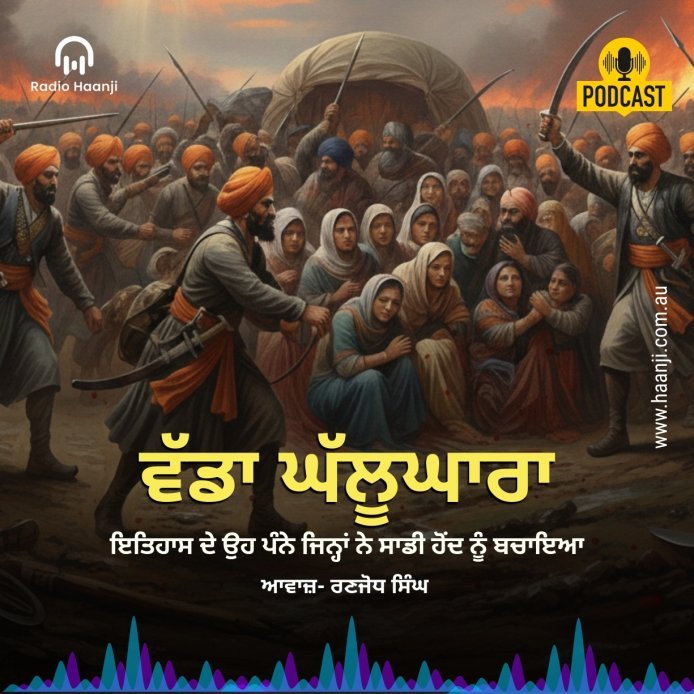
Wadda Ghallughara 1762: Sikh History | Ranjodh Singh | Punjabi Podcast | Radio Haanji
Host:-
 Ranjodh Singh
Learn about Wadda Ghallughara, the 1762 Sikh massacre near Sangrur. Host Ranjodh Singh explores this pivotal day in Sikh history on Radio Haanji Australia.
Wadda Ghallughara: The Great Sikh Holocaust of 1762
Remembering February 9th: A Day of Sacrifice and Resilience in Sikh History

Today marks the 264th anniversary of one of the darkest yet most defining moments in Sikh history - Wadda Ghallughara, which occurred on February 9, 1762, near Kup Rahira in present-day Sangrur district. On this solemn occasion, Radio Haanji's popular show "On This Day Today in Sikh History" with host Ranjodh Singh brought this significant historical event to Australian Punjabi listeners, ensuring that the memories of those who sacrificed their lives continue to inspire future generations.
What Was Wadda Ghallughara?
Wadda Ghallughara, meaning "the great massacre" or "the great holocaust," was the mass killing of Sikhs by Afghan forces led by Ahmad Shah Durrani, also known as Ahmad Shah Abdali. The tragedy unfolded at Kup Rahira, approximately 12 kilometers north of Malerkotla in Punjab, India. Historical estimates suggest that between 25,000 to 30,000 Sikhs lost their lives in this massacre, representing one-third to half of the entire Sikh population at that time.
This horrific event is distinguished from the Chhota Ghallughara (the "lesser holocaust") of 1746, where 7,000 Sikh soldiers were killed by Mughal forces.
The Events Leading to the Tragedy
The massacre didn't happen in isolation. Following his victory over the Marathas at the Third Battle of Panipat in January 1761, Ahmad Shah Durrani looted and destroyed Delhi before beginning his return journey to Afghanistan. As he retreated, Sikh forces attacked his army from the River Sutlej to the River Indus, liberating approximately 2,000 women prisoners and recovering a significant portion of the looted wealth.
Enraged by these losses, Ahmad Shah Durrani decided to return with a large force to destroy the Sikhs completely. He received intelligence about Sikh movements from Aqil Das of Jandiala, the leader of the heretical Niranjania sect and an ally of the Afghans.
The Day of the Massacre
In the twilight hours of February 9, 1762, Durrani and his allies surprised approximately 30,000 Sikhs at Kup village, most of whom were non-combatants including women, children, and elderly men. The Sikh group included 11 Misldars (leaders of Misls) of the Sikh Confederacy, including the renowned Jassa Singh Ahluwalia and Charat Singh of the Sukerchakia Misl.
Ahmad Shah Durrani attacked with 30,000 horsemen from the western side after crossing the River Sutlej, while the forces of Sirhind under Zain Khan and Malerkotla under Bhikhan Khan attacked with over 20,000 men and artillery from another direction.
The Sikhs, protecting their slow-moving convoy of families, formed a protective ring approximately 4 kilometers in length around their women, children, and elders. Unable to use their typical hit-and-run guerrilla tactics, they faced a stationary battle against vastly superior numbers and artillery.
Acts of Extraordinary Valor
Despite being outnumbered and outgunned, the Sikh warriors displayed remarkable courage. Jassa Singh Ahluwalia sustained 22 wounds, while Charat Singh received 19 wounds during the battle. Nearly every Sikh warrior was wounded in this fierce engagement. The fighting continued throughout the day as the Sikhs tried to move toward the Malwa region.
At sunset, both the Sikhs and their pursuers reached a large pond (dhab) near the villages of Kutba and Bahmania, about 25 kilometers west of Rohira and Kup, where the bloodshed temporarily stopped as both sides needed water and rest.
The Aftermath
The roads along the route were littered with dead Sikh bodies, and Durrani ordered his forces to dismember the heads of the corpses and load them onto carts to take back to Lahore. On March 3, 1762, he returned to Lahore with fifty carts filled with Sikh heads to invoke fear among the local Sikh population. Pyramids of severed heads were erected outside Delhi Gate.
In a further act of sacrilege, Ahmad Shah Durrani returned to Amritsar and blew up the Harmandir Sahib on April 10, 1762, on Vaisakhi, filling the sacred pool around it with cow carcasses.
The Indomitable Sikh Spirit
What makes this chapter of Sikh history truly remarkable is not the tragedy itself, but the response that followed. According to Prachin Panth Prakash, as the Sikhs gathered on the evening of February 5th, a Nihang stood up and proclaimed: "The weak have been shed; the true Khalsa remains intact."
Within just three months, in May 1762, the reorganized Sikhs attacked Zain Khan at Sirhind, who was forced to pay them 50,000 rupees for peace. By July-August 1762, they were ravaging the neighborhood of Lahore while Ahmad Shah Durrani watched helplessly.
Seven months after Wadda Ghallughara, on Diwali day, October 17, 1762, under the leadership of Sardar Jassa Singh Ahluwalia, the Khalsa achieved justice by triumphing decisively over the Afghan army at the Third Battle of Amritsar.
Memorials and Remembrance
Today, several Gurdwaras stand at the sites of this historic tragedy. Gurdwara Sri Wadda Ghallughara Sahib Rohira marks where the massacre began, while Gurdwara Sri Wadda Ghallughara Sahib Kutba commemorates where the remaining Sikhs escaped and the Wadda Ghallughara ended. A government-built memorial also stands near the Rohira Gurdwara, and a local railway station has been renamed "Ghallughara Rahira Railway Station" in memory of these events.
Lessons for Today
Wadda Ghallughara stands as a powerful testament to the Sikh community's resilience, courage, and unwavering commitment to their principles. Despite facing overwhelming odds and suffering catastrophic losses, the Sikhs refused to be defeated. Their ability to reorganize, rebuild, and eventually triumph over their oppressors within months demonstrates an extraordinary spirit that continues to inspire Sikhs worldwide.
As host Ranjodh Singh reminded listeners on Radio Haanji today, remembering Wadda Ghallughara is not merely about honoring the past—it serves as a wellspring of strength, resilience, and inspiration for challenges we face today and tomorrow.
Listen to On This Day Today in Sikh History
For more insights into this significant day in Sikh history and to hear Ranjodh Singh's complete discussion on Wadda Ghallughara, tune in to Radio Haanji, Australia's premier Punjabi radio station.
Available for live streaming online and through the Radio Haanji app, the show brings the rich tapestry of Sikh history to Punjabi communities across Melbourne, Sydney, and throughout Australia.
What's Your Reaction?







Related Posts