











































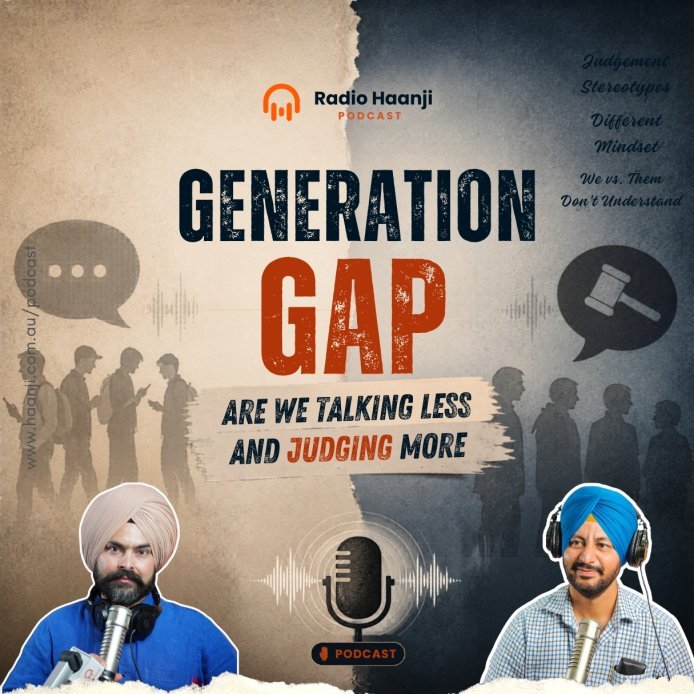
Generation Gap - Are We Talking Less and Judging More? - Preetinder Grewal - Ranjodh Singh
Host:-
 Preetinder Grewal
 Ranjodh Singh
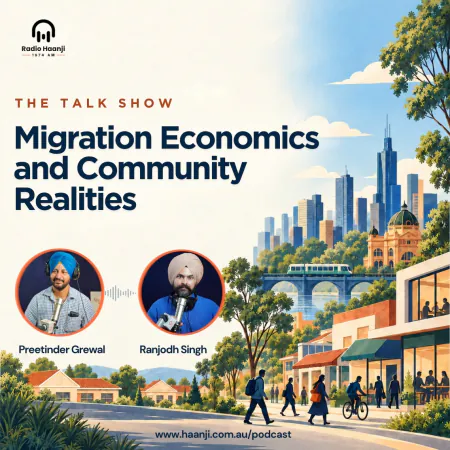
Punjabi families in Australia and the generation gap — values, career, mental health and what actually helps. The Talk Show on Radio Haanji 1674 AM.
Podcast: The Talk Show | Hosts: Preetinder Grewal & Ranjodh Singh Show: Radio Haanji 1674 AM — Melbourne, Australia
Ask a Punjabi parent in Melbourne what worries them most, and most will not say money or work. They will say something like: "My kids don't listen anymore" or "They don't understand our values." Ask their children, and you get the other side: "They don't give me any space" or "They judge everything I do."
Two people. One family. And somehow, a distance that feels impossible to close.
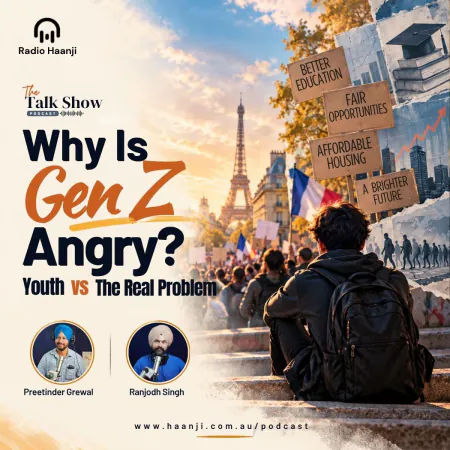
This is the generation gap — and in a recent episode of The Talk Show on Radio Haanji 1674 AM, hosts Preetinder Grewal and Ranjodh Singh had an honest, no-filter conversation about why this gap exists in Punjabi and Indian families in Australia, and what — if anything — can actually be done about it.
The Numbers Tell a Story Worth Paying Attention To
Before we get into the conversation, let's look at what is actually happening in Australia's Punjabi community.
The 2021 Census showed that 239,033 people speak Punjabi at home in Australia — the largest growth of any language in the country. Australia's generational breakdown shows Baby Boomers (55–74 years) and Millennials (25–39 years) at almost equal numbers, around 21.5% each of the population. Meanwhile, Gen Z — aged 10 to 24 — makes up 18.2% of the population. These are the children and young adults at the centre of most generation gap conversations.
The Punjabi community, already one of the fastest-growing in Australia, carries this tension in a particularly concentrated form. First-generation parents arrived here with their values intact — family structure, respect for elders, community reputation, marriage expectations. Their children grew up here. Different schools, different friend groups, different social norms. Two entirely different reference points for what a "good life" looks like.
The gap is real. The question is whether it is inevitable.
What the Generation Gap Is Actually About — And What It Is Not
Preetinder Grewal was direct about this on The Talk Show: the generation gap is not really about age. You can be 60 and deeply connected to your 25-year-old child. You can be 30 and completely unable to communicate with your parents.
What the gap is about, at its core, is three things missing from both sides simultaneously — conversation, understanding, and acceptance.
When all three are absent, it does not matter how much both sides love each other. The silence grows.
What Parents Are Feeling
For first-generation Punjabi parents in Australia, the fear underneath most conflicts is the same: I brought you here for a better life, and now you are becoming someone I do not recognise.
The values they hold — family discipline, respect for elders, community reputation, sacrifice — were not arbitrary rules. They were survival strategies that worked for generations. Parents who push back against their children's choices often do so because those choices feel like a rejection not just of a rule, but of everything the family came from.
The difficulty is that this fear rarely gets expressed as fear. It comes out as judgment, restriction, or silence.
What Young People Are Feeling
Young Punjabis growing up in Australia are navigating something genuinely difficult. They are often doing it without a roadmap.
They want to be good sons and daughters. They also want to choose their own career, their own partner, manage their mental health, and have space for an identity that belongs to them. These two things are not actually in conflict — but in many families, they feel like they are.
When there is no safe space to have that conversation, young people stop talking. They stop bringing things home. They manage their two worlds separately, and the distance grows not from disrespect but from exhaustion.
The Four Things That Actually Widen the Gap
Ranjodh Singh identified several specific drivers in the episode. Here are the most important ones.
1. Technology and Social Media — The Invisible Third Party in Every Room
Parents and children are not just navigating different values. They are living in genuinely different information environments.
A Punjabi father in his 50s gets his news from WhatsApp groups, Punjabi radio and community gatherings. His 22-year-old daughter gets hers from Instagram, YouTube and international media. They are not just drawing different conclusions — they are working from different sets of facts, different role models, and different ideas about what success looks like.
Social media has also changed how young people relate to themselves. The concepts of personal branding, mental health awareness, therapy, LGBTQ+ identity and individual expression are not abstract Western imports. They are lived realities for a large portion of Punjabi youth in Australia. When parents dismiss these as "modern nonsense," they are dismissing their children's actual inner lives.
2. Career and Education Expectations
This is still one of the most common flashpoints in Punjabi families. Doctor, engineer, accountant, lawyer — these four words have launched a thousand dinner table arguments.
The issue is not that parents want their children to succeed. Of course they do. The issue is that what counts as success has genuinely changed. A 24-year-old who chooses to become a creative director, a social worker, a chef or an entrepreneur is not failing. They are making a choice based on a completely different set of economic and social realities than the ones their parents navigated when they arrived in Australia.
When that choice gets met with disappointment rather than curiosity, the child learns not to share the next decision either.
3. Relationships and Marriage
In many Punjabi families, this is where the generation gap becomes most visible and most painful.
For older generations, marriage within the community — ideally with parental input — carries deep meaning. It is about family honour, community belonging, and continuity of culture. For younger people, the priority is compatibility, emotional connection and personal choice.
Neither position is wrong. But when both sides are presented as non-negotiable, the conflict becomes about who wins — and somebody always loses.
4. Personal Space and Mental Health
Perhaps the biggest shift of all. Young Punjabis in Australia are increasingly aware of their mental health needs — boundaries, therapy, alone time, the right to say no — in ways that their parents' generation genuinely did not have language for.
This is not selfishness. But it is often received that way.
When a young person says "I need space," they mean they need to decompress, to process, to be a full person outside their family role. When an elder hears this, they often hear: "I don't want to be around you." Both interpretations are sincere. Neither is quite right.
What Can Actually Reduce the Gap — Preetinder Grewal and Ranjodh Singh's Take
The most valuable part of the episode was not the diagnosis. It was what came after.
Start Conversations Before They Become Conflicts
Most generation gap conversations happen too late — in the middle of a crisis, when someone has already made a decision or when trust has already broken down. The window for real conversation is during the quiet times, not the loud ones.
Ranjodh Singh put it simply: if the only time you talk about something is when there is a problem, you have already waited too long.
Families that communicate regularly about the small things — careers, friends, current events, personal values — are much better positioned to navigate the big disagreements when they arrive.
Replace Judgment With Curiosity
This applies to both generations. When a parent hears their child talk about something unfamiliar, the default response is often concern or dismissal. When a young person hears their parents' traditional expectations, the default is often eye-rolling or avoidance.
What would happen if the first response was a genuine question instead?
"Tell me more about that." Three words. Harder than they sound. More powerful than almost anything else you can say.
Acknowledge That Both Sides Are Carrying Something Real
One of the most useful things Preetinder Grewal said in the episode was this: the generation gap is not a problem of one side being right and the other being wrong. It is a problem of two different realities existing in the same house, both of them legitimate, neither fully visible to the other.
Young people need to acknowledge what their parents sacrificed to give them this life. Parents need to acknowledge that the world their children are navigating is genuinely different from the one they grew up in.
Neither acknowledgment happens often enough.
Find the Shared Values Underneath the Different Expressions
Most Punjabi families actually want the same things — stability, love, respect, belonging, a good life. The arguments are almost always about how to get there, not about whether those things matter.
When a young person chooses a non-traditional career, they are usually chasing security and meaning — the same things their parents want for them. When a parent pushes for a community marriage, they are usually trying to protect and connect — not control.
Finding the shared value underneath the surface disagreement is not always easy. But it is almost always there.
The Punjabi Community in Australia Has a Specific Responsibility Here
This is not a generic "talking to your parents" piece. It is specifically about the Punjabi community in Australia — a community that is growing fast, that is producing the next generation of Australians, and that is carrying its culture forward in a country that is not Punjab.
That is a genuinely hard thing to do. It requires holding two things at once — pride in where you come from and openness to where you are.
The Punjabi community in Australia has enormous strengths: deep family bonds, work ethic, community generosity, cultural richness. Those strengths do not have to be sacrificed to close the generation gap. In many ways, they are the very things that make closing it possible.
The conversation that Preetinder Grewal and Ranjodh Singh started on Radio Haanji is the kind that needs to happen in more Punjabi homes across Melbourne, Sydney and beyond. Not to resolve everything. Just to begin.
Frequently Asked Questions
What causes the generation gap in Punjabi families in Australia?
The generation gap in Punjabi families in Australia is driven by a combination of migration experience, differing cultural reference points, technology, and communication breakdowns. First-generation parents carry values from a Punjab they grew up in. Their children grew up in Australian schools and social environments. The gap grows when both sides stop talking — or stop genuinely listening.
Is the generation gap worse in immigrant families?
Research consistently shows that generation gaps are more pronounced in first-generation immigrant families, because the cultural distance between parent and child is greater than in families where both grew up in the same country. This does not mean the gap is inevitable — it means it requires more deliberate effort to bridge.
How can Punjabi parents and their children improve communication?
Start conversations early, before disagreements arise. Replace judgment with genuine questions. Acknowledge what the other person is carrying. Look for the shared values underneath surface-level conflicts. And accept that agreement on everything is not the goal — mutual respect is.
Can traditional Punjabi values and modern Australian life coexist?
Yes — and millions of Punjabi Australians are proof of that. The question is not whether they can coexist, but how. The answer usually involves negotiation, compromise and a willingness from both generations to hold their own certainties a little more lightly.
What is the role of radio and community media in addressing the generation gap?
Platforms like Radio Haanji create spaces where the Punjabi community can hear these conversations in their own language, in a culturally familiar context. That matters. People are more likely to genuinely reflect on a difficult topic when it is presented by voices they trust, in a language that carries the full weight of what is being said.
Listen to the Full Episode on Radio Haanji
The full conversation between Preetinder Grewal and Ranjodh Singh on The Talk Show is available now.
Listen at: haanji.com.au/podcast/the-talk-show
About Radio Haanji 1674 AM
Radio Haanji 1674 AM is Australia's first 24/7 Punjabi radio station, broadcasting from Melbourne and Sydney and streaming free worldwide at haanji.com.au. The Talk Show, hosted by Preetinder Grewal, covers the issues that matter most to the Punjabi and Indian community in Australia — directly, honestly and in Punjabi.
Published by Radio Haanji 1674 AM | The Talk Show | haanji.com.au
What's Your Reaction?