



















































































Chewing Gum Microplastics — What Every Parent Must Know | Punjabi Podcast | Radio Haanji
Host:-
 Ranjodh Singh
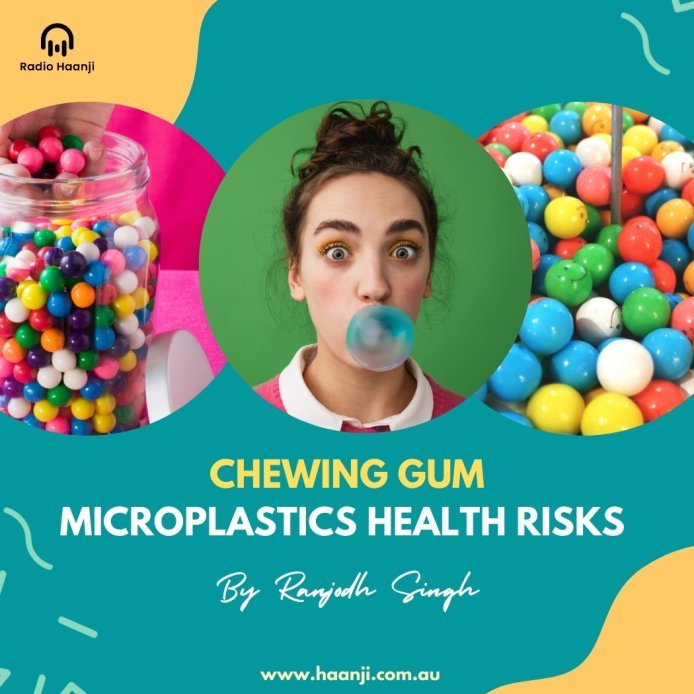
Ranjodh Singh reveals shocking research on chewing gum releasing 3,000+ microplastics per piece — and why children are most at risk. Listen on Radio Haanji 1674 AM.
Chewing Gum and Microplastics — What Ranjodh Singh Revealed on Radio Haanji 1674 AM That Every Parent Needs to Know
There are things we hand our children without a second thought — a stick of chewing gum being one of them. It is harmless, we assume. Just a little treat. But in a recent episode of his podcast on Radio Haanji 1674 AM, host Ranjodh Singh sat down with some deeply unsettling research, and what he shared has prompted a genuine conversation across the Punjabi and Indian community in Australia. The science, it turns out, tells a very different story from the one printed on the wrapper.
Every Piece of Chewing Gum Is Releasing Thousands of Plastic Particles Into Your Body
The findings that Ranjodh Singh discussed come from two major pieces of research — one led by scientists at the University of California, Los Angeles (UCLA) and presented at the American Chemical Society's Spring 2025 meeting, and another published in the Journal of Hazardous Materials, led by Queen's University Belfast.
The UCLA study examined ten commercially available chewing gums — five synthetic and five marketed as natural — and found that every single one of them released microplastics into saliva during chewing. On average, each gram of gum shed approximately 100 microplastic particles, though some pieces released as many as 600 particles per gram. Since a large stick of gum can weigh up to six grams, a single piece alone can release more than 3,000 plastic particles into a person's mouth. A person who chews 160 to 180 pieces of gum per year — a moderate habit by most standards — could be ingesting close to 30,000 microplastics from gum alone, on top of the tens of thousands already entering the body through water, food packaging, and other daily sources.
The Queen's University Belfast study went even further, tracking microplastic release over a full hour of chewing a single piece of gum. The results were striking: over 250,000 microplastic and nanoplastic particles were detected in the saliva of the study participant over that period. Crucially, the researchers found microplastics in every sample collected across the hour — from the first twenty minutes through to the final set — which led them to state that there may be no safe chewing duration. Both research teams noted that the instruments used can only detect particles above a certain size threshold, meaning the actual counts are almost certainly an underestimate. Nanoplastics — far smaller than microplastics and significantly more capable of penetrating human tissue — were likely present in far greater numbers than the studies were able to capture.
Natural Gum Is Not the Answer Either — The Industry's Quiet Problem
When parents and health-conscious consumers started paying attention to what goes into synthetic chewing gum, the market responded predictably. Natural gum brands — using chicle, tree sap, or other plant-based polymers — began positioning themselves as the safe alternative. It is a persuasive argument: plant-based sounds inherently cleaner, more wholesome, less industrial.
The research does not support this distinction. Both the UCLA and Queen's University Belfast studies found that natural gums released microplastics and nanoplastics at comparable levels to their synthetic counterparts. The UCLA team specifically noted their surprise at this finding — they had hypothesised that synthetic gums, whose base is derived from petroleum-based polymers, would release significantly more plastic than plant-based versions. Instead, both types tested positive across the board.
The reason is not fully understood yet. One possibility is contamination occurring during the manufacturing process — machinery, packaging materials, and processing equipment can all introduce microplastics into a product at various stages of production. Another factor is the additives, flavourings, sweeteners and stabilisers blended into the gum base, many of which may carry their own plastic-derived components. Several widely used gum ingredients have also drawn separate health concerns: titanium dioxide, used for whitening, has been linked to cellular damage in the gut; propyl gallate, used as a preservative, has been associated with hormone disruption; and synthetic food dyes found in many coloured gum varieties have raised concerns from public health researchers. The label that says "natural" tells you something about the origin of the base polymer. It tells you very little about everything else in the product.
Why Children Face a Deeper Risk
Adults who chew gum are making an informed choice about a known product. Children are not. And the research emerging on microplastics in developing bodies makes uncomfortable reading for any parent.
Children are more vulnerable to microplastic exposure than adults for a cluster of connected reasons. Their organs are still developing — particularly the liver, kidneys, reproductive system, immune system and brain — meaning that disruptions occurring during childhood can have consequences that extend far into adult life. Stanford Medicine researchers studying microplastics in children have found these particles embedded not just on the surface of tonsil tissue removed from children, but deep within it. In one child's tonsils, visible flecks of Teflon were found under microscope.
Children also ingest and inhale considerably more microplastics per unit of body weight than adults. Research on daily microplastic exposure among children in India found estimated levels reaching 7,375 particles per kilogram of body weight per day — a figure considerably higher than comparable adult estimates. Young children under six are particularly at risk. They inhale up to three times more microplastics than adults relative to body size, engage in frequent hand-to-mouth behaviour, and spend time crawling on floors where microplastic fibres accumulate in dust. When you add a regular gum-chewing habit to this already elevated baseline of exposure, the additional burden is not trivial.
The potential health consequences being studied in children include disruption of the developing endocrine system and hormonal function, inflammation of the digestive tract and liver, impacts on the respiratory system including increased vulnerability to asthma and respiratory infections, and possible effects on neurodevelopment. Animal studies have shown that nano-sized plastic particles can cross the blood-brain barrier — a finding that has elevated concern considerably among paediatric researchers. The Lancet Child and Adolescent Health has described plastics as presenting an urgent threat to children's health, noting that the evidence of harm to multiple organ systems and to hormonal function is robust and growing.
None of this means that a child who occasionally chews a piece of gum is in immediate danger. The honest answer from the research community is that the long-term effects of accumulated microplastic exposure remain incompletely understood. But the weight of evidence is moving in one direction, and the precautionary argument for limiting unnecessary additional exposure — particularly for children — is growing stronger with each new study.
What Can Families Do
The first step is awareness, which is exactly why Ranjodh Singh brought these findings to the community on Radio Haanji 1674 AM. Armed with accurate information, families can make more considered choices.
The UCLA researchers offered one practical note: if someone does chew gum, they should chew a single piece for longer rather than cycling through multiple pieces. Their data showed that 94 per cent of the microplastics detectable in a piece of gum are released within the first eight minutes of chewing. Chewing a second piece begins the release cycle again from zero. Fewer pieces means less exposure. Choosing not to give gum to young children — particularly those under ten, whose oral habits and body weight make them more vulnerable — is a reasonable precaution that several health researchers have advocated.
Beyond gum, the broader picture on microplastics suggests it is worth examining the full range of plastic-heavy daily habits: bottled water over tap water where tap is safe, glass or stainless steel food containers over plastic, and minimal use of plastic packaging when heating food. These are not radical changes. They are the kinds of small, practical adjustments that add up over time — and that the Punjabi and Indian community in Australia, deeply attentive to family health and wellbeing, is well-placed to consider seriously.
About Radio Haanji 1674 AM — Melbourne's Home of Indian Community Radio
Radio Haanji 1674 AM is Melbourne's premier Indian and Punjabi community radio station, broadcasting 24 hours a day to listeners across Victoria and streaming live worldwide at haanji.com.au. Hosted by Ranjodh Singh and a rotating team of trusted voices, the station's podcast content spans health, current affairs, culture, music and community programming — all delivered in Punjabi and Hindi for the Indian diaspora in Australia.
Episodes like this one — bringing the latest scientific research directly to the community in an accessible, caring and informative format — are what make Radio Haanji one of the best Punjabi podcasts in Australia for families who want to stay informed and stay healthy.
Listen to Radio Haanji — Free, Anytime, on Any Device
You can catch this episode and every Radio Haanji podcast completely free on all major platforms.
Listen on Spotify: https://open.spotify.com/show/5fhykpM6TPzerC2Yr2J1eQ
Listen on Apple Podcasts: https://podcasts.apple.com/us/podcast/radio-haanji-podcast/id1687047958
Download the Radio Haanji App on iPhone and iPad: https://apps.apple.com/in/app/radio-haanji/id1439919649
Download the Radio Haanji App on Android: https://play.google.com/store/apps/details?id=callstem.radio.haanji&hl=en_IN
What's Your Reaction?