











































































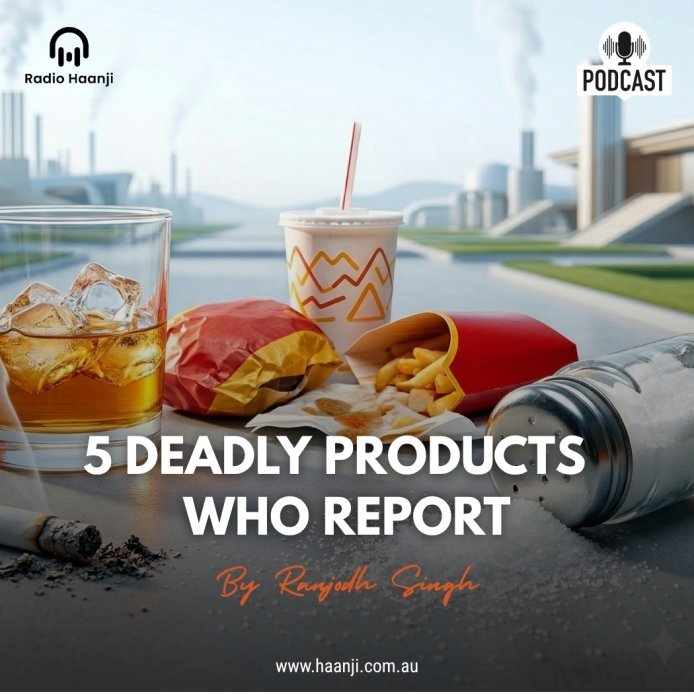

obacco, junk food, salt — 5 products killing millions. Hear what Ranjodh Singh revealed on Haanji Melbourne. Free on Spotify & Radio Haanji app.
5 Deadly Products the WHO Says Are Killing Millions — What Australians Need to Know
Did you know that five everyday products are responsible for roughly one-third of all deaths on the planet? Not rare diseases. Not freak accidents. Products that most of us encounter every single day — in our kitchens, our workplaces, and our daily routines.
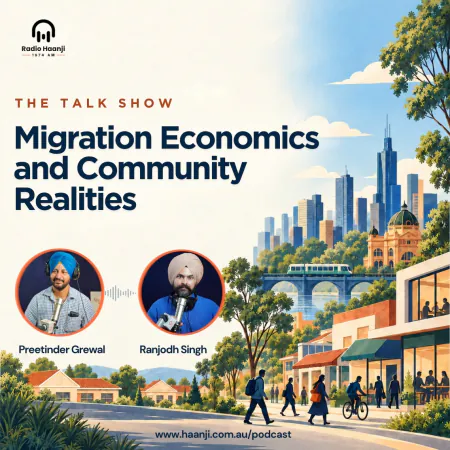
In a recent episode of Haanji Melbourne on Radio Haanji 1674 AM, host Ranjodh Singh broke down a major World Health Organization (WHO) disclosure that was reported in the Sydney Morning Herald and The Age. The findings are alarming — and they hit especially close to home for the Australian community. If you missed the broadcast, this article covers everything you need to know, plus practical steps your family can take starting today.
What the WHO Report Actually Says About Dangerous Products
The WHO's findings are striking in their scale. According to the report, five commercial products — tobacco, alcohol, ultra-processed foods, fossil fuels, and excessive salt — are collectively responsible for approximately one-third of all global deaths every year. In the European region alone, these products account for nearly 2.7 million deaths annually.
What makes these findings particularly disturbing is not just the death toll. It is the deliberate role that powerful industries play in keeping these products flowing. The WHO report documents how large corporations in tobacco, food, fossil fuels, and alcohol have consistently lobbied governments to weaken public health regulations — and have even funded research designed to downplay or distort the scientific evidence of harm.
As Ranjodh Singh highlighted on Haanji Melbourne, this is not a matter of personal weakness or poor individual choices. It is a system designed by profit-driven industries that places consumer health as a secondary concern.
The Five Products — Broken Down
1. Tobacco
Tobacco remains the single deadliest product on the WHO list. It is directly linked to cancer, emphysema, and severe respiratory diseases. In the European region, tobacco alone causes over 1.1 million deaths per year. In Australia, the government has responded with some of the world's toughest measures — including plain packaging laws, high cigarette taxes, and the 2024 Vaping Reform, which now restricts vape sales to pharmacies by prescription only.
2. Alcohol
Alcohol is far more dangerous than many people realise. Beyond liver disease, it is a major contributor to heart conditions and several forms of cancer. The WHO European region has the highest alcohol consumption of any region in the world. In Australia, alcohol-related harm costs the health system billions each year. Ranjodh Singh noted that swapping alcohol for healthier alternatives — lassi, lemon water, or herbal syrups — is one of the simplest lifestyle changes a family can make.
3. Ultra-Processed Foods (UPF)
This is where the Australian community faces one of its biggest health threats. Ultra-processed foods include fast food, soft drinks, packaged snacks, mass-produced bread, and instant noodles — foods engineered for overconsumption, not nutrition.
Research from Deakin University confirms that ultra-processed foods make up approximately 42% of the average Australian's daily calorie intake. These foods are the primary drivers of obesity, type 2 diabetes, and heart disease. Australia currently ranks fifth globally for obesity rates among OECD nations, and the link to ultra-processed food consumption is well-established in medical research.
4. Fossil Fuels
Air pollution caused by fossil fuels leads to terminal lung and heart conditions — even for people who never smoke. Vehicle emissions, industrial pollution, and poor air quality are silent killers, particularly in urban areas. Australia's commitment to Net Zero 2050, combined with EV subsidies and tax cuts, represents a step in the right direction. On a personal level, choosing public transport or cycling when possible makes a meaningful difference.
5. Salt (Sodium)
Excessive salt consumption is one of the leading causes of high blood pressure and stroke. The WHO recommends limiting daily salt intake to no more than 5 grams — roughly one teaspoon. For the Punjabi community in Melbourne, where traditional cooking often involves generous use of salt, this is a particularly important reminder. Ranjodh Singh's advice was simple: stop adding extra salt to meals that are already cooked.
Why This Matters So Much for Australians
The Australian context is sobering. According to health data, approximately 89% of deaths in Australia are caused by chronic diseases — many of which are directly linked to these five products. Australia has the fifth-highest obesity rate in the OECD, a figure driven in large part by ultra-processed food consumption. Youth vaping has risen sharply, prompting the WHO to categorise it as a new health emergency.
At the same time, Australia has taken stronger action than many nations. The Health Star Rating system on packaged foods helps consumers identify better choices quickly. The 2024 Vaping Reform was a world-leading intervention. The Net Zero 2050 policy and EV incentives address the fossil fuel crisis from the top down.
But government policy alone cannot do the work. As Ranjodh Singh emphasised on Haanji Melbourne, the changes that matter most begin at home — in the kitchen, at the dinner table, and in the choices families make every day.
What Your Family Can Do Right Now
- Cook at home more often. Homemade meals are the single most effective way to reduce ultra-processed food intake. When buying packaged food, aim for products with a Health Star Rating of 4 or 5 stars.
- Reduce salt gradually. Stop adding salt to already-cooked meals. Taste your food first. Over time, your palate adjusts and you genuinely stop craving the extra sodium.
- Replace alcohol with flavourful alternatives. Lassi, nimbu pani, kokum water, herbal teas — the Punjabi pantry is full of drinks that are both delicious and genuinely good for the body.
- If you or someone you love smokes, reach out to Quitline on 13 78 48. It is free, confidential, and highly effective.
- Make small transport changes. Walk to local destinations, use public transport once a week, or consider an EV for your next vehicle purchase.
[INTERNAL LINK: Explore more health and community episodes → https://haanji.com.au/podcast]
For further reading on Australia's chronic disease statistics, the Australian Institute of Health and Welfare publishes the most authoritative data. The original WHO Europe report is available at who.int/europe.
Frequently Asked Questions
What are the five dangerous products identified by the WHO?
The WHO report identifies tobacco, alcohol, ultra-processed foods, fossil fuels, and excessive salt as the five most dangerous commercial products globally. Together, they are responsible for roughly one-third of all deaths worldwide each year, amounting to approximately 19 million deaths annually, with 2.7 million in the European region alone.
How many deaths do these products cause globally each year?
According to the WHO, tobacco, alcohol, ultra-processed foods, fossil fuels, and excessive salt contribute to approximately 19 million deaths per year globally — which is around 34% of all deaths. These industries also interfere with government efforts to regulate their harmful products, making the problem harder to address at a policy level.
Why are ultra-processed foods so dangerous in Australia?
Ultra-processed foods make up around 42% of the average Australian's daily calorie intake, according to Deakin University research. They are high in salt, refined sugar, and unhealthy fats, and are engineered for overconsumption. Australia has the fifth-highest obesity rate in the OECD, and chronic diseases — many linked to UPFs — account for 89% of deaths in the country.
How much salt should you eat per day according to WHO guidelines?
The WHO recommends consuming no more than 5 grams of salt per day — approximately one teaspoon. Excess sodium is a leading cause of high blood pressure and stroke. A practical step recommended by health experts is to avoid adding extra salt at the table and to choose lower-sodium options when buying packaged foods.
What is the Vaping Reform 2024 in Australia?
Australia's Vaping Reform 2024 restricts the sale of vaping products to pharmacies, and only with a valid prescription from a doctor. This policy was introduced to address the sharp rise in youth vaping, which the WHO has identified as a new global health emergency. Australia also leads the world in plain packaging laws and high taxation on tobacco products.
Conclusion
The WHO's findings are a wake-up call — and Ranjodh Singh brought that message home for the Melbourne Punjabi community on Haanji Melbourne. These five products are not abstract global statistics. They are in our supermarkets, our takeaway containers, and our daily habits.
The good news is that awareness is the first step, and the steps that follow are genuinely achievable. Cook more at home. Reduce salt. Choose healthier drinks. Support your loved ones to quit smoking. Make transport choices that are better for your lungs and the planet. Small, consistent changes — especially when shared across a community — create a health shift that is real and lasting.
Shukriya for listening. Sat Sri Akal.
Listen to the WHO Five Dangerous Products episode on Haanji Melbourne with Ranjodh Singh — only on Radio Haanji.
Listen free:
Radio Haanji 1674 AM is Austalia's Punjabi community radio station.
Listen free at haanji.com.au | Spotify | Apple Podcasts | iOS App | Android App
Serving the Punjabi community in Australia, Canada, Singapore and world wide.
What's Your Reaction?