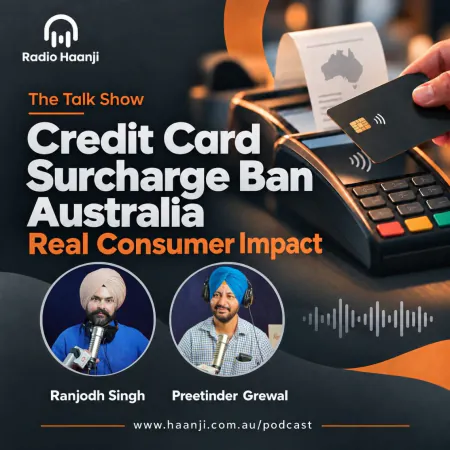































































































Credit Card Surcharge Ban Australia: Real Consumer Impact - Preetinder Grewal & Ranjodh Singh
Host:-
 Preetinder Grewal
 Ranjodh Singh
Explore how the credit card surcharge ban in Australia impacts small businesses, tax payments, and consumer pricing. Listen to the full episode on Radio Haanji.
The debate surrounding payment transaction costs has taken an unexpected turn across the Australian retail and institutional landscape. While regulatory discussions aimed at abolishing extra checkout fees were pitched as a direct win for household budgets, the practical fallout tells a far more complicated story. On The Talk Show, broadcast on Radio Haanji 1674 AM, hosts Preetinder Grewal and Ranjodh Singh explored the mechanics of the credit card surcharge ban in Australia, examining why policy shifts designed to lower consumer costs often trigger reactive price hikes elsewhere.
When merchants and public entities face inflexible overhead charges from financial institutions, eliminating customer-facing surcharges does not make transaction expenses disappear. Instead, organizations must choose between absorbing the cost, dropping credit card processing entirely, or distributing those fees across their baseline pricing. This unintended dynamic is already altering how Australians settle large obligations and handle everyday retail transactions.
Understanding this payment shift requires looking beyond political announcements to examine the operational pressures bearing down on merchants, tax compliance channels, and credit reward structures. As regulatory bodies seek to modernise digital payments, the gap between bank interchange costs and consumer protections continues to widen.
Where to Listen
The Talk Show is hosted by Preetinder Grewal and Ranjodh Singh on Radio Haanji 1674 AM. Catch in-depth analyses on regulatory updates, community affairs, and financial news across your preferred listening platforms:
Episode Highlights
The broadcast examined several interconnected developments triggered by regulatory proposals to eliminate payment surcharges:
-
Regulatory Interventions and Market Realities: The hosts addressed announcements from the Reserve Bank of Australia and federal authorities regarding the abolition of credit card surcharges, noting how public excitement often overlooks merchant fee structures.
-
Institutional Exits from Card Schemes: An examination of decisions by non-retail organizations, including government departments and private educational institutions, to cease card processing altogether to avoid absorbing substantial overheads.
-
Cost Absorption for Small Enterprises: Discussion on the operational friction confronting independent businesses, where merchant acquiring fees persist regardless of whether customer surcharging is permitted.
-
The Global Regulatory Contrast: A comparative analysis contrasting Australia’s regulatory steps with the European Union framework that capped foundational banking interchange rates first.
-
Listener Contributions on Personal Debt: Direct reflections from listeners on managing credit balances, high-interest traps exceeding 20%, and implementing structured cash-flow buffers.
Why Are Australian Institutions Dropping Credit Card Payments?
Institutions are dropping credit card payments because removing checkout surcharges forces them to absorb card processing fees that scale into millions of dollars annually. Rather than cutting operational budgets or subsidising third-party card processors, public agencies and schools are terminating card facilities and mandating direct bank transfers.
When policy initiatives seek to prevent merchants from passing on merchant processing fees, large-volume entities face immediate budgetary deficits. The Australian Taxation Office announced plans to discontinue credit card acceptance for tax and Goods and Services Tax obligations beginning November 30, 2026. For the taxation authority, processing tens of millions in annual payments via commercial credit networks translates to significant fees that would otherwise drain public revenue collections.
A similar trend has emerged within private education. Lauriston Girls' School moved to phase out credit card tuition collections after evaluating the steep cost of covering merchant interchange charges. Rather than incorporating hundreds of dollars in card processing overhead into general school fees for all families, administrators determined that direct debits and bank transfers provide an equitable, fee-free solution. This structural retreat demonstrates that when organizations cannot charge for expensive payment channels, they simply refuse to offer them.
How Will Scrapping Surcharges Drive Up Everyday Retail Prices?
Scrapping surcharges forces merchants to build underlying payment network costs directly into the shelf price of goods.Instead of charging cardholders a transparent 1% to 3% fee at the terminal, small businesses must elevate their baseline retail prices, forcing cash and debit users to subsidise credit card processing.
The economic challenge for small business owners stems from acquiring charges levied by commercial banks and card terminal providers. These merchant fees typically sit between 1% and 3% on credit transactions. While large multinational retailers can negotiate volume-discounted merchant agreements, local cafes, bakeries, and trade contractors pay standard tier rates on every tap.
If business owners are barred from presenting an itemised surcharge, their only mathematical option for preserving thin operating margins is increasing retail pricing. A standard coffee that might have cost five dollars could increase to five dollars and fifty cents or six dollars to cover payment overheads. Ultimately, customers paying through standard debit cards or currency absorb higher prices to offset the processing costs of premium credit cards.
What Can Australia Learn From the European Interchange Fee Model?
Australia can learn that surcharge bans only protect consumers when preceded by strict legal caps on bank interchange fees. The European Union capped interchange charges at 0.2% for debit and 0.3% for credit cards, ensuring merchant processing remained low before restricting consumer checkout fees.
The regulatory sequencing in Europe addressed the core revenue stream of payment networks rather than targeting the terminal interface. When the European Union introduced interchange fee regulations in 2015, authorities targeted the fees that merchant banks pay to card-issuing institutions. By capping credit transactions at 0.3%, the actual expense borne by a shopkeeper became negligible, making an outright surcharge prohibition practical and economically sustainable for small enterprises.
In Australia, regulatory discussions have placed the operational burden on the final merchant link. Without capping underlying interchange rates, financial institutions continue to generate billions in merchant acquiring revenue while businesses are legally constrained from recovering those costs transparently. This structural imbalance leaves Australian businesses vulnerable to the very bank processing charges that European regulators dismantled a decade earlier.
The Vanishing Value of Loyalty and Reward Schemes
For decades, consumer credit adoption across Australia has been fueled by reward programs, complimentary flight bookings, and bundled travel insurance policies. However, these rewards are largely financed through merchant interchange revenue generated during point-of-sale transactions. As regulatory pressures compress fee margins and institutions cease credit card acceptance, banks inevitably downgrade their rewards programs.
When significant payment avenues such as tax obligations, utilities, and school fees drop credit processing, cardholders lose the primary high-value mechanisms used to accumulate frequent flyer balances. Points per dollar spent are progressively devalued, transfer ratios tighten, and annual card maintenance fees climb. Consumers who historically justified paying premium card fees on the premise of travel upgrades are finding that the mathematical value proposition no longer holds up.
Practical Financial Literacy and Responsible Card Management
The broader debate over payment surcharges brings foundational personal financial management back into sharp focus.Commercial credit instruments present structural debt risks for households that treat available limits as supplemental income rather than short-term payment buffers. Credit card interest rates frequently exceed 20%, quickly compounding minor debts into persistent financial strain.
Listeners and financial commentators emphasize strict operational rules for managing credit accounts:
-
Automating Direct Debits: Setting up automated, full balance clearances on card statements avoids costly default fees and compounding interest penalties.
-
Leveraging Offset Accounts: Disciplined cardholders utilize interest-free settlement windows (ranging from 30 to 55 days) to keep cash sitting inside home mortgage offset facilities, temporarily reducing housing loan interest before settling card statements in full.
-
Limiting Fraud Exposure: Keeping a designated credit card with a strictly capped balance for online shopping protects core savings and checking accounts from potential digital fraud.
-
Eliminating Redundant Lines of Credit: Consumers unable to consistently clear balances benefit most by cancelling surplus credit lines and relying on standard debit facilities.
Key Takeaways
-
Regulators are moving to eliminate consumer credit card surcharges, but underlying merchant processing charges between 1% and 3% remain active on card transactions.
-
The Australian Taxation Office is scheduled to discontinue credit card payments for tax and GST accounts from November 30, 2026, to prevent public revenue loss to processing fees.
-
Independent institutions, such as Lauriston Girls' School, are eliminating credit facilities to avoid subsidising card fees through general tuition rates.
-
Without a legislated cap on bank interchange rates similar to the European Union’s 0.3% threshold, small merchants will likely raise retail prices across all customer segments.
-
Surcharge restrictions accelerate the reduction of credit card reward incentives, diminishing the real-world value of airline points and cardholder benefits.
-
Carrying persistent card balances at interest rates above 20% quickly erodes any temporary payment benefits or loyalty program points.
Financial tools only work when consumers understand the balance sheets operating behind the counter. The changing rules around credit card surcharges highlight the ongoing tension between regulatory protections, banking revenue, and small business realities. To explore this discussion and hear caller perspectives on local business management, listen to the full episode of The Talk Show with Preetinder Grewal and Ranjodh Singh on Spotify, Apple Podcasts, or the Radio Haanji mobile app.
Frequently Asked Questions
Why is the Australian Taxation Office ending credit card payments?
Will banning credit card surcharges make shopping cheaper?
How did the European Union successfully ban credit card surcharges?
What happens to frequent flyer points if credit card surcharges are banned?
Why don't commercial banks lower their transaction charges voluntarily?
What's Your Reaction?