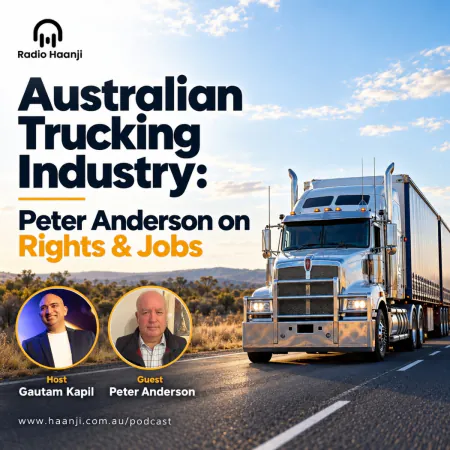

























































































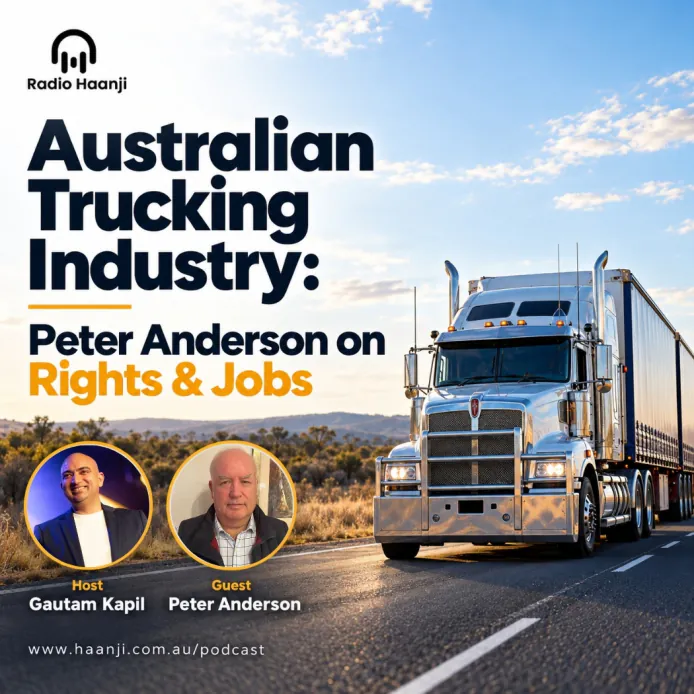

Host Gautam Kapil and guest Peter Anderson discuss rights, sham contracting, and careers in the Australian trucking industry. Listen to the full episode.
Road transport serves as the vital lifeline of the domestic supply chain, moving essential goods across cities, regional hubs, and interstate corridors. On Radio Haanji 1674 AM, host Gautam Kapil sat down with Peter Anderson, Chief Executive Officer of the Victorian Transport Association, to examine the real-world realities shaping the australian trucking industry. Their conversation explores how operational growth, regulatory enforcement, and fair workplace practices intersect for drivers operating across the road network.
Behind the movement of freight lies an ongoing tension between soaring logistics demand and the vulnerability of drivers who keep goods moving on the road. While the heavy vehicle sector offers long-term career stability, issues such as unlawful engagement models and compliance gaps place unneeded financial and legal risks onto workers. By addressing systemic hurdles early, industry leaders aim to ensure that drivers operate safely, legally, and with genuine workplace protections.
Where to Listen
Catch the full discussion between host Gautam Kapil and guest Peter Anderson on the Radio Haanji podcast. Available across leading audio streaming platforms:
-
Spotify: https://open.spotify.com/show/5fhykpM6TPzerC2Yr2J1eQ
-
Apple Podcasts: https://podcasts.apple.com/at/podcast/radio-haanji-podcast/id1687047958?l=en-GB
-
Radio Haanji App: https://haanji.com.au/download-our-app
Episode Highlights
Peter Anderson outlined the core advocacy function of the Victorian Transport Association, highlighting its duty to represent road transport operations before government departments, lawmakers, and the public media. He noted that the heavy vehicle sector requires an authoritative voice to ensure that legislation supports operational realities while upholding safety on the road.
The discussion brought significant attention to the heavy reliance on migrant workers, particularly from the Punjabi community, whose dedication and family values keep supermarket shelves stocked and distribution centres moving. Anderson explained that driving heavy vehicles is tough and dangerous work that requires mutual respect and institutional support.
A major topic of concern was the exploitation of drivers through sham contracting arrangements, where workers are pressured onto Australian Business Numbers despite having no real commercial autonomy. This leaves drivers shouldering extensive legal liabilities without statutory employment protections.
Finally, the dialogue explored freight movements across Victoria and the growing shortfall of qualified operators. Anderson detailed joint initiatives with Senator Glenn Sterle alongside targeted VTA training initiatives designed to equip new drivers with the formal skills and legal knowledge needed to thrive safely.
The Critical Role of Transport and Migrant Drivers
Australia's domestic supply chains rely entirely on the daily commitment of heavy vehicle operators. The Punjabi community and incoming migrant families have made substantial generational contributions to road freight, stepping into roles essential to keeping retail shelves full and industrial goods in motion. Their strong work ethic and community cohesion have become central to sustaining freight capacity across regional and metropolitan hubs.
Operating heavy vehicles carries high operational demands and inherent road risks. Despite its difficulty, the sector offers meaningful economic opportunities for those looking to build a sustainable life, own a home, and secure their financial future. Maintaining a strong supply chain requires recognizing driver skill, ensuring reasonable working conditions, and eliminating practices that take advantage of workers entering the sector.
What Is Sham Contracting in Australian Trucking?
Sham contracting in Australian trucking occurs when an employer engages an individual under an Australian Business Number (ABN) to operate a company-owned truck, treating them as an independent business rather than a direct employee. This unlawfully strips the driver of statutory award wages, sick leave, holiday pay, superannuation, and workers' compensation coverage.
When transport businesses implement sham contracting truck drivers, the worker takes on financial and operational burdens that lawfully belong to the employer. Drivers on forced ABNs receive lower overall compensation while being personally responsible for insurances, administrative filings, and complex tax liabilities. Because rates are suppressed below statutory award requirements, drivers struggle to cover daily living expenses, vehicle upkeep, and personal financial commitments.
Australia maintains robust industrial relations protections, yet administrative gaps and limited legal awareness leave newly arrived workers exposed to predatory practices. Unscrupulous operators leverage this confusion to cut labor costs, creating an unfair race to the bottom that harms ethical transport companies and places drivers under severe financial strain. Regulatory bodies and industry associations continue working to identify and eliminate these unlawful contracting schemes across the logistics sector.
Heavy Vehicle Regulatory Frameworks and Penalties
Operating heavy vehicles requires strict compliance with statutory frameworks designed to safeguard drivers and the general motoring public. Fleet operators and drivers must navigate complex regulatory requirements that establish legal operating boundaries across the road network:
-
Heavy Vehicle National Law compliance governing vehicle standards, loading limits, and driver operational duties.
-
Occupational Health and Safety mandates establishing safe loading bays, warehouse drop zones, and secure work environments.
-
Heavy vehicle access regulations dictating permissible network paths and route configurations for distinct freight classes.
-
Comprehensive chain of responsibility principles holding every party in the logistics chain accountable for safety breaches.
Failing to meet these safety regulations leads to severe regulatory intervention. When breaches occur, authorities issue heavy financial penalties directly to responsible individuals in addition to corporate fines. Maintaining high compliance standards ensures workers remain protected from unsafe employer pressures on the highway.
How Many Truck Drivers Are Needed in Victoria?
Victoria currently faces an immediate deficit of approximately 5,000 heavy vehicle drivers to meet ongoing freight movement demands. Over the next twenty years, this regional labor shortage is projected to quadruple as freight volumes expand across urban development hubs, commercial distribution networks, and industrial trade corridors.
The long-term truck driver shortage victoria faces is driven by persistent economic growth, population gains, and increasing consumer freight movement across Australia. As freight volumes multiply, heavy vehicle driving remains an exceptionally secure, resilient career path that guarantees sustained employment across decades of trade expansion.
Closing this labor shortfall requires elevating the status of commercial driving into a respected, well-compensated technical profession. Transport operators must invest in structured on-the-job training and foster supportive workplaces that welcome new demographics into transport careers.
Do Local Truck Drivers Return Home Daily in Victoria?
Yes, most truck drivers sleep in their own beds every night, as approximately 80 percent of freight on Australia's east coast travels less than 100 kilometres from its point of departure. Regional intrastate journeys account for 15 percent, while long-haul interstate trips represent only about 5 percent of freight tasks.
The public often views road transport as exclusively long-haul driving involving consecutive nights away from home. In reality, the overwhelming majority of heavy vehicle runs in Victoria consist of local distribution, port collections, and short-haul regional transfers. This local freight focus allows drivers to balance high-demand work with consistent family and community life.
Interstate line-haul driving represents only a small portion of commercial freight activity. Because metropolitan distribution and intermodal hubs handle massive cargo volumes daily, qualified operators can readily build predictable careers without taking on continuous long-haul interstate travel.
Industry Support, Education, and Career Pathways
Addressing sector-wide workforce shortages requires dedicated institutional backing and practical educational programs. The Victorian Transport Association actively collaborates with federal lawmaker Senator Glenn Sterle to secure government recognition, elevate driver training programs, and establish clear workplace standards across the commercial freight network.
To bridge the gap between initial licensing and professional workplace readiness, the VTA has introduced specialized training courses designed for emerging drivers entering commercial operations. These programs provide foundational instruction in regulatory safety, loading standards, and industrial workplace rights.
Peter Anderson emphasized that the association welcomes direct contact from any driver seeking reliable advice regarding employment rights, contracting compliance, or operational concerns. Open access to advisory support helps drivers navigate the industry with confidence, ensuring they work safely, receive fair pay, and build fulfilling transport careers.
Key Takeaways
-
Migrant drivers, particularly from the Punjabi community, play an indispensable role in maintaining domestic supply chains and keeping essential goods on store shelves across Australia.
-
Sham contracting occurs when drivers operating company vehicles are forced onto an ABN, improperly denying them statutory sick leave, annual leave, superannuation, and workers' compensation.
-
Safety across the transport sector is enforced through the Heavy Vehicle National Law and Occupational Health and Safety legislation, with significant personal and corporate fines for non-compliance.
-
Approximately 80 percent of freight on the east coast moves within 100 kilometres of its origin, enabling the majority of local drivers to return home every evening.
-
Victoria currently experiences an estimated shortfall of 5,000 drivers, a deficit expected to quadruple over the coming two decades.
-
The Victorian Transport Association and Senator Glenn Sterle are actively working to expand training resources, improve safety standards, and support emerging drivers across the road freight industry.
To hear Peter Anderson's full analysis on workplace rights, freight trends, and the future of transport, tune into this episode of the Radio Haanji podcast via Spotify, Apple Podcasts, or the Radio Haanji mobile app. Share this episode with fellow operators, leave a review, and join the conversation on building a safer, fairer heavy vehicle sector.
Frequently Asked Questions
What distinguishes legitimate subcontracting from sham contracting?
Why do so many local truck drivers avoid long-haul interstate routes?
What legal liabilities do drivers face for heavy vehicle non-compliance?
How can new drivers verify whether their pay structure is legal?
What initiatives are underway to address the heavy vehicle driver shortage?
What's Your Reaction?