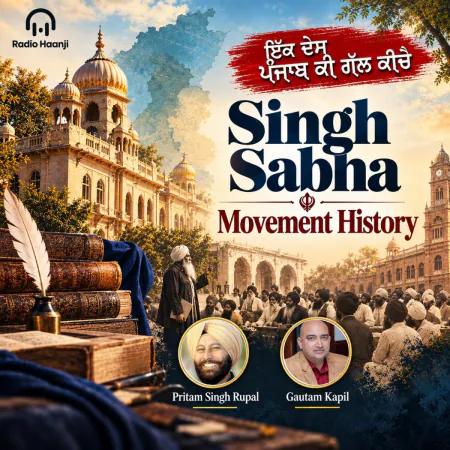
























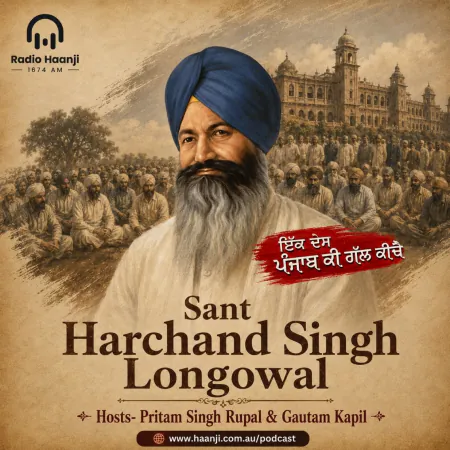



















































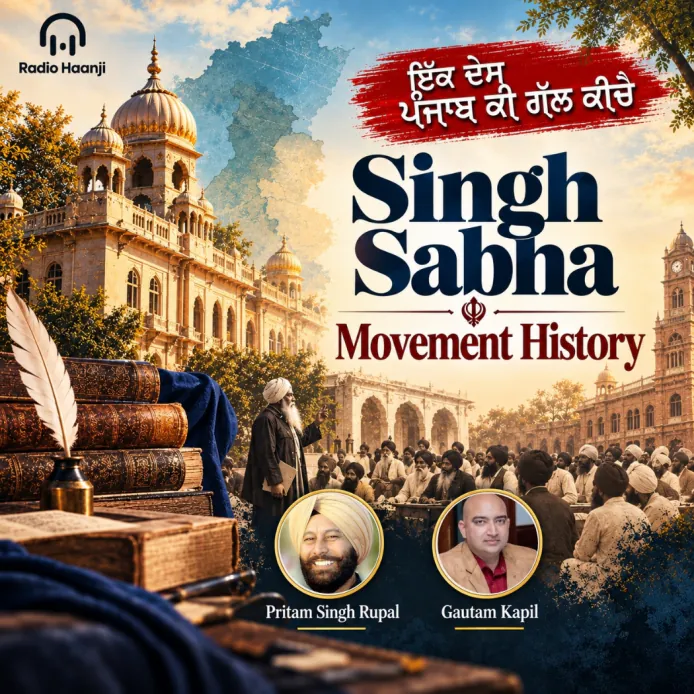


Explore the Singh Sabha movement history, educational reforms, and media origins with Pritam Singh Rupal and Gautam Kapil. Listen to the episode.
The nineteenth century brought seismic administrative, cultural, and religious shifts across Punjab under colonial British rule. As European missionary organizations expanded their institutional footprint through newly founded mission schools, indigenous communities faced unprecedented pressures concerning their heritage, language, and cultural autonomy. Exploring the singh sabha movement history provides an essential lens into how community leaders navigated these colonial transformations. On the broadcast program Des Punjab Ki Gal Kichai aired on Radio Haanji 1674 AM, hosts Gautam Kapil and Pritam Singh Rupal detailed how this pivotal movement emerged to defend Sikh identity through educational, religious, and institutional revival.
The conversation centers on the socio-religious dynamics of the 1870s, tracing the transformation of local defense initiatives into an organized renaissance across northern India. Rather than adopting revolutionary political violence, the movement strategically focused on systemic community building, standardizing religious identity, promoting indigenous language literacy, and establishing formal academic institutions.
By analyzing the movement's evolution from its inception in Amritsar to its intellectual flourishing in Lahore, the broadcast demonstrates how the initiatives established in the late nineteenth century laid the operational groundwork for contemporary Sikh governance, academia, and public discourse.
Where to Listen
You can listen to this complete discussion on Des Punjab Ki Gal Kichai with hosts Gautam Kapil and Pritam Singh Rupal across these official podcast and radio streaming platforms:
-
Spotify: https://open.spotify.com/show/5fhykpM6TPzerC2Yr2J1eQ
-
Apple Podcasts: https://podcasts.apple.com/at/podcast/radio-haanji-podcast/id1687047958?l=en-GB
-
Radio Haanji App: https://haanji.com.au/download-our-app
Episode Highlights
The broadcast covers the historical triggers of the movement, beginning with colonial missionary activities in nineteenth-century Punjab and the specific conversion crisis among mission school students in Amritsar that led to the founding of the original Singh Sabha on October 1, 1873. Gautam Kapil and Pritam Singh Rupal explain how traditional nobility, granthis, and scholars initially united to curb cultural decline and foster religious consciousness.
The dialogue then turns toward the ideological transition seen in the establishment of the Lahore branch in 1879, where reform-minded intellectuals such as Professor Gurmukh Singh and Bhai Ditt Singh shifted priorities toward institutionalized modern education and Gurmukhi typography. The hosts further trace the founding of pivotal bodies like the Chief Khalsa Diwan, the establishment of Khalsa College Amritsar in 1892, early periodicals like Gurmukhi Akhbar, and the eventual transition from mahant-run shrines to democratic gurdwara governance.
Why Was the Singh Sabha Movement Started in 1873?
The Singh Sabha Movement was founded on October 1, 1873, in Amritsar primarily in response to British colonial expansion and active proselytization by Christian missionaries in Punjab. The immediate catalyst was the decision of four Sikh students at an Amritsar mission school to convert to Christianity, prompting community leaders to organize a formal revival.
Following the annexation of the Sikh Empire by the British, missionary networks expanded rapidly throughout Punjab, opening mission schools and colleges that directly influenced students from prominent local families. When four students—Aaya Singh, Attar Singh, Sadhu Singh, and Santokh Singh—announced their intention to abandon their faith and receive Christian baptism, local leaders recognized the lack of an organized institutional alternative to safeguard their tradition.
To address this challenge, prominent figures including Thakur Singh Sandhawalia and Baba Khem Singh Bedi convened a broad coalition of community figures, traditional sects like the Udasis and Nirmalas, granthis, and local elites. Together, they established the first Singh Sabha at Amritsar. The primary mandate of this initial body was to restore pride in Sikh heritage, counteract religious conversions, and revive an appreciation for religious traditions through collective community action.
What Was the Role of the Lahore Singh Sabha in Educational Reform?
The Lahore Singh Sabha, founded in 1879, spearheaded modern educational reform by blending contemporary academic structures with Sikh principles and Gurmukhi literacy. Led by scholars Professor Gurmukh Singh and Bhai Ditt Singh, the branch championed modern schooling, leading to the creation of the Chief Khalsa Diwan and the founding of Khalsa College Amritsar in 1892.
While the Amritsar branch maintained a more conservative leadership structure, Lahore emerged as an intellectual hub with institutions like the Oriental College. Reformers recognized that community members preferred European-style mission academies because those schools offered high-quality, structured learning. The Lahore leaders argued that indigenous traditions could survive only if modern schooling systems were created that matched colonial standards while teaching Punjabi and core Sikh principles.
Sympathetic European scholars, such as Dr. Leitner at Oriental College in Lahore, supported initiatives to teach local languages and encouraged the academic development of Gurmukhi alongside classical curricula. These collaborative efforts laid the groundwork for an independent network of educational institutions, unifying under the Chief Khalsa Diwan and culminating in the establishment of Khalsa College, Amritsar, in 1892 as a premier center for higher learning.
How Did the Singh Sabha Movement Pioneer Gurmukhi Journalism?
The Singh Sabha Movement pioneered modern Punjabi print media by establishing indigenous printing presses and publishing periodicals directly in the Gurmukhi script. It launched Gurmukhi Akhbar as a weekly newspaper on November 10, 1880, followed by the monthly literary magazine Vidyarak, creating the foundation for structured Punjabi journalism.
Prior to this era, print circulation across northern India was heavily dominated by Urdu and English, with early local publications in Gurmukhi often incorporating heavy Hindi or Urdu phrasing rather than authentic Punjabi vernacular. The reformers recognized that public communication, religious scholarship, and mass education required accessible, dedicated regional print media.
In addition to publishing Gurmukhi texts, the movement produced literature in other administrative languages to reach broader audiences. For Sikhs educated primarily in Urdu, the movement launched the Khalsa Gazette under the editorship of Bhai Maya Singh. This multi-pronged media strategy enabled reformers to distribute tracts, interpret historical texts, and publish community news directly to households across urban and rural Punjab.
Institutional Legacies: From Gurdwaras to Modern Committees
Beyond classrooms and printing presses, the movement fundamentally altered the administration of historical and local Sikh places of worship. In the mid-nineteenth century, historical gurdwaras were largely controlled by hereditary custodians, known as mahants, who frequently operated the shrines as private estates. Many allowed rituals, customs, and idol worship contrary to core Gurmat principles.
The Singh Sabha inspired local communities to step outside mahant control by forming independent, elected local committees to construct and govern community gurdwaras. By demonstrating that congregations could independently manage holy sites in accordance with Sikh code, the movement planted the organizational seeds for the twentieth-century Akali movement. This ongoing drive toward institutional transparency and doctrinal fidelity eventually gave rise to statutory community bodies, specifically the Shiromani Gurdwara Parbandhak Committee (SGPC) and the Shiromani Akali Dal.
Nuances, Ideological Debates, and Colonial Dynamics
The historical evolution of the movement also contained internal nuances, external ideological clashes, and a distinct political posture toward the colonial state. Constitutionally, the Singh Sabha opted for an apolitical stance, establishing rules that strictly barred political agitations against the British government in order to protect its schools, media outlets, and community funding. This strategy allowed the movement to accept colonial administrative support and financial contributions for projects like Khalsa College, Amritsar.
Simultaneously, the era saw sharp public debates with the Arya Samaj, particularly after Swami Dayanand Saraswati published critical statements regarding Guru Nanak Dev Ji and Sikh tenets in his text Satyarth Prakash. Prominent scholars, notably Bhai Kahn Singh Nabha, articulated a distinct, independent identity through landmark tracts such as Ham Hindu Nahin.
At the community level, the reformers' opposition to traditional rituals, folk superstitions, and gatherings like shraddhs or festive teeyan meets drew occasional criticism from folksinger traditions and rural groups, who saw some reform measures as rigid, even while embracing the movement's overarching religious, social, and educational advancements.
Key Takeaways
-
The Singh Sabha was founded on October 1, 1873, in Amritsar following the attempted conversion of four mission school students to Christianity.
-
The movement's primary objective was to revive religious identity, counter proselytization, and develop indigenous education.
-
The Lahore branch, established in 1879 under Professor Gurmukh Singh and Bhai Ditt Singh, spearheaded modern schooling and intellectual mobilization.
-
Modern Punjabi print media was established with the launch of Gurmukhi Akhbar on November 10, 1880, alongside educational periodicals like Vidyarak.
-
The movement fostered local gurdwara management committees, laying the institutional blueprint for the SGPC and modern Sikh governance.
To explore the deeper history, archival details, and community debates of this defining era, stream the full episode of Des Punjab Ki Gal Kichai with hosts Gautam Kapil and Pritam Singh Rupal on Spotify, Apple Podcasts, or the Radio Haanji mobile app.
Frequently Asked Questions
When and where was the Singh Sabha Movement established?
Who were the key founding leaders of the Amritsar Singh Sabha?
What role did Professor Gurmukh Singh and Bhai Ditt Singh play?
What was the first weekly newspaper launched by the movement?
How did the Singh Sabha influence modern bodies like the SGPC?
What's Your Reaction?







Related Posts