
















































































Flying Officer Man Mohan Singh - Tarnpreet Singh - Ranjodh Singh - Punjabi Podcast - Radio Haanji
Host:-
 Ranjodh Singh
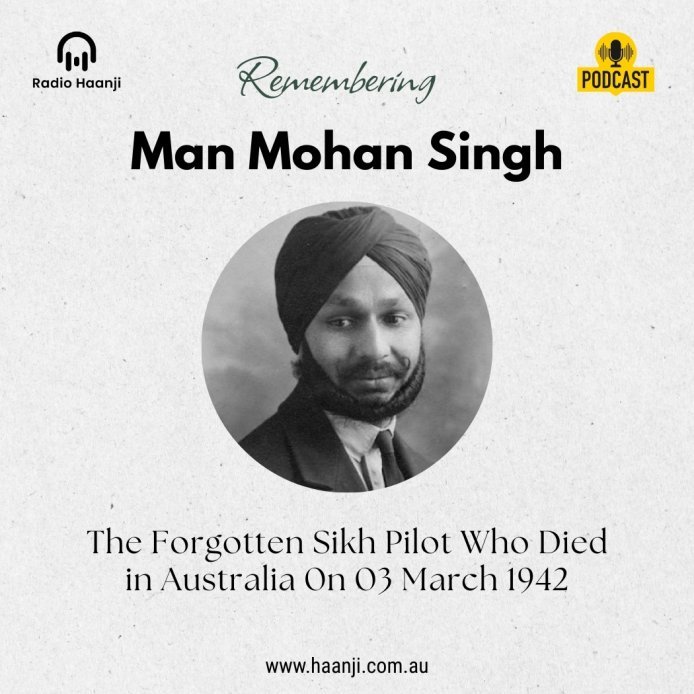
Ranjodh Singh and Tarnpreet Singh tell the forgotten story of Flying Officer Man Mohan Singh — first Sikh aviator, first Indian to die on Australian soil in WWII. Radio Haanji 1674 AM.
The Forgotten Story of Flying Officer Man Mohan Singh | Radio Haanji 1674 AM Podcast
Eighty-four years ago today, on 3 March 1942, a Sikh pilot from Rawalpindi drowned in a harbour in Western Australia. He was 35 years old. He had flown solo from England to India. He had flown solo from England to South Africa. He had commanded flying boats in the Battle of the Atlantic and in the waters of Southeast Asia as the Japanese swept through Singapore and Java. He was one of the most remarkable aviators of the early twentieth century. And almost nobody knows his name. In a special podcast episode on Radio Haanji 1674 AM, host Ranjodh Singh sat down with Tarnpreet Singh from the Australian Sikh Heritage Association to tell the story of Flying Officer Man Mohan Singh — the first Sikh aviator, the first Indian to fly solo from England to India, and the first Indian to die on Australian soil in the Second World War.
A Boy from Rawalpindi Who Taught Himself to Touch the Sky
Man Mohan Singh was born in Rawalpindi in September 1906 — a city that now sits in Pakistan but was then the heart of British India's Punjab. His father, Dr Makhan Singh, was a physician of distinction and a recipient of the Kaisar-i-Hind Medal, awarded for distinguished public service. In 1923, at just seventeen, Singh left for England on a Government of India scholarship to study civil engineering at the University of Bristol, graduating with a Bachelor of Science in 1927. He then enrolled in a two-year course in flying and aeronautical engineering on scholarship, emerging not just as a qualified engineer but as a licensed pilot.
In 1929, the Aga Khan offered a prize of five hundred pounds to the first Indian to complete a solo flight between England and India within one month. Man Mohan Singh named his de Havilland Gipsy Moth aircraft Miss India, had the Maharani of Cooch Behar preside over its naming ceremony at Stag Lane Aerodrome in London, and had a map of India painted on its rudder — because, he joked, he frequently lost his way. An editor of a flight journal noted drily: "Mr Man Mohan Singh called his aeroplane Miss India and he is likely to."
He made his first attempt on 11 January 1930 from Croydon Airport but smashed his propeller at Noyon in France. His second attempt ended in a crash landing on a mountain road in Paola, southern Italy, injuring his eye. His third attempt departed Croydon on 8 April 1930 and reached RAF Drigh Road in Karachi on 9 May 1930. He had done it — the first Sikh and the first Indian to fly solo from England to India. He also missed the Aga Khan prize deadline by precisely one day. It went to Aspy Engineer instead.
Maharaja Bhupinder Singh of Patiala, moved by his perseverance, compensated him personally and employed him as his chief pilot. Between 1934 and 1935, Singh went further — becoming the first Sikh and the first Indian to fly solo from England to South Africa. During the Aga Khan race period, the industrialist JRD Tata encountered him at Gaza and later recalled Singh's fearless, unorthodox flying style with great admiration. These were not sporting achievements alone. In an era when aviation was still young and dangerous, they were extraordinary acts of courage.
From the Atlantic to the Edge of the Pacific
When the Second World War began in 1939, Man Mohan Singh joined the Indian Air Force Volunteer Reserve as a pilot officer. He was then selected as leader of a batch of Indian Air Force pilots sent to England for training and active duty. In England, he was given command of a Sunderland flying boat with the RAF Coastal Command, flying anti-submarine patrols across the North Atlantic during the Battle of the Atlantic.
Tarnpreet Singh shared with Radio Haanji 1674 AM listeners a detail that speaks to the man's character: during his time stationed in England in wartime, Man Mohan Singh took a cold shower every single morning and would not eat until he had recited the full Sikh morning prayer of Japji Sahib. In the middle of a world war, far from Punjab, his faith remained unbroken.
He was later promoted to Flying Officer in the British Indian Air Force and given command of a Consolidated Catalina flying boat in No. 205 Squadron RAF. The Catalina was built for the vast open waters of the Pacific — with a wingspan of 104 feet, a range exceeding 2,300 miles, and a crew of seven to nine. Singh's squadron flew maritime reconnaissance missions to locate Japanese invasion fleets advancing through Malaya and the Dutch East Indies. As the Japanese advance accelerated, No. 205 Squadron withdrew from Singapore in late December 1941, relocated to Java, and when Java too fell, retreated south toward Australia. Singh flew evacuation missions from Cilacap in Java on 1 and 2 March 1942. On the morning of 3 March 1942, the squadron's flying boats arrived at Broome, a small port town on the northwest coast of Western Australia.
9:50 AM, 3 March 1942 — The Last Morning in Broome Harbour
By early 1942, Broome had become a critical escape corridor from the Japanese advance — crowded with flying boats carrying refugees, wounded soldiers and exhausted Allied personnel fleeing Singapore and Java. It was almost entirely undefended.
At 9:50 that morning, nine Japanese Mitsubishi A6M2 Zero fighters arrived over Broome and began strafing runs across the harbour. In minutes, all fifteen flying boats on the water were destroyed. At least 88 people were killed — many of them refugees who had survived the fall of Singapore only to die in a harbour they had reached believing themselves safe. The Broome attack remains the deadliest single Japanese air raid on Australian soil and is sometimes called Australia's Pearl Harbour.
Flying Officer Man Mohan Singh was in his Catalina when the Zeros struck. He survived the initial attack — the shelling, the explosions, the burning harbour. But he could not swim. The man who had flown solo over deserts, mountains and oceans across three continents drowned in Broome harbour on 3 March 1942. He was thirty-five years old. He was the first Indian to die on Australian soil in the Second World War.
There was no body recovered. There is no known grave. He is commemorated at the Singapore Memorial, Column 423, maintained by the Commonwealth War Graves Commission for those lost without trace. He appears on the Memorial Wall to the Allied Dead of World War II in Northern Australia at the Darwin Military Museum. At Broome's own memorial, his name is inscribed simply as "Plt Ofr MM Singh."
The Forgotten Hero — And the People Keeping His Memory Alive
For decades, Man Mohan Singh's story fell through the gap between two histories. In India, Partition had fractured the records of a Punjab now divided in two. In Australia, the contribution of Sikh and Indian servicemen to the Allied cause was rarely included in the national story. He was lost to both.
Tarnpreet Singh, who shared Man Mohan Singh's story with Radio Haanji 1674 AM listeners today, has worked through the Australian Sikh Heritage Association to research, document and champion this history. As Tarnpreet Singh noted, in World War I and World War II combined, 83,005 Sikhs were killed and 109,045 were wounded fighting for the Allied forces. Man Mohan Singh is one name among tens of thousands — but he died here, in Australian water, and his story belongs in Australia's history as much as India's.
His nephew, Mohindra S. Chowdhry, wrote about his life in the 2018 book Defence of Europe by Sikh Soldiers in the World Wars, published by Troubador, ensuring that a full record of his extraordinary life is preserved for future generations.
Why Radio Haanji Tells Stories Like This One
This episode reflects what Radio Haanji 1674 AM has always stood for — bringing the Punjabi and Indian community in Australia the stories that matter, from history, science, culture and current affairs, told with depth, care and genuine respect for the community. As Melbourne's most trusted Indian community radio station and one of the best Punjabi podcasts in Australia, Radio Haanji is the home for stories that deserve to be heard. Man Mohan Singh's story should have been taught in every Australian school. Today, at least, it found its audience.
Explore every episode free at haanji.com.au or on all major podcast platforms.
Listen To Radio Haanji — Free, Anytime, Anywhere
Laughter Therapy is completely free to listen to, live every weekday morning, and available on demand on all major podcast platforms.
Listen on Spotify
Listen on Apple Podcasts
Download the Radio Haanji App on iPhone and iPad
Download the Radio Haanji App on Android
What's Your Reaction?







Related Posts