


























































































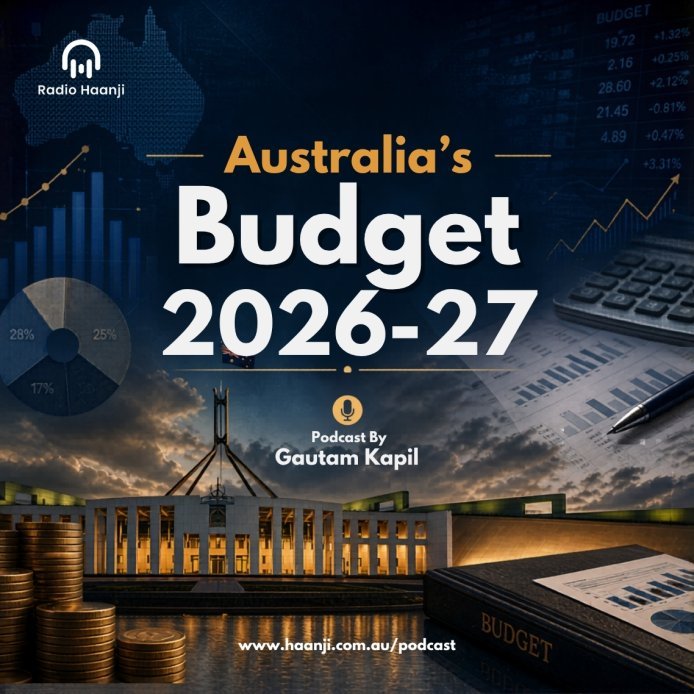

Radio Haanji's Gautam Kapil breaks down the 2026-27 Australian Federal Budget. Tax cuts, NDIS reform, fuel relief — here's what hits your wallet first.
In This Article
- The Budget's Economic Backdrop — Why This Year Is Different
- Tax Cuts From July 2026: Who Benefits and By How Much?
- What Is the Australian Budget Deficit for 2026-27?
- NDIS Reform: Why the Government Calls It Unsustainable
- Housing, Negative Gearing and Capital Gains Tax — What's Changing?
- Will HECS Debt Actually Be Reduced in the 2026 Budget?
- Fuel Costs and Energy Relief: What's on the Table
- How Much Will I Save From Australia's 2026 Tax Cuts?
- Urgent Care Clinics: The Quietly Significant Healthcare Move
- Key Takeaways
- References and Further Reading
- Frequently Asked Questions
On the morning of a regular broadcast from Sydney, Radio Haanji 1674 AM's senior journalist and producer Gautam Kapil sat down to do what he has done for over two decades — cut through the noise. The subject this time was the 2026-27 Australian Federal Budget, due for official delivery by Treasurer Jim Chalmers on 12 May 2026. In the weeks leading up to that date, speculation has been loud and often contradictory. What Gautam offered was something rarer: a structured, clear reading of what is actually expected, what has already been legislated, and what the Indian and Punjabi community specifically should be paying attention to.
This article is the companion piece to that broadcast. It takes the Radio Haanji analysis and layers in verified data from Treasury's own MYEFO figures, pre-budget assessments by KPMG and Commonwealth Bank economists, and reporting from the Sydney Morning Herald and Wikipedia's living budget summary. Every figure cited here has been cross-checked against at least one authoritative source. Nothing has been invented. Where uncertainty remains — because some details are genuinely not yet confirmed as of early May 2026 — this article says so plainly.
The 2026-27 Budget is Labor's first of its second term. It is being written in an economy under real pressure: global oil supply disruption from the Iran conflict, petrol at $3 a litre in Sydney and Melbourne, inflation still not fully tamed, and a housing market that has locked out an entire generation. How the Albanese government responds to all of that at once — on one budget night — is worth understanding before May 12.
The Budget's Economic Backdrop — Why This Year Is Different
The 2025 federal election gave Labor a renewed mandate, but the economy it inherited for its second term is considerably more complicated than the one it faced in 2022. The Reserve Bank of Australia raised the cash rate to 4.10% in March 2026. APRA's new debt-to-income restrictions are tightening mortgage lending. And an ongoing energy shock — tied directly to the Iran war and its effect on global oil markets — has pushed petrol prices to $3 per litre in major cities (WealthWorks, April 2026).
Against this backdrop, the government is targeting GDP growth of 2.3% and aiming to hold CPI inflation around 3% for 2025-26. The unemployment rate target is set at 4.25%, reflecting a still-relatively-resilient labour market. These are not boom-time numbers. They are the projections of a government trying to hold a difficult line between spending enough to ease household pain and not spending so much that it adds fuel to inflation.
According to Gautam Kapil's Radio Haanji analysis, the central challenge of this budget is precisely that balancing act — and several of the proposed measures walk that line uncomfortably close to the edge.
Tax Cuts From July 2026: Who Benefits and By How Much?
The income tax cuts for 2026-27 are already legislated. They are not speculation. From 1 July 2026, the tax rate on the lowest bracket — covering income between $18,201 and $45,000 — drops from 16% to 15%. Based on KPMG's pre-budget analysis, this saves the average earner in this bracket approximately $268 for the 2026-27 financial year. From 1 July 2027, the rate drops again to 14%, taking the annual saving to approximately $536 (KPMG, 2026).
These cuts sit on top of the Stage 3 tax changes already in place, which flattened the 37% bracket and raised the 32.5% threshold to $135,000. The new cuts are specifically designed to help lower-income earners — the people who have felt cost-of-living pressure the most sharply and who have the least capacity to absorb it through savings or discretionary cuts.
For families in the Indian and Punjabi community who are working multiple jobs, supporting extended households, or sending remittances home, the $268 is not a dramatic figure on its own. But for a dual-income household both earning in the lower bracket, that is $536 back in the pocket — and from 2027-28, $1,072. KPMG estimates a double-income household earning $150,000 combined will also receive $150 in electricity rebates next financial year alongside these tax reductions.
The Medicare levy low-income threshold is also expected to rise from approximately $26,000 to $27,000–$28,000, removing some of the lowest earners from the levy entirely (WealthWorks, 2026).
What Is the Australian Budget Deficit for 2026-27?
The 2026-27 Australian Federal Budget is expected to carry a deficit of approximately $27.6 to $36.8 billion, depending on how planned NDIS savings and CGT reforms are accounted for in the final figures.
The Mid-Year Economic and Fiscal Outlook (MYEFO) for the 2025 budget placed the deficit at $36.8 billion — already $5.3 billion lower than initially forecast. Commonwealth Bank economists, in their pre-budget analysis published in late April 2026, projected the deficit could narrow further to approximately $22 billion once NDIS reform savings and revenue from capital gains tax changes are factored in. The actual headline figure as delivered by Treasurer Jim Chalmers on 12 May will determine which of these estimates lands closest to reality.
What is not in dispute is the direction. Overall net debt is projected to increase by more than $210 billion over the forward estimates period (KPMG, 2026). The government is spending into a deficit by design — prioritising household relief and structural reform over fiscal surplus. Whether that is the right call given current inflation levels is genuinely contested among economists.
As Gautam Kapil noted in the Radio Haanji broadcast, this is fundamentally a values document as much as a financial one. What the government chooses to spend on — and what it chooses to cut — tells you what it believes the country needs most right now.
NDIS Reform: Why the Government Calls It Unsustainable
The National Disability Insurance Scheme currently costs the budget close to 10% annual growth in spending. That is not a rate any government can sustain over a decade without either cutting elsewhere or increasing taxes. Prime Minister Albanese has been explicit: the NDIS needs structural reform or it will crowd out every other spending priority.
The planned reforms are significant. The government has announced it will reduce the number of NDIS participants by 160,000 — from approximately 760,000 down to around 600,000 — by 2030 (Wikipedia, 2026). Commonwealth Bank economists estimate this will save approximately $25 billion over four years and $170 billion over the decade, making NDIS reform by far the largest single savings measure in the budget.
The partial replacement program, Thriving Kids, is meant to absorb some of the support needs of participants who exit the NDIS. Crossbench MPs have warned publicly that NDIS cost-shifting to health and aged care sectors is a real risk if Thriving Kids is not fully operational before the transition begins (Wikipedia, 2026). That concern has not been resolved as of the time of writing.
For the Indian and Punjabi diaspora community in Australia, this matters in a specific way. Many families in this community have members on the NDIS or are navigating the system for children with developmental needs. Any structural reduction in participant numbers will require active engagement with the review process — something Radio Haanji has consistently encouraged its listeners to do through its community affairs programming.
Housing, Negative Gearing and Capital Gains Tax — What's Changing?
The housing conversation in this budget is the most politically charged element of the entire package. The Sydney Morning Herald has reported that the government is considering cutting the capital gains tax discount — currently 50% — to either 33% or 25%. Labor's previous policy positions in 2016 and 2019 targeted 25%. Reports also suggest the government may scrap negative gearing entirely rather than merely capping it, which would deliver substantially larger tax revenue than early estimates anticipated (Commonwealth Bank, 2026).
Commonwealth Bank economists were confident well before the budget announcement that CGT and negative gearing changes were locked in. What surprised analysts was the apparent scale — CGT indexation reportedly applied to all assets, not just residential property, and full negative gearing removal rather than a partial cap.
The government's stated goal is improved housing affordability. The Help to Buy scheme — allowing the government to co-purchase up to 40% of a home alongside first-home buyers — is expected to receive firm funding commitments in the budget. The $10 billion Housing Australia Future Fund will also see new deployment commitments to finance social and affordable housing construction (WealthWorks, 2026).
Whether CGT and negative gearing reform will actually improve affordability is contested. Commonwealth Bank's own modelling suggests the price impact will be relatively modest, particularly in the short term, given how many current investors will be grandfathered under transition arrangements. The Liberal Party has signalled opposition. The Greens appear supportive. The political fight over this will outlast budget night by months.
Will HECS Debt Actually Be Reduced in the 2026 Budget?
A one-time 20% reduction in HECS-HELP student debt is a confirmed budget measure being previewed ahead of May 12. For a student with $30,000 in outstanding HECS debt, this means an immediate reduction of $6,000. For someone carrying $50,000 — common for graduates of medicine, law or engineering — the reduction is $10,000.
This is not a radical debt forgiveness scheme. It will not eliminate student debt for anyone. But it represents meaningful financial breathing room for younger Australians who have been hit disproportionately by the combination of high rents, stagnant wage growth, and cost-of-living pressure at precisely the career stage where that pressure is hardest to absorb.
The Indian and Punjabi diaspora community has a higher-than-average proportion of university graduates — many of whom used Australia's higher education system after migrating or studying on student visas. The HECS reduction is directly relevant to this demographic, and yet it has received limited coverage in community media compared to the tax cuts and housing changes. Radio Haanji's budget analysis, as presented by Gautam Kapil, made a point of flagging this as one of the underreported wins in the pre-budget coverage.
Fuel Costs and Energy Relief: What's on the Table
The fuel situation is where the 2026-27 budget has already been partially pre-empted. On 30 March 2026, the government cut the fuel excise by 26.3 cents per litre in consultation with National Cabinet, alongside removing the Heavy Road User Charge — both for a three-month period. This decision carries a $2.55 billion cost to the budget and reduces the cost of filling a 65-litre tank by approximately $19 (Wikipedia, 2026).
With petrol at $3 per litre in Sydney and Melbourne, this cut matters immediately. The question going into budget night is whether it gets extended. Energy Minister King indicated in April that an extension beyond three months is on the table. Prime Minister Albanese also flagged the government is exploring longer-term options — accelerating EV adoption, extracting more natural resources, and increasing fuel storage capacity to 90 days (from the current 30 days for diesel and 40 days for petrol), though that last measure alone is estimated to cost $20 billion over four years (Wikipedia, 2026).
On electricity, $1.8 billion has been committed to additional quarterly energy bill rebates for more than 10 million households. The earlier $150 energy rebate from the 2025 budget is expected to be extended for a further six months. For a typical household in Melbourne or Sydney, this means continued partial offset on bills that have risen substantially over the past two years.
How Much Will I Save From Australia's 2026 Tax Cuts?
The direct saving from the 2026 income tax cut depends entirely on where your income falls. For anyone earning between $18,201 and $45,000, the saving is approximately $268 for the 2026-27 financial year. From 2027-28, when the rate drops to 14%, that saving doubles to approximately $536 per year (KPMG, 2026).
For a dual-income household where both earners fall in this bracket, the combined saving is $536 for 2026-27 and $1,072 from 2027-28 onwards — before accounting for electricity rebates, which add a further $150 per household for next financial year.
Earners above $45,000 do not benefit from this specific tax bracket change, though they already benefited from the Stage 3 cuts that came into effect previously. The 2026 cuts are deliberately targeted at the lower end of the income scale — a design choice that reflects the government's view that this is where cost-of-living pressure is most acute and where additional spending is most likely to flow directly into the economy rather than savings.
For specific advice on your individual tax position, particularly if you have investment properties, superannuation considerations, or HECS debt, the budget period is worth a conversation with a registered financial adviser or accountant before the end of June 2026.
Urgent Care Clinics: The Quietly Significant Healthcare Move
While the NDIS reform generates the loudest headlines, the Urgent Care Clinics expansion is the healthcare measure that will affect the most households day-to-day. The government plans to make permanent a network of 100 to 125 Urgent Care Clinics, all operating on a bulk-billing model that eliminates out-of-pocket costs for patients.
These clinics target the gap between GP visits and hospital emergency departments — the space where Australians currently turn up to overwhelmed EDs for conditions that are urgent but not life-threatening. Minor injuries, infections, children's illnesses at 9pm on a Friday: these are the situations Urgent Care Clinics are designed to handle without a Medicare gap payment.
For community members navigating an unfamiliar health system, often in suburbs where bulk-billing GPs are increasingly rare, these clinics represent a concrete access improvement. Radio Haanji has covered health access issues extensively as part of its community affairs programming, and this expansion was one of the elements Gautam Kapil specifically highlighted as meaningful for listeners across Melbourne and Sydney.
The broader Medicare strengthening includes $648 million in Medicare levy relief for low-income earners — a targeted measure that quietly reduces the tax burden on some of the most economically vulnerable households without requiring a policy fight.
Key Takeaways
- The income tax rate on the $18,201–$45,000 bracket drops from 16% to 15% from 1 July 2026, saving eligible earners approximately $268 in 2026-27 and $536 annually from 2027-28, based on KPMG analysis.
- A one-time 20% reduction in HECS-HELP student debt is a confirmed pre-budget measure, providing immediate relief to millions of graduates, including many in Australia's Indian and Punjabi diaspora.
- NDIS reform is the budget's largest single savings measure, with plans to reduce participants by 160,000 and save approximately $25 billion over four years — but risks of cost-shifting to health and aged care remain a valid concern raised by crossbench MPs.
- The fuel excise cut of 26.3 cents per litre — already enacted on 30 March 2026 — may be extended beyond its initial three-month window, with a budget decision expected on 12 May.
- Capital gains tax and negative gearing changes appear locked in, with CGT discount cuts from the current 50% and potential full removal of negative gearing representing the most consequential property investment reforms in a generation.
- Energy bill rebates totalling $1.8 billion will continue for over 10 million households, and 100–125 bulk-billed Urgent Care Clinics will be made permanent, directly expanding healthcare access for cost-sensitive families.
References and Further Reading
External Sources:
- Wikipedia — 2026 Australian Federal Budget (living document updated to May 2026): https://en.wikipedia.org/wiki/2026_Australian_federal_budget
- KPMG Australia — Federal Budget 2026-27 Analysis, including legislated tax changes and deficit projections: https://kpmg.com/au/en/insights/australian-federal-budget.html
- Commonwealth Bank of Australia — "2026 Federal Budget Preview: Go Big or Go Home" (April 2026): https://www.commbank.com.au/articles/newsroom/2026/04/2026-federal-budget-preview-go-big-or-go-home.html
- WealthWorks — Federal Budget 2026-27: Tax Cuts, Superannuation Changes, and What Australians Should Do Before May: https://wealthworks.com.au/blog/federal-budget-2026-27-tax-cuts-super-small-business-what-to-prepare
Internal Links:
- Listen to Gautam Kapil's full budget analysis on The Insight Report — haanji.com.au/podcast
- Radio Haanji community news and Australian affairs coverage — haanji.com.au/today-updates
Frequently Asked Questions
When is the 2026-27 Australian Federal Budget being delivered? Treasurer Jim Chalmers will deliver the 2026-27 Federal Budget at approximately 7:30 pm AEST on Tuesday, 12 May 2026, to the House of Representatives. It is the first budget of Labor's second term following the 2025 federal election and the government's fifth budget since coming to power in 2022.
How does the 2026 budget affect Indian and Punjabi families in Australia? Several measures are directly relevant. The income tax cut from 16% to 15% on the lowest bracket benefits earners under $45,000. The 20% HECS debt reduction helps graduates — a large proportion of Australia's Indian diaspora. Fuel excise cuts reduce daily transport costs. Energy rebates continue. And the Urgent Care Clinic expansion improves healthcare access in suburbs where bulk-billing GPs are harder to find.
Will the capital gains tax discount be abolished in Australia's 2026 budget? The full abolition of the CGT discount has not been confirmed as of early May 2026, but reporting from the Sydney Morning Herald and pre-budget analysis from Commonwealth Bank and WealthWorks indicate the discount will be cut from the current 50% — potentially to 25% or 33%. Negative gearing may also be scrapped entirely rather than capped. Final details will be confirmed on 12 May.
What is Radio Haanji 1674 AM and who is Gautam Kapil? Radio Haanji 1674 AM is Australia's number one Punjabi and Hindi radio station, broadcasting 24/7 from Melbourne with a presence across Sydney, Brisbane and the national Indian diaspora community. Gautam Kapil is a senior journalist, broadcaster and the Sydney Manager at Radio Haanji, with over 20 years of experience across All India Radio, Zee News, SBS and Haanji Radio. He hosts The Insight Report and Today Updates, and is known for in-depth analysis of Australian politics, geopolitics and community affairs.
Is the fuel excise cut permanent or temporary? The 26.3 cents per litre fuel excise cut enacted on 30 March 2026 was initially for three months. Energy Minister King and Prime Minister Albanese have both indicated that an extension is being considered and may be confirmed in the 12 May budget. A permanent change to fuel excise is less likely given its $2.55 billion per-quarter cost to the budget.
What is the NDIS and how is it changing in 2026? The National Disability Insurance Scheme (NDIS) funds support for Australians with permanent and significant disability. Its costs have been growing at roughly 10% annually, which the government considers unsustainable. The 2026 budget is expected to include cuts that reduce the participant base from approximately 760,000 to 600,000 by 2030, saving an estimated $25 billion over four years. A new support program called Thriving Kids is being developed as a partial replacement for some exiting participants.
Where can I listen to the Radio Haanji budget podcast episode? The full budget analysis episode hosted by Gautam Kapil is available at haanji.com.au/podcast and through the Radio Haanji app on both Google Play and the Apple App Store. The station broadcasts live on 1674 AM across Melbourne and streams globally through its website and app.
The 2026-27 Australian Federal Budget is not just a government financial document — for millions of families in Australia's Indian and Punjabi diaspora, it is a direct statement of where they stand in the country they have chosen to build their lives. Tax cuts that arrive in July, student debt that drops overnight, clinics that do not charge a gap fee: these are not abstractions. They are real changes to real household budgets. Radio Haanji 1674 AM's mission has always been to make this kind of information accessible to the community in language and tone it recognises — and this broadcast did exactly that. Listen to the full episode at haanji.com.au/podcast, share it with someone who needs to know, and tune in on 12 May for live budget night coverage.
What's Your Reaction?