































































































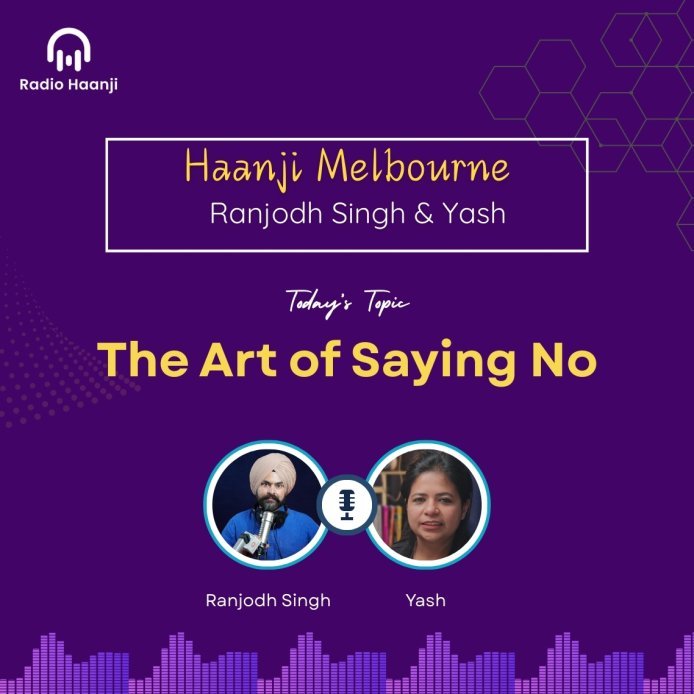
The Art of Saying No: Master Boundaries Without Guilt | Punjabi Podcast | Radio Haanji
Host:-
 Ranjodh Singh
 Yash Kaur
Learn how to say no without guilt and set healthy boundaries. Hosts Ranjodh Singh and Yash discuss practical strategies on Radio Haanji 1674 AM Melbourne
The Art of Saying No: Master Boundaries Without Guilt
????️ Punjabi Podcast Haanji Melbourne
Hosted by Ranjodh Singh & Yash
What You'll Learn
- Why Saying No Matters for Your Mental Health
- The Psychology Behind People-Pleasing
- Life-Changing Benefits of Setting Boundaries
- 7 Practical Ways to Say No Without Guilt
- Setting Boundaries at Work
- Navigating Family and Personal Relationships
- Real Experiences from Radio Haanji Listeners
- Frequently Asked Questions
Have you ever said "yes" when every fiber of your being screamed "no"? That sinking feeling in your stomach when you agree to something you don't want to do, followed by days of resentment and regret? You're not alone.
Today on Radio Haanji 1674 AM, Melbourne's premier Punjabi radio station, hosts Ranjodh Singh and Yash tackled one of the most crucial life skills many of us never learned: the art of saying no without guilt. In a powerful two-part show, they explored why setting boundaries is essential for mental health, shared practical strategies for asserting yourself, and opened the phone lines for listeners across Melbourne, Sydney, and the broader Australian Punjabi community to share their personal experiences.
Key Takeaway
Saying no isn't about rejection—it's about self-respect. When you protect your time and energy, you ensure you can show up fully for commitments that truly matter. This comprehensive guide will show you exactly how to master this essential life skill.
Why Is Saying No So Difficult?
During the first segment of the show, Ranjodh Singh opened with a question that resonated deeply with listeners: "Why do we struggle so much with a simple two-letter word?"
The answer lies in how we're wired from childhood. Many of us, particularly within South Asian cultures, are raised to prioritize harmony, respect for elders, and accommodating others' needs. While these values build strong communities, they can also create patterns where our own needs become secondary.
The Fear Triangle: What Holds Us Back
Research shows that difficulty saying no stems from three primary fears:
- Fear of Disappointing Others: We worry that saying no will let people down or make them think less of us. This fear is particularly strong in close-knit communities where reputation and family honor carry significant weight.
- Fear of Damaging Relationships: There's a persistent belief that boundaries will push people away. In reality, healthy relationships are built on mutual respect, not endless accommodation.
- Fear of Being Perceived as Selfish: Society teaches us that saying yes makes us good people. But constantly sacrificing your well-being isn't virtue—it's a path to burnout and resentment.
Yash's Insight: "When we say yes to everything, we're actually saying no to ourselves—to our time, our health, our priorities. The question isn't whether to say no, but how to do it in a way that honors both yourself and your relationships."
The People-Pleasing Pattern
People-pleasing isn't a personality flaw—it's a learned behavior that often develops as a survival mechanism. When approval and love felt conditional during childhood, many of us learned that agreement equals safety and acceptance.
Women, in particular, face additional social conditioning. Studies reveal that women have a harder time declining professional requests than men, fearing career consequences. This creates a never-ending cycle of overcommitment that affects mental, emotional, and physical health.
The Life-Changing Benefits of Learning to Say No
Ranjodh Singh emphasized that learning to say no isn't just about avoiding unwanted commitments—it's about transforming your entire quality of life. Here's what changes when you master this skill:
1. Protected Mental Energy and Reduced Burnout
Constantly saying yes spreads you too thin, leaving you overwhelmed and exhausted. By setting limits, you protect your mental energy and create space for activities that genuinely nourish you. Think of your energy as a finite resource—every yes is an investment. Make sure it's worth the cost.
???? Research Finding: People who regularly practice boundary-setting report 40% lower stress levels and significantly reduced symptoms of anxiety and depression compared to chronic people-pleasers.
2. Enhanced Focus on What Truly Matters
When you say no to non-essential commitments, you create room to concentrate on your actual priorities—whether that's personal goals, meaningful relationships, or career advancement. Successful people understand this principle deeply.
As Warren Buffett famously said: "The difference between successful people and really successful people is that really successful people say no to almost everything." This isn't about being negative—it's about being strategic with your most precious resource: time.
3. Strengthened Self-Respect and Confidence
Each time you honor your boundaries, you send a powerful message to yourself: My needs matter. My time is valuable. I deserve respect. This builds self-esteem and reinforces your sense of agency in the world.
4. Healthier, More Authentic Relationships
Contrary to popular belief, boundaries don't damage relationships—they strengthen them. When you're honest about your limits, you create foundations of trust and mutual respect. People learn to value your time more because they know your yes actually means something.
???? Practical Tip from the Show: Start viewing boundaries as acts of kindness to everyone involved. When you're not resentful or overwhelmed, you show up as a better friend, colleague, family member, and community member.
7 Practical Strategies for Saying No Without Guilt
The most valuable part of the Radio Haanji podcast came when Yash and Ranjodh Singh shared actionable techniques for saying no gracefully. Here are seven proven strategies you can start using today:
1. Keep It Simple and Direct
The biggest mistake people make is over-explaining. You don't need to justify your boundaries with elaborate excuses. A simple, polite response is often most effective:
- "Thank you for thinking of me, but I can't commit to that right now."
- "I appreciate the invitation, but I need to pass this time."
- "I'm not able to take this on."
Notice what these phrases have in common? They're clear, brief, and don't invite negotiation. The fewer words you use, the less room there is for debate.
2. Buy Yourself Time
If you tend to say yes automatically, replace your instant agreement with: "Let me check my schedule and get back to you." This creates space to assess whether you genuinely want to commit.
Use this time to ask yourself honest questions: Does this align with my priorities? Do I have the energy for this? Will I resent saying yes? If the answer to the last question is yes, your response should be no.
3. Offer an Alternative (When Appropriate)
Sometimes you want to help but can't commit to what's being asked. In these cases, suggest alternatives:
- "I can't take on the whole project, but I can help for 30 minutes."
- "I'm not available this week, but I could help next month."
- "I can't do this myself, but I recommend [someone else] who might be able to help."
This shows willingness to contribute while maintaining clear boundaries.
4. Use the "Sandwich Method"
Frame your no between two positives to soften the delivery:
"Thank you so much for inviting me—I really appreciate being included. Unfortunately, I won't be able to make it this time. I'd still love to connect with you soon though. Let's find another time that works better."
This approach maintains warmth while being clear about your boundary.
5. Practice the Calm Repetition Technique
Some people won't accept your first no. They'll push, negotiate, or guilt-trip. When this happens, calmly repeat your boundary with minimal variation:
"I understand, but I still can't commit to this."
"I hear what you're saying, but my answer hasn't changed."
The calmer and more consistent your repetition, the faster people stop testing the boundary. Consistency builds credibility.
6. Start with Low-Stakes Practice
Don't begin by setting a major boundary with your boss or parent. Build confidence with smaller situations first:
- Declining to upgrade your coffee order
- Saying no to a sales pitch
- Turning down a social media friend request
- Choosing not to share personal information
These low-stakes nos help you build the muscle memory and confidence for bigger boundary-setting moments.
7. Reframe Guilt as Growth
Feeling guilty when you first start saying no is completely normal—it means you're doing something new, not something wrong. The discomfort is temporary, but the benefits are permanent.
"Every time you feel guilty for saying no, remind yourself: This discomfort is the price of self-respect. It's a small investment that pays enormous dividends in the long run."
Setting Boundaries at Work Without Sabotaging Your Career
One of the most common concerns listeners raised during the call-in segment was: "How do I say no at work without appearing uncommitted or lazy?"
This fear is particularly acute in competitive work environments where saying yes to everything feels like the path to advancement. However, research shows that strategic boundary-setting actually enhances professional performance and career growth.
Professional No Strategies
Be Solutions-Oriented: Instead of a flat no, acknowledge the request and explain your capacity:
"I'd love to help with this project, but looking at my current workload, I won't be able to give it the attention it deserves. Can we discuss adjusting deadlines on my existing projects, or would you prefer I recommend someone else?"
This shows you're committed to quality work while being realistic about your bandwidth.
Prioritize Transparently: Help your manager understand your workload:
"I'm currently focused on [Project A] and [Project B], which you marked as high priority. If I take this on, something else will need to shift. What would you like me to deprioritize?"
This puts the decision back on your manager while demonstrating your commitment to existing responsibilities.
Protect Core Work Hours: Set boundaries around when you're available:
"I've committed to not taking calls outside work hours to maintain work-life balance. I'm happy to discuss this first thing tomorrow morning."
Increasingly, employers recognize that boundary-setting professionals are more sustainable, productive, and less likely to burn out.
Navigating Boundaries in Family and Personal Relationships
Family dynamics present unique challenges, especially in South Asian communities where collective values often take precedence over individual needs. Yash addressed this directly during the show, acknowledging the cultural context many listeners navigate.
Cultural Considerations
Respect for elders and family obligation run deep in Punjabi and broader Indian culture. Setting boundaries doesn't mean abandoning these values—it means expressing them in healthier ways.
You can honor your family while also honoring yourself. The key is communication that balances respect with honesty.
Family Boundary Scripts
With Parents: "I know this is important to you, and I respect that. Right now, I need to focus on [specific commitment]. Can we talk about another time when I can help?"
With Extended Family: "I wish I could be there, but I've already committed to something else. I'll make sure to attend the next family gathering."
With Friends: "I value our friendship, which is why I want to be honest—I don't have the energy for this right now. Can we reconnect next week when I'm in a better place?"
The common thread? Acknowledgment + Clear Boundary + Alternative or Reassurance.
Frequently Asked Questions About Saying No
Why is it so hard to say no to people?
How can I say no without feeling guilty?
What are the benefits of learning to say no?
How do I set boundaries at work without damaging my career?
What if people get angry when I set boundaries?
How do I practice saying no effectively?
Is saying no selfish?
Final Thoughts from Hosts Ranjodh Singh and Yash
Remember: saying no doesn't make you difficult, unkind, or uncommitted. It makes your yes meaningful. It makes your commitments genuine. It makes your relationships healthier.
The art of saying no is really the art of saying yes—yes to yourself, your health, your priorities, and your peace of mind. Start small, be consistent, and watch how your life transforms when you stop living for everyone else's expectations and start honoring your own needs.
Join the Conversation on Radio Haanji
Did this article resonate with you? Share your boundary-setting experiences with Melbourne and Sydney's largest Punjabi community.
Tune in to Radio Haanji 1674 AM for more life-changing conversations like this. Available on FM radio, online streaming, and through the Radio Haanji app(Android & iOS).
Listen to Punjabi Podcast Haanji Melbourne with hosts Ranjodh Singh and Yash every week for honest discussions about mental health, relationships, culture, and personal growth.
What's Your Reaction?







Related Posts