




























































































Australia Digital Duty of Care Bill: Fines & Safety Rules - The Insight Report - Gautam Kapil
Host:-
 Gautam Kapil
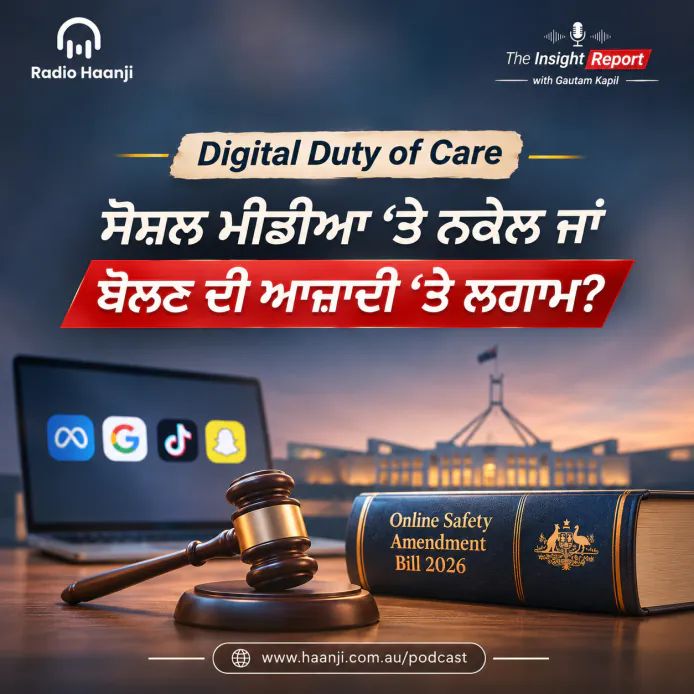
 breaks down Australia's Digital Duty of Care Bill, 5% global revenue fines, and new eSafety powers on Radio Haanji. Listen to the full episode.
Australia is moving forward with major reforms to hold global technology and social media companies legally responsible for user safety on their platforms. On November 24, Federal Communications Minister Anika Wells announced that the government had secured Senate support to advance the Digital Duty of Care legislation, backed by negotiations with the Greens and crossbench senators including Sarah Hanson-Young.
In this episode of The Insight Report on Radio Haanji, host Gautam Kapil examines what this legislation means for everyday Australians, parents, content creators, and global tech giants like Meta, Google, ByteDance, and Snapchat.Rather than treating online platforms as passive spaces where users alone bear the risk, the bill shifts legal accountability onto the companies that design, manage, and profit from digital ecosystems.
Where to Listen
You can listen to this full breakdown of Australia’s Digital Duty of Care legislation on The Insight Report, hosted by Gautam Kapil on Radio Haanji. Stream the episode across major audio platforms or directly via the official station app:
-
Spotify: https://open.spotify.com/show/5fhykpM6TPzerC2Yr2J1eQ
-
Apple Podcasts: https://podcasts.apple.com/at/podcast/radio-haanji-podcast/id1687047958?l=en-GB
-
Radio Haanji App: https://haanji.com.au/download-our-app
Episode Highlights
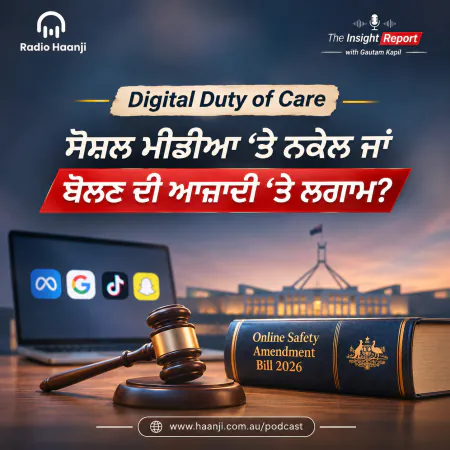
Legislative Breakthrough in the Senate Gautam Kapil opens the discussion with Federal Communications Minister Anika Wells' November 24 press conference detailing how the government negotiated amendments with the Greens party and Senator Sarah Hanson-Young following a Senate inquiry report. With Labor and the Greens reaching an agreement, the Online Safety Amendment (Digital Duty of Care) Bill 2026 has a clear path toward becoming law.
Five Core Pillars Announced by Minister Wells The episode outlines the five major additions highlighted by Anika Wells: giving Australians a private right of action to sue platforms, strengthening privacy protections, expanding the eSafety Commissioner’s nudify removal powers, requiring platforms to assess addictive tools in formal risk assessments, and clarifying the definition of hostile attitudes toward women and gender equality to protect children while preserving legitimate expression.
Why Existing Age Bans Were Not Enough While Australia previously introduced under-16 social media account restrictions, Kapil explains why lawmakers concluded that age limits alone fail to protect young people. Children still access harmful material through fake accounts, parent-created profiles, or algorithmic recommendations, prompting a shift toward regulating platform design itself.
Global Tech Giants and Massive Financial Penalties Following Greens party negotiations, the penalty structure was expanded beyond a flat fine to tie penalties to global revenue. Companies that breach their statutory duty of care face fines of up to $109 million AUD (66,000 penalty units) or up to 5 percent of their global revenue, significantly raising the stakes for multinational platforms.
Balancing Online Safety With Freedom of Expression The discussion also addresses pushback from the Liberal-National Coalition, which raised concerns that broad definitions of harmful content could lead to over-censorship and threaten freedom of speech. Kapil reflects on how media organizations and everyday users must navigate transparency,parental guidance, and responsible digital participation.
What Is Australia’s Digital Duty of Care Bill?
Australia’s Digital Duty of Care Bill is a federal legislative reform requiring digital platforms, search engines,messaging apps, and AI tools to proactively prevent foreseeable harm to users. Instead of relying solely on users to report abuse after it occurs, platforms carry a legal obligation to design safer digital environments from the outset.
Gautam Kapil uses the analogy of a school principal or hospital administrator to explain how the law works. Just as a school principal holds a duty of care to keep students safe on campus rather than blaming children for misbehavior,tech companies own the digital infrastructure and must take responsibility for harms occurring on their platforms.
Under this framework, platforms cannot deflect accountability by claiming they are merely neutral hosts for user-generated content. The legislation covers social media networks such as Facebook, Instagram, TikTok, Snapchat, and Reddit, alongside search engines like Google, video platforms like YouTube, messaging services, and generative AI chatbots.
How Much Will Tech Companies Be Fined Under the New Law?
Tech companies that breach Australia’s Digital Duty of Care face maximum penalties of $109 million AUD—equivalent to 66,000 penalty units under Australian law—or up to 5 percent of their global revenue. This tiered penalty structure was secured after the Greens party pushed for stronger financial deterrents during Senate negotiations.
Originally, the government proposed a fixed maximum penalty of $109 million AUD for serious breaches. However,the Greens argued that a flat fine would be easily absorbed as a minor operating cost by trillion-dollar multinational corporations whose global revenues run into hundreds of billions of dollars.
By tying fines to 5 percent of global turnover, a major technology firm generating $100 billion in annual revenue could theoretically face penalties reaching $5 billion AUD for systemic compliance failures. In addition to government enforcement, the amended bill introduces a private right of action, allowing individual Australians or groups to sue digital platforms directly in court when they suffer harm from a breach of duty.
What Powers Does the eSafety Commissioner Gain?
The legislation significantly expands the enforcement and oversight powers of Australia’s eSafety Commissioner,particularly regarding non-consensual AI-generated imagery and systemic platform safety. The regulator gains stronger authority to order the rapid removal of AI nudification apps, websites, and deepfake abuse tools from app stores and search engines.
During the broadcast, Kapil highlights how rapidly artificial intelligence has enabled the creation of non-consensual explicit deepfakes targeting women and teenagers using ordinary social media photos. Under the new rules, regulators can require Apple, Google, and search engines to delist offending apps and block their advertisements, preventing platforms from profiting from abusive tools.
Beyond content takedowns, the eSafety Commissioner will receive mandatory risk assessments from tech companies evaluating how addictive design features affect users. Platforms must also publish transparency reports every six months detailing complaint volumes, removal timelines, and safety measures, while accredited researchers gain conditional access to platform data to study online harms independently.
Algorithmic Accountability and Youth Protection
The Digital Duty of Care Bill targets recommendation algorithms and addictive design features that repeatedly expose children and teenagers to harmful, violent, or sexually explicit content. Platforms will be legally required to modify their systems rather than relying on basic age-verification pop-ups.
As Kapil notes, simple "Are you over 18?" prompts on adult websites or basic account sign-up checks are easily bypassed by minors. Even when a teenager watches a single distressing video or receives an unsolicited push notification, recommendation algorithms quickly flood their feed with similar content, intensifying anxiety,cyberbullying, and mental health trauma.
To address this, the legislation mandates stronger age assurance, strict default privacy settings, and parental controls for users under 16. Companies must prevent algorithmic amplification of self-harm material, online scams, fraudulent advertisements, and cyberbullying, ensuring that platform design actively protects minors rather than maximizing screen time at the expense of wellbeing.
Free Speech Concerns vs. Digital Accountability
While the government and crossbench supporters frame the bill as urgent child protection reform, opposition lawmakers from the Liberal-National Coalition have warned that vague definitions of online harm could chill free speech. Critics argue that fearing multi-billion-dollar fines, tech companies may aggressively censor legitimate political debate, journalism, and minority viewpoints.
Addressing these concerns during her November 24 announcement, Communications Minister Anika Wells stated that the bill’s updated wording clarifies provisions around hostile attitudes toward women and gender equality. She emphasized that the law is not intended to restrict opinions or debates around feminism, but to shield children from harmful and abusive content.
Kapil also reflects on how responsible broadcasters and media outlets already practice a voluntary duty of care by verifying facts, protecting privacy, and avoiding content that harms young minds. Extending similar accountability to global technology companies aims to balance public safety with open expression, though the practical boundary between harm prevention and censorship will remain closely watched once the law takes effect.
Key Takeaways
-
Australia’s Online Safety Amendment (Digital Duty of Care) Bill 2026 shifts legal responsibility for online safety directly onto technology platforms rather than placing the burden solely on users and parents.
-
Following negotiations between the federal government, the Greens party, and Senator Sarah Hanson-Young,companies breaching their duty of care face fines of up to $109 million AUD (66,000 penalty units) or 5 percent of global revenue.
-
Individual Australians and groups gain a private right of action to sue digital platforms when a breach of duty causes harm.
-
The eSafety Commissioner gains expanded powers to force the removal of AI nudification tools, block harmful app advertisements, and audit platforms for addictive design risks.
-
Platforms must submit regular risk assessments, publish semi-annual transparency reports, and grant approved researchers access to study algorithmic harms affecting young people.
To hear the complete analysis—including real-world examples of how algorithms impact families and how media organizations uphold digital responsibility—listen to the full episode of The Insight Report with Gautam Kapil on Spotify,Apple Podcasts, or the Radio Haanji app. Share this article with parents and creators who want to stay informed about Australia’s changing digital landscape.
Frequently Asked Questions
Does Australia’s Digital Duty of Care Bill replace the under-16 social media ban?
Which platforms are covered by Australia’s new online safety rules?
Can everyday Australians sue social media companies under this bill?
How does the law address AI deepfakes and nudification apps?
Why did the Greens push for fines based on global revenue?
What's Your Reaction?